Hung Dorothy Y, Harrison Michael I, Truong Quan, Du Xue
Palo Alto Medical Foundation Research Institute, 2350 W. El Camino Real #447, Mountain View, CA, 94040, USA.
Agency for Healthcare Research and Quality, Center for Delivery, Organization, and Markets, 5600 Fishers Lane, Mail Stop 7W25B, Rockville, MD, 20857, USA.
BMC Health Serv Res. 2018 Apr 10;18(1):274. doi: 10.1186/s12913-018-3062-5.
In response to growing pressures on primary care, leaders have introduced a wide range of workforce and practice innovations, including team redesigns that delegate some physician tasks to nonphysicians. One important question is how such innovations affect care team members, particularly in view of growing dissatisfaction and burnout among healthcare professionals. We examine the work experiences of primary care physicians and staff after implementing Lean-based workflow redesigns. This included co-locating physician and medical assistant dyads, delegating significant responsibilities to nonphysician staff, and mandating greater coordination and communication among all care team members.
The redesigns were implemented and scaled in three phases across 46 primary care departments in a large ambulatory care delivery system. We fielded 1164 baseline and 1333 follow-up surveys to physicians and other nonphysician staff (average 73% response rate) to assess workforce engagement (e.g., job satisfaction, motivation), perceptions of the work environment, and job-related burnout. We conducted multivariate regressions to detect changes in experiences after the redesign, adjusting for respondent characteristics and clustering of within-clinic responses.
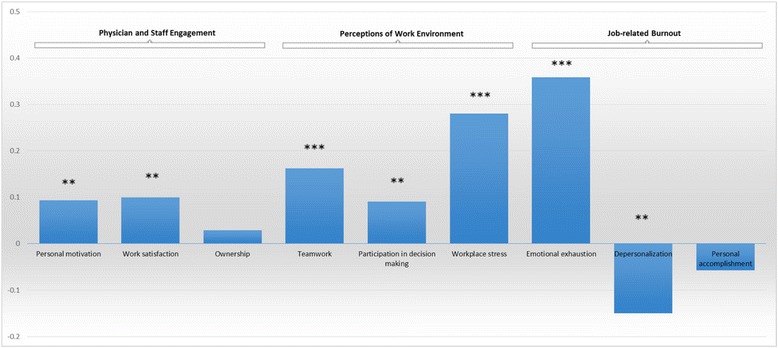
We found that both physicians and nonphysician staff reported higher levels of engagement and teamwork after implementing redesigns. However, they also experienced higher levels of burnout and perceptions of the workplace as stressful. Trends were the same for both occupational groups, but the increased reports of stress were greater among physicians. Additionally, members of all clinics, except for the pilot site that developed the new workflows, reported higher burnout, while perceptions of workplace stress increased in all clinics after the redesign.
Our findings partially align with expectations of work redesign as a route to improving physician and staff experiences in delivering care. Although teamwork and engagement increased, the redesigns in our study were not enough to moderate long-standing challenges facing primary care. Yet higher levels of empowerment and engagement, as observed in the pilot clinic, may be particularly effective in facilitating improvements while combating fatigue. To help practices cope with increasing burdens, interventions must directly benefit healthcare professionals without overtaxing an already overstretched workforce.
为应对基层医疗日益增加的压力,领导者引入了一系列劳动力和实践创新措施,包括团队重新设计,将一些医生任务委托给非医生人员。一个重要问题是这些创新如何影响护理团队成员,特别是考虑到医疗保健专业人员日益增长的不满和倦怠情绪。我们研究了实施基于精益的工作流程重新设计后基层医疗医生和工作人员的工作经历。这包括将医生和医疗助理配对安置在同一地点,将重大责任委托给非医生工作人员,并要求所有护理团队成员加强协调与沟通。
重新设计分三个阶段在一个大型门诊医疗服务系统的46个基层医疗部门实施并推广。我们向医生和其他非医生工作人员发放了1164份基线调查问卷和1333份随访调查问卷(平均回复率为73%),以评估劳动力参与度(如工作满意度、积极性)、对工作环境的看法以及与工作相关的倦怠情况。我们进行了多变量回归分析,以检测重新设计后经历的变化,并对受访者特征和诊所内回复的聚类情况进行了调整。
我们发现,实施重新设计后,医生和非医生工作人员都报告了更高的参与度和团队合作水平。然而,他们也经历了更高水平的倦怠以及对工作场所压力的感知。两个职业群体的趋势相同,但医生中压力增加的报告更多。此外,除了开发新工作流程的试点站点外,所有诊所的成员都报告了更高的倦怠水平,而重新设计后所有诊所对工作场所压力的感知都有所增加。
我们的研究结果部分符合工作重新设计的预期,即作为改善医生和工作人员护理体验的途径。虽然团队合作和参与度有所提高,但我们研究中的重新设计不足以缓解基层医疗面临的长期挑战。然而,如试点诊所所观察到的,更高水平的授权和参与度可能在促进改善的同时对抗疲劳方面特别有效。为帮助医疗机构应对不断增加的负担,干预措施必须直接使医疗保健专业人员受益,而不会给本已过度紧张的劳动力带来过重负担。