Department of Stem Cell and Immune Regulation, Yokohama City University Graduate School of Medicine, 3-9 Fukuura, Kanazawa-Ku, Yokohama, 236-0004, Japan.
Department of Allergy and Rheumatology, Nippon Medical School Graduate School of Medicine, Tokyo, Japan.
Arthritis Res Ther. 2018 Apr 10;20(1):64. doi: 10.1186/s13075-018-1568-1.
Innate immunity including macrophages (Mϕ) in lupus nephritis (LN) has been gaining attention, but roles of Mϕ in LN remain uncertain.
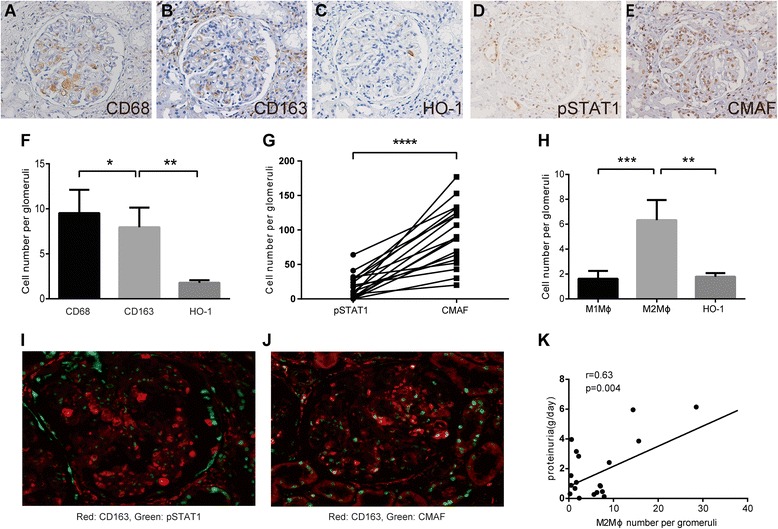
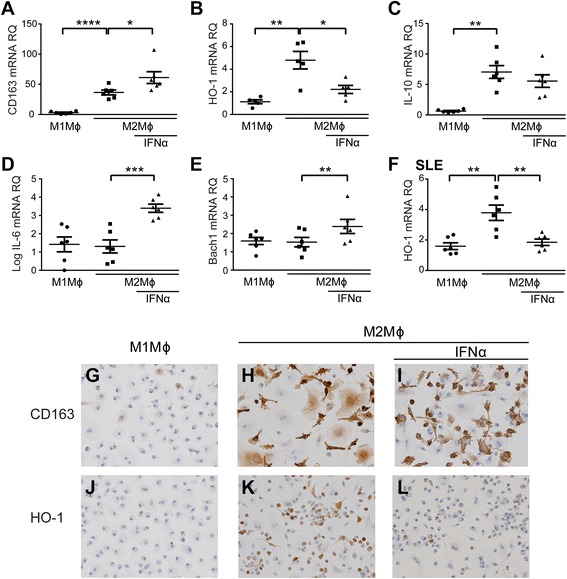
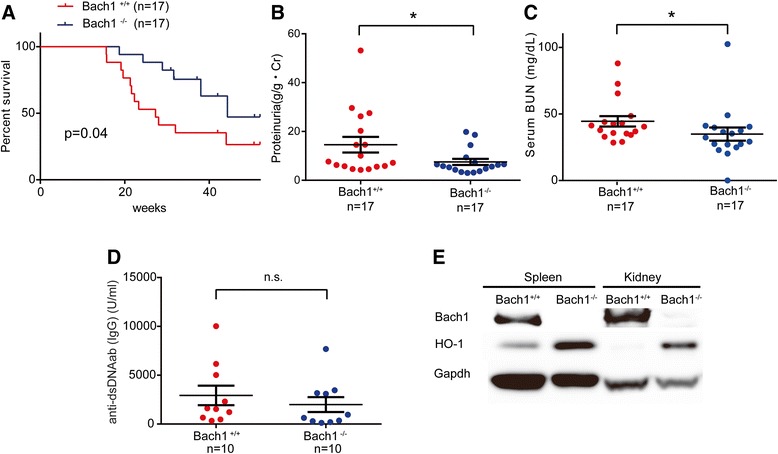
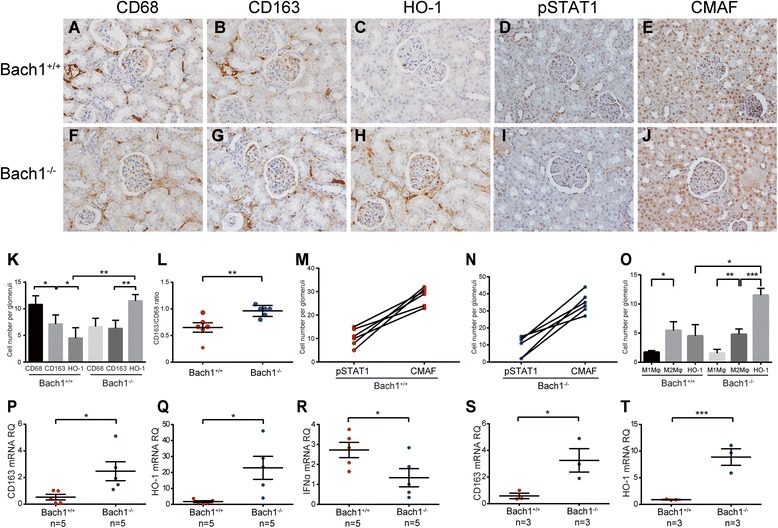
Immunohistochemical staining was performed to determine CD68, CD163, heme oxygenase (HO)-1 (a stress-inducible heme-degrading enzyme with anti-inflammatory property), pSTAT1, and CMAF-expressing Mϕ in the glomeruli of patients with LN. Effects of type I interferons on the expression levels of CD163, HO-1, BTB and CNC homology 1 (Bach1; a transcriptional HO-1 repressor), interleukin (IL)-6, and IL-10 by human M2-like Mϕ, which were differentiated in vitro from peripheral monocytes with macrophage colony-stimulating factor, were assessed by RT-PCR and immunocytostaining. Clinical manifestations, anti-double-stranded DNA (anti-dsDNA), and local HO-1 expression were compared in Bach1-deficient and wild-type MRL/lpr mice.
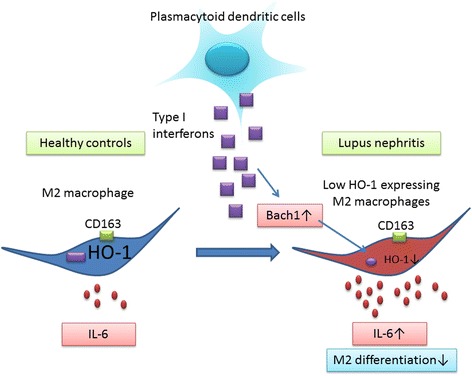
The number of glomerular M2-like Mϕ correlated with the amounts of proteinuria in patients with LN. Unlike monocyte-derived M2-like Mϕ, HO-1 expression was defective in the majority of glomerular M2-like Mϕ of patients with LN. Stimulation of human M2-like Mϕ with type I interferons led to reduced HO-1 expression and increased Bach1 and IL-6 expression. Bach1-deficient MRL/lpr mice exhibited increased HO-1 expression in kidneys, prolonged survival, reduced urine proteins, and serum blood urea nitrogen levels, but serum anti-dsDNA antibody levels were comparable. Increased expression of CD163 and HO-1 was found in peritoneal Mϕ from Bach1-deficient MRL/lpr mice.
Our data suggest that dysregulated M2-like Mϕ play a proinflammatory role in LN. Bach1 is a potential therapeutic target that could restore the anti-inflammatory property of M2 Mϕ.
固有免疫包括狼疮肾炎 (LN) 中的巨噬细胞 (Mϕ),已受到关注,但 Mϕ 在 LN 中的作用仍不确定。
通过免疫组织化学染色确定 LN 患者肾小球中 CD68、CD163、血红素加氧酶 (HO)-1(一种具有抗炎特性的应激诱导血红素降解酶)、pSTAT1 和 CMAF 表达的 Mϕ。通过 RT-PCR 和免疫细胞化学染色评估来自外周单核细胞的人 M2 样 Mϕ在体外用巨噬细胞集落刺激因子分化后,I 型干扰素对 CD163、HO-1、BTB 和 CNC 同源结构域 1(Bach1;HO-1 的转录抑制因子)、白细胞介素 (IL)-6 和 IL-10 的表达水平的影响。比较 Bach1 缺陷型和野生型 MRL/lpr 小鼠的临床表现、抗双链 DNA (anti-dsDNA) 和局部 HO-1 表达。
LN 患者肾小球 M2 样 Mϕ 的数量与蛋白尿的量相关。与单核细胞衍生的 M2 样 Mϕ 不同,LN 患者肾小球中大多数 M2 样 Mϕ 的 HO-1 表达存在缺陷。I 型干扰素刺激人 M2 样 Mϕ 导致 HO-1 表达减少,Bach1 和 IL-6 表达增加。Bach1 缺陷型 MRL/lpr 小鼠肾脏中 HO-1 表达增加,存活时间延长,尿液蛋白和血清尿素氮水平降低,但血清抗 dsDNA 抗体水平无差异。Bach1 缺陷型 MRL/lpr 小鼠腹腔巨噬细胞中 CD163 和 HO-1 的表达增加。
我们的数据表明,失调的 M2 样 Mϕ 在 LN 中发挥促炎作用。Bach1 是一种潜在的治疗靶点,可恢复 M2 Mϕ 的抗炎特性。