• 文献检索
  • 文档翻译
  • 深度研究
  • 学术资讯
  • Suppr Zotero 插件Zotero 插件
  • 邀请有礼
  • 套餐&价格
  • 历史记录
应用&插件
Suppr Zotero 插件Zotero 插件浏览器插件Mac 客户端Windows 客户端微信小程序
定价
高级版会员购买积分包购买API积分包
服务
文献检索文档翻译深度研究API 文档MCP 服务
关于我们
关于 Suppr公司介绍联系我们用户协议隐私条款
关注我们

Suppr 超能文献

核心技术专利:CN118964589B侵权必究
粤ICP备2023148730 号-1Suppr @ 2026

文献检索

告别复杂PubMed语法,用中文像聊天一样搜索,搜遍4000万医学文献。AI智能推荐,让科研检索更轻松。

立即免费搜索

文件翻译

保留排版,准确专业,支持PDF/Word/PPT等文件格式,支持 12+语言互译。

免费翻译文档

深度研究

AI帮你快速写综述,25分钟生成高质量综述,智能提取关键信息,辅助科研写作。

立即免费体验

采用健康行动过程方法(HAPA)对创伤恢复网络干预的参与情况进行解释:纵向研究。

Engagement With a Trauma Recovery Internet Intervention Explained With the Health Action Process Approach (HAPA): Longitudinal Study.

作者信息

Yeager Carolyn M, Shoji Kotaro, Luszczynska Aleksandra, Benight Charles C

机构信息

Department of Psychology, University of Colorado Colorado Springs, Colorado Springs, CO, United States.

Trauma Health and Hazards Center, University of Colorado Colorado Springs, Colorado Springs, CO, United States.

出版信息

JMIR Ment Health. 2018 Apr 10;5(2):e29. doi: 10.2196/mental.9449.

DOI:10.2196/mental.9449
PMID:29636323
原文链接:https://pmc.ncbi.nlm.nih.gov/articles/PMC5938690/
Abstract

BACKGROUND

There has been a growing trend in the delivery of mental health treatment via technology (ie, electronic health, eHealth). However, engagement with eHealth interventions is a concern, and theoretically based research in this area is sparse. Factors that influence engagement are poorly understood, especially in trauma survivors with symptoms of posttraumatic stress.

OBJECTIVE

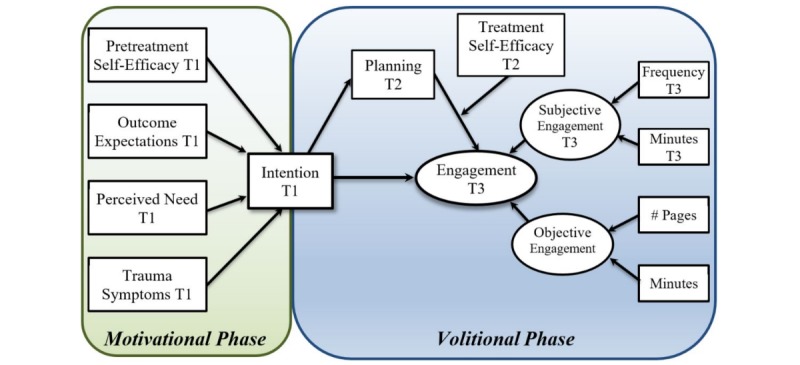
The aim of this study was to examine engagement with a trauma recovery eHealth intervention using the Health Action Process Approach theoretical model. Outcome expectancy, perceived need, pretreatment self-efficacy, and trauma symptoms influence the formation of intentions (motivational phase), followed by planning, which mediates the translation of intentions into engagement (volitional phase). We hypothesized the mediational effect of planning would be moderated by level of treatment self-efficacy.

METHODS

Trauma survivors from around the United States used the eHealth intervention for 2 weeks. We collected baseline demographic, social cognitive predictors, and distress symptoms and measured engagement subjectively and objectively throughout the intervention.

RESULTS

The motivational phase model explained 48% of the variance, and outcome expectations (beta=.36), perceived need (beta=.32), pretreatment self-efficacy (beta=.13), and trauma symptoms (beta=.21) were significant predictors of intention (N=440). In the volitional phase, results of the moderated mediation model indicated for low levels of treatment self-efficacy, planning mediated the effects of intention on levels of engagement (B=0.89, 95% CI 0.143-2.605; N=115).

CONCLUSIONS

Though many factors can affect engagement, these results offer a theoretical framework for understanding engagement with an eHealth intervention. This study highlighted the importance of perceived need, outcome expectations, self-efficacy, and baseline distress symptoms in the formation of intentions to use the intervention. For those low in treatment self-efficacy, planning may play an important role in the translation of intentions into engagement. Results of this study may help bring some clarification to the question of what makes eHealth interventions work.

摘要

背景

通过技术手段(即电子健康,eHealth)提供心理健康治疗的趋势日益增长。然而,参与电子健康干预是一个令人担忧的问题,并且该领域基于理论的研究很少。影响参与度的因素知之甚少,尤其是在有创伤后应激症状的创伤幸存者中。

目的

本研究的目的是使用健康行动过程方法理论模型来检验对创伤恢复电子健康干预的参与度。结果期望、感知需求、治疗前自我效能感和创伤症状会影响意图的形成(动机阶段),随后是计划,计划介导意图转化为参与度(意志阶段)。我们假设计划的中介作用会受到治疗自我效能感水平的调节。

方法

来自美国各地的创伤幸存者使用该电子健康干预措施两周。我们收集了基线人口统计学、社会认知预测因素和痛苦症状,并在整个干预过程中主观和客观地测量了参与度。

结果

动机阶段模型解释了48%的方差,结果期望(β = 0.36)、感知需求(β = 0.32)、治疗前自我效能感(β = 0.13)和创伤症状(β = 0.21)是意图的显著预测因素(N = 440)。在意志阶段,调节中介模型的结果表明,对于治疗自我效能感水平较低的人,计划介导了意图对参与度水平的影响(B = 0.89,95% CI 0.143 - 2.605;N = 115)。

结论

尽管许多因素会影响参与度,但这些结果为理解电子健康干预的参与度提供了一个理论框架。本研究强调了感知需求、结果期望、自我效能感和基线痛苦症状在形成使用干预措施意图方面的重要性。对于治疗自我效能感较低的人,计划可能在将意图转化为参与度方面发挥重要作用。本研究结果可能有助于澄清使电子健康干预措施起作用的因素这一问题。
https://cdn.ncbi.nlm.nih.gov/pmc/blobs/cf6c/5938690/92e7f3f6d204/mental_v5i2e29_fig2.jpg
https://cdn.ncbi.nlm.nih.gov/pmc/blobs/cf6c/5938690/4f0ce171fcf1/mental_v5i2e29_fig1.jpg
https://cdn.ncbi.nlm.nih.gov/pmc/blobs/cf6c/5938690/92e7f3f6d204/mental_v5i2e29_fig2.jpg
https://cdn.ncbi.nlm.nih.gov/pmc/blobs/cf6c/5938690/4f0ce171fcf1/mental_v5i2e29_fig1.jpg
https://cdn.ncbi.nlm.nih.gov/pmc/blobs/cf6c/5938690/92e7f3f6d204/mental_v5i2e29_fig2.jpg

相似文献

1
Engagement With a Trauma Recovery Internet Intervention Explained With the Health Action Process Approach (HAPA): Longitudinal Study.采用健康行动过程方法(HAPA)对创伤恢复网络干预的参与情况进行解释:纵向研究。
JMIR Ment Health. 2018 Apr 10;5(2):e29. doi: 10.2196/mental.9449.
2
Engagement, Predictors, and Outcomes of a Trauma Recovery Digital Mental Health Intervention: Longitudinal Study.创伤恢复数字心理健康干预的参与度、预测因素及结果:纵向研究
JMIR Ment Health. 2022 May 2;9(5):e35048. doi: 10.2196/35048.
3
Turning Good Intentions Into Actions by Using the Health Action Process Approach to Predict Adherence to Internet-Based Depression Prevention: Secondary Analysis of a Randomized Controlled Trial.通过运用健康行动过程方法预测对基于互联网的抑郁症预防的依从性,将良好意图转化为行动:一项随机对照试验的二次分析
J Med Internet Res. 2018 Jan 11;20(1):e9. doi: 10.2196/jmir.8814.
4
Predicting Change in Posttraumatic Distress Through Change in Coping Self-Efficacy After Using the My Trauma Recovery eHealth Intervention: Laboratory Investigation.在使用“我的创伤恢复”电子健康干预措施后,通过应对自我效能感的变化预测创伤后应激的变化:实验室调查
JMIR Ment Health. 2018 Nov 29;5(4):e10309. doi: 10.2196/10309.
5
Application of an Adapted Health Action Process Approach Model to Predict Engagement With a Digital Mental Health Website: Cross-Sectional Study.适应健康行动过程模型在预测数字心理健康网站参与度中的应用:横断面研究。
JMIR Hum Factors. 2024 Aug 7;11:e57082. doi: 10.2196/57082.
6
An assessment of the social cognitive predictors of exclusive breastfeeding behavior using the Health Action Process Approach.采用健康行动过程方法评估社会认知因素对纯母乳喂养行为的预测作用。
Soc Sci Med. 2017 Jun;182:106-116. doi: 10.1016/j.socscimed.2017.04.014. Epub 2017 Apr 12.
7
Predicting Hand Washing and Sleep Hygiene Behaviors among College Students: Test of an Integrated Social-Cognition Model.预测大学生的洗手和睡眠卫生行为:综合社会认知模型的检验。
Int J Environ Res Public Health. 2020 Feb 13;17(4):1209. doi: 10.3390/ijerph17041209.
8
If we build it, will they come? Issues of engagement with digital health interventions for trauma recovery.如果我们构建了它,他们会来吗?关于参与创伤恢复数字健康干预措施的问题。
Mhealth. 2018 Sep 11;4:37. doi: 10.21037/mhealth.2018.08.04. eCollection 2018.
9
Use Intention and User Expectations of Human-Supported and Self-Help eHealth Interventions: Internet-Based Randomized Controlled Trial.人类辅助和自助式电子健康干预措施的使用意图和用户期望:基于互联网的随机对照试验。
JMIR Form Res. 2024 Feb 15;8:e38803. doi: 10.2196/38803.
10
Factors Affecting General Practitioners' Readiness to Accept and Use an Electronic Health Record System in the Republic of North Macedonia: A National Survey of General Practitioners.影响北马其顿共和国全科医生接受和使用电子健康记录系统意愿的因素:全科医生全国性调查
JMIR Med Inform. 2021 Apr 5;9(4):e21109. doi: 10.2196/21109.

引用本文的文献

1
User engagement in a digital health intervention designed for young people who have experienced technology-assisted sexual abuse (i-Minds trial).针对遭受技术辅助性虐待的年轻人设计的数字健康干预措施中的用户参与情况(i-Minds试验)。
Internet Interv. 2025 Jul 8;41:100858. doi: 10.1016/j.invent.2025.100858. eCollection 2025 Sep.
2
Application of a Sociotechnical Framework to Uncover Factors That Influence Effective User Engagement With Digital Mental Health Tools in Clinical Care Contexts: Scoping Review.应用社会技术框架揭示临床护理环境中影响用户有效使用数字心理健康工具的因素:范围综述
J Med Internet Res. 2025 Apr 28;27:e67820. doi: 10.2196/67820.
3

本文引用的文献

1
Adherence to a web-based pre-treatment for phobias in outpatient clinics.门诊诊所中对恐惧症基于网络的预处理的依从性。
Internet Interv. 2017 Jun 1;9:38-45. doi: 10.1016/j.invent.2017.05.004. eCollection 2017 Sep.
2
Engagement and attrition in Internet smoking cessation interventions: Insights from a cross-sectional survey of "one-hit-wonders".互联网戒烟干预中的参与度与退出率:对“昙花一现者”横断面调查的见解
Internet Interv. 2016 Jul 7;5:23-29. doi: 10.1016/j.invent.2016.07.001. eCollection 2016 Sep.
3
Clarifying the Concept of Adherence to eHealth Technology: Systematic Review on When Usage Becomes Adherence.
Studying the Digital Intervention Engagement-Mediated Relationship Between Intrapersonal Measures and Pre-Exposure Prophylaxis Adherence in Sexual and Gender Minority Youth: Secondary Analysis of a Randomized Controlled Trial.
研究性少数和性别少数青年中人际测量与暴露前预防依从性之间的数字干预参与介导关系:一项随机对照试验的二次分析
J Med Internet Res. 2025 Jan 13;27:e57619. doi: 10.2196/57619.
4
Application of an Adapted Health Action Process Approach Model to Predict Engagement With a Digital Mental Health Website: Cross-Sectional Study.适应健康行动过程模型在预测数字心理健康网站参与度中的应用:横断面研究。
JMIR Hum Factors. 2024 Aug 7;11:e57082. doi: 10.2196/57082.
5
The Impact of Video-Based Microinterventions on Attitudes Toward Mental Health and Help Seeking in Youth: Web-Based Randomized Controlled Trial.基于视频的微干预对青少年心理健康态度及求助行为的影响:网络随机对照试验
J Med Internet Res. 2024 Apr 24;26:e54478. doi: 10.2196/54478.
6
How to Improve People's Intentions Regarding COVID-19 Vaccination in China: A Randomized Controlled Trial.如何提高中国民众对新冠疫苗接种的意愿:一项随机对照试验
Int J Behav Med. 2024 Feb 20. doi: 10.1007/s12529-024-10258-6.
7
The Effect of a Digital Mental Health Program on Anxiety and Depression Symptoms: Retrospective Analysis of Clinical Severity.数字心理健康项目对焦虑和抑郁症状的影响:临床严重程度的回顾性分析
JMIR Form Res. 2023 Oct 3;7:e36596. doi: 10.2196/36596.
8
An Integrative Engagement Model of Digital Psychotherapy: Exploratory Focus Group Findings.数字心理治疗的综合参与模型:探索性焦点小组研究结果
JMIR Form Res. 2023 Apr 26;7:e41428. doi: 10.2196/41428.
9
Identifying essential factors that influence user engagement with digital mental health tools in clinical care settings: Protocol for a Delphi study.识别临床护理环境中影响用户对数字心理健康工具参与度的关键因素:德尔菲研究方案
Digit Health. 2022 Oct 11;8:20552076221129059. doi: 10.1177/20552076221129059. eCollection 2022 Jan-Dec.
10
Measuring Engagement with Mental Health and Behavior Change Interventions: an Integrative Review of Methods and Instruments.测量心理健康和行为改变干预措施的参与度:方法和工具的综合评价。
Int J Behav Med. 2023 Apr;30(2):155-166. doi: 10.1007/s12529-022-10086-6. Epub 2022 May 16.
厘清电子健康技术依从性的概念:关于使用何时转变为依从性的系统评价
J Med Internet Res. 2017 Dec 6;19(12):e402. doi: 10.2196/jmir.8578.
4
Analyzing mHealth Engagement: Joint Models for Intensively Collected User Engagement Data.分析移动健康参与度:针对密集收集的用户参与度数据的联合模型
JMIR Mhealth Uhealth. 2017 Jan 12;5(1):e1. doi: 10.2196/mhealth.6474.
5
Conceptualising engagement with digital behaviour change interventions: a systematic review using principles from critical interpretive synthesis.对数字行为改变干预措施参与度的概念化:一项运用批判性解释性综合原则的系统评价
Transl Behav Med. 2017 Jun;7(2):254-267. doi: 10.1007/s13142-016-0453-1.
6
Understanding and Promoting Effective Engagement With Digital Behavior Change Interventions.理解并促进与数字行为改变干预措施的有效互动。
Am J Prev Med. 2016 Nov;51(5):833-842. doi: 10.1016/j.amepre.2016.06.015.
7
Program Use and Outcome Change in a Web-Based Trauma Intervention: Individual and Social Factors.基于网络的创伤干预中的项目使用情况及结果变化:个体因素与社会因素
J Med Internet Res. 2016 Sep 9;18(9):e243. doi: 10.2196/jmir.5839.
8
Gamification and Adherence to Web-Based Mental Health Interventions: A Systematic Review.游戏化与基于网络的心理健康干预措施的依从性:系统评价。
JMIR Ment Health. 2016 Aug 24;3(3):e39. doi: 10.2196/mental.5710.
9
A Rolling Stone Gathers No Moss-The Long Way from Good Intentions to Physical Activity Mediated by Planning, Social Support, and Self-Regulation.滚石不生苔——从良好意愿到通过计划、社会支持和自我调节介导的身体活动的漫长道路。
Front Psychol. 2016 Jul 6;7:1024. doi: 10.3389/fpsyg.2016.01024. eCollection 2016.
10
The Posttraumatic Stress Disorder Checklist for DSM-5 (PCL-5): Development and Initial Psychometric Evaluation.《精神疾病诊断与统计手册》第5版创伤后应激障碍检查表(PCL-5):编制与初步心理测量评估
J Trauma Stress. 2015 Dec;28(6):489-98. doi: 10.1002/jts.22059. Epub 2015 Nov 25.