Beatt K J, Serruys P W, de Feyter P, van den Brand M, Verdouw P D, Hugenholtz P G
Catheterisation Laboratory, Thoraxcenter, Erasmus University, Rotterdam, The Netherlands.
Br Heart J. 1988 Feb;59(2):159-67. doi: 10.1136/hrt.59.2.159.
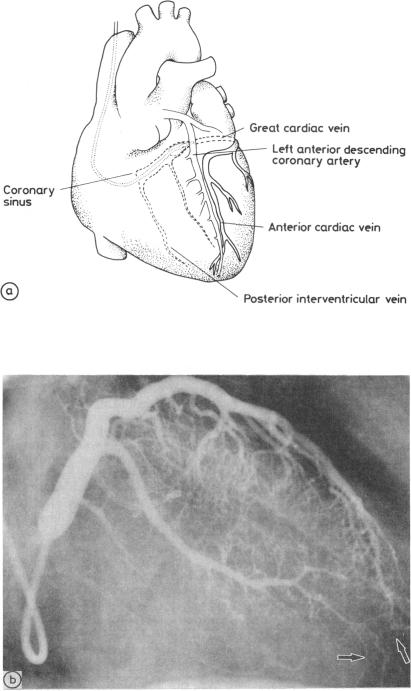
Animal studies have demonstrated that synchronised coronary sinus retroperfusion with arterial blood can provide effective perfusion of ischaemic myocardium. Preliminary clinical studies have shown that the technique can also be used with safety in human beings, and in the present study its effectiveness was assessed in three patients undergoing repeated coronary artery occlusions during percutaneous transluminal coronary angioplasty. Arterial blood was removed via an 8F catheter positioned in the femoral artery and delivered by a retroperfusion pumping system to a 7F retroperfusion balloon catheter positioned in the anterior cardiac vein. Ischaemia-related indices were monitored both before and during coronary sinus retroperfusion. These indices included high fidelity left ventricular pressure recordings and pressure derived indices (including velocities of isovolumic contraction and relaxation), as well as electrocardiographic changes and symptoms. Analysis of these variables showed that the ischaemic changes induced during coronary artery occlusion were not prevented by this type of coronary sinus retroperfusion. There was no major complication in any of the patients. It may be that adaptation of the technique or the use of alternative end points will establish a benefit, but further modifications of the delivery system are necessary for effective clinical use.
动物研究表明,动脉血同步冠状窦逆行灌注可有效灌注缺血心肌。初步临床研究表明,该技术在人体中使用也很安全,在本研究中,对3例在经皮腔内冠状动脉成形术期间反复发生冠状动脉闭塞的患者评估了其有效性。通过置于股动脉的8F导管抽取动脉血,并通过逆行灌注泵系统将其输送至置于心前静脉的7F逆行灌注球囊导管。在冠状窦逆行灌注之前和期间监测缺血相关指标。这些指标包括高保真左心室压力记录和压力衍生指标(包括等容收缩和舒张速度),以及心电图变化和症状。对这些变量的分析表明,这种类型的冠状窦逆行灌注并不能预防冠状动脉闭塞期间诱发的缺血性变化。所有患者均未出现重大并发症。可能是该技术的改进或使用替代终点将带来益处,但要实现有效的临床应用,输送系统还需要进一步改进。