Liu Jian-Feng, Li Jun-Xu
Department of Pharmacology and Toxicology, University at Buffalo, Buffalo, NY, United States.
School of Pharmacy, Yantai University, Yantai, China.
Front Pharmacol. 2018 Mar 27;9:279. doi: 10.3389/fphar.2018.00279. eCollection 2018.
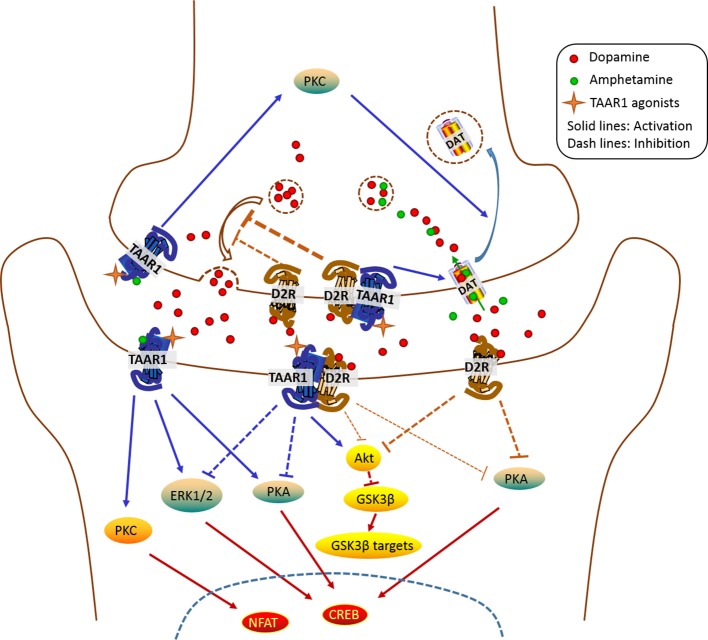
Trace-amine associated receptor 1 (TAAR1) is the best-characterized member of the family of TAARs. TAAR1 is broadly expressed in the brain, especially within the monoaminergic systems. Evidence from electrophysiological and neurochemical studies evaluating the effects of genetic and pharmacological interventions on TAAR1 revealed that TAAR1 modulates transmission of monoamines, especially dopamine. TAAR1 agonists dampened drugs of abuse-induced dopamine accumulation. In general, TAAR1 agonists specifically inhibited the rewarding and reinforcing effects of drugs of abuse and drug-abuse related behaviors. Details of the mechanism of TAAR1 remain elusive; however, it is thought to be regulated by its interactions with D2 receptors. In addition, the alternative cellular mechanism such as an interaction between TAAR1 and D3 may also participate in the action of TAAR1 agonists. Further studies are required to investigate the role of TAAR1 in other drugs of abuse-related behaviors and the underlying neural mechanisms. Collectively, TAAR1 negatively modulates dopaminergic systems and dopamine-related behaviors and TAAR1 agonists are promising pharmacotherapy to treat drug addiction and relapse.
痕量胺相关受体1(TAAR1)是痕量胺相关受体(TAAR)家族中特征最为明确的成员。TAAR1在大脑中广泛表达,尤其是在单胺能系统中。评估基因和药物干预对TAAR1影响的电生理和神经化学研究证据表明,TAAR1调节单胺的传递,尤其是多巴胺。TAAR1激动剂可抑制滥用药物诱导的多巴胺积累。一般来说,TAAR1激动剂特异性地抑制滥用药物的奖赏和强化作用以及与药物滥用相关的行为。TAAR1的作用机制细节仍不清楚;然而,人们认为它是通过与D2受体的相互作用来调节的。此外,诸如TAAR1与D3之间相互作用等其他细胞机制也可能参与TAAR1激动剂的作用。需要进一步研究来探讨TAAR1在其他与药物滥用相关行为中的作用以及潜在的神经机制。总的来说,TAAR1对多巴胺能系统和与多巴胺相关的行为起负调节作用,TAAR1激动剂有望成为治疗药物成瘾和复发的药物疗法。