Yang Bin, Le Jiaqing, Wu Peng, Liu Jianxin, Guan Le L, Wang Jiakun
Institute of Dairy Science, College of Animal Sciences, Zhejiang University, Hangzhou, China.
Department of Agricultural, Food & Nutritional Science, University of Alberta, Edmonton, AB, Canada.
Front Microbiol. 2018 Mar 27;9:574. doi: 10.3389/fmicb.2018.00574. eCollection 2018.
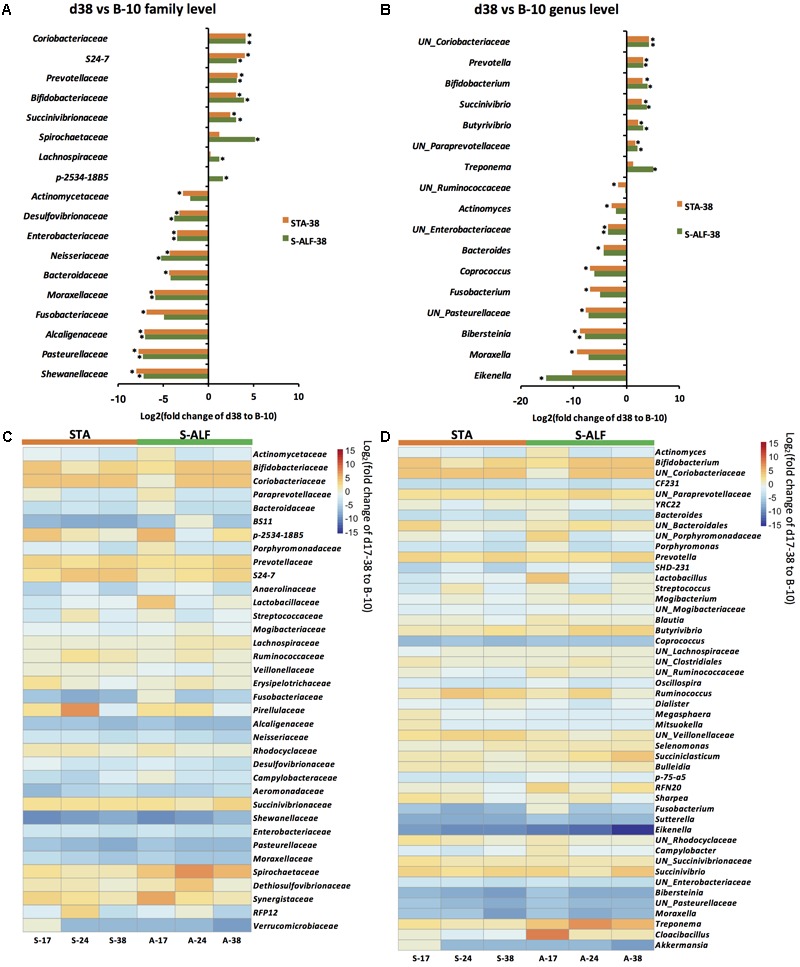
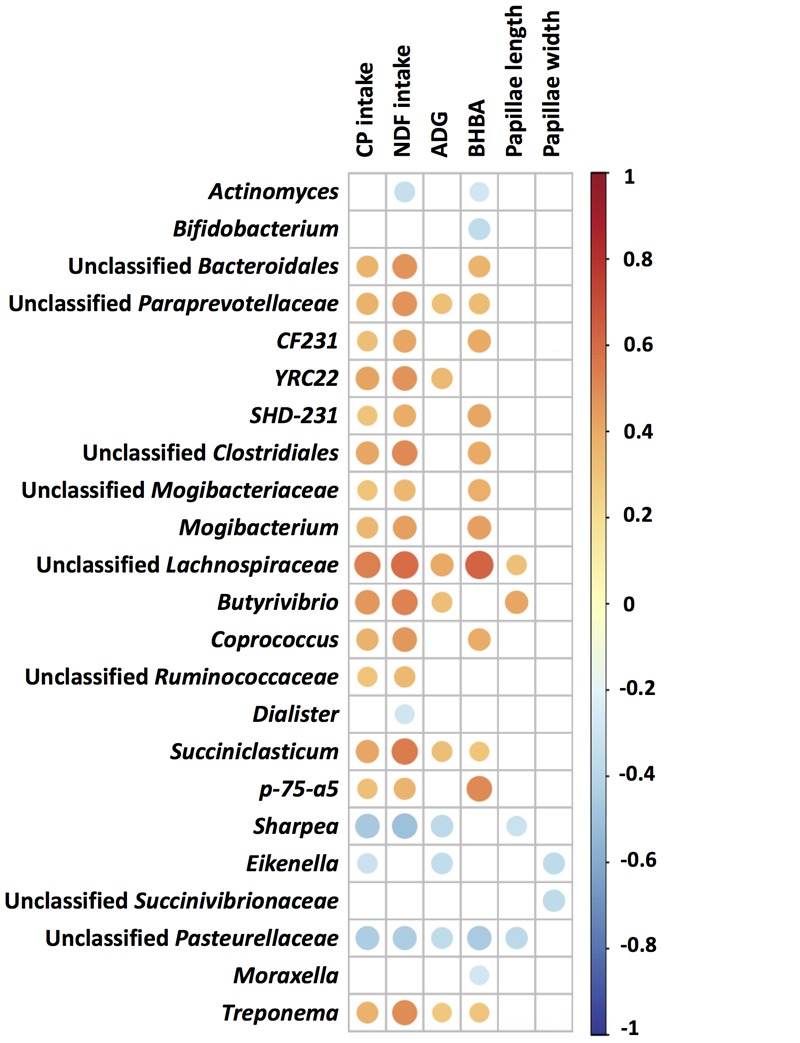
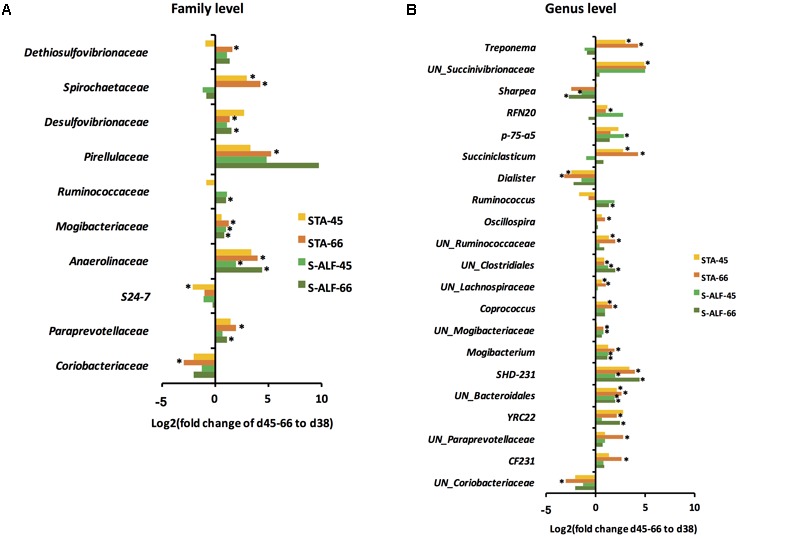
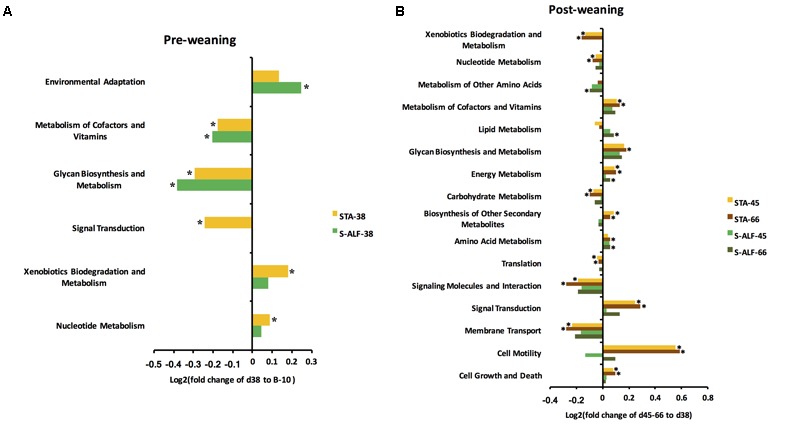
The pre-weaning period is crucial for rumen developmental plasticity, which can have a long-term impact on animal performance. Understanding the rumen microbiota during early life is important to elucidate its potential role in rumen development. In this study, the rumen microbiota of 10-day-old Hu lambs fed either milk replacer (B-10), milk replacer and starter (STA) or milk replacer and starter supplemented with alfalfa (S-ALF) in the pre- (d17, 24, and 38) and post-weaning periods (d45 and 66) were assessed to characterize rumen microbial colonization during early life and its response to fiber intervention. In the rumens of B-10 lambs, 498 operational taxonomic units belonging to 33 predominant genera were observed, and the top six predicted functions included "Membrane transport," "carbohydrate metabolism," "amino acid metabolism," "replication and repair," "translation," and "energy metabolism." , , , and abundances were increased at d38 for both STA and S-ALF groups compared to the B-10 group, whereas fibrolytic bacteria of the taxa and were only increased in the S-ALF group at d38. A number of saccharolytic bacteria (), organic acid-producing bacteria ( and ), proteolytic and amino acid fermenters () and fibrolytic bacteria (unclassified ) were significantly decreased in the STA lambs but not in the S-ALF lambs at d38. After weaning and exposed to alfalfa, the rumen microbial composition in the STA group started to appear similar to that of the S-ALF lambs. The relative abundance of unclassified was higher in S-ALF lambs than STA lambs after weaning. Spearman's correlation analysis showed positive relationships between unclassified , unclassified , , unclassified , and crude protein intake, neutral detergent fiber intake, and plasma β-hydroxybutyrate. The unclassified and were also positively correlated with average daily gain. Our results revealed that alfalfa stimulated changes in rumen microbiota during the pre- and post-weaning periods and was consistent with rumen development for better feed intake and animal performance before and after weaning. The findings of this study provide clues for strategies to improve rumen function through manipulation of the rumen microbiota during early life.
断奶前时期对于瘤胃发育可塑性至关重要,这可能对动物生产性能产生长期影响。了解早期生命阶段的瘤胃微生物群对于阐明其在瘤胃发育中的潜在作用很重要。在本研究中,评估了10日龄湖羊羔羊在断奶前(第17、24和38天)和断奶后时期(第45和66天)分别饲喂代乳粉(B - 10)、代乳粉和开食料(STA)或添加苜蓿的代乳粉和开食料(S - ALF)后的瘤胃微生物群,以表征早期生命阶段瘤胃微生物的定殖情况及其对纤维干预的反应。在B - 10羔羊的瘤胃中,观察到属于33个优势属的498个可操作分类单元,前六项预测功能包括“膜转运”、“碳水化合物代谢”、“氨基酸代谢”、“复制与修复”、“翻译”和“能量代谢”。与B - 10组相比,STA组和S - ALF组在第38天时 、 、 和 的丰度增加,而分类群 和 的纤维分解菌仅在S - ALF组第38天时增加。在第38天时,STA羔羊中一些分解糖类细菌( )、产有机酸细菌( 和 )、蛋白水解和氨基酸发酵菌( )以及纤维分解菌(未分类 )显著减少,但S - ALF羔羊中未减少。断奶并接触苜蓿后,STA组的瘤胃微生物组成开始与S - ALF羔羊相似。断奶后,S - ALF羔羊中未分类 的相对丰度高于STA羔羊。Spearman相关性分析表明,未分类 、未分类 、 、未分类 和 与粗蛋白摄入量、中性洗涤纤维摄入量和血浆β - 羟基丁酸之间呈正相关。未分类 和 也与平均日增重呈正相关。我们的结果表明,苜蓿在断奶前后刺激了瘤胃微生物群的变化,并且与瘤胃发育一致,有利于断奶前后更好的采食量和动物生产性能。本研究结果为通过在生命早期操纵瘤胃微生物群来改善瘤胃功能的策略提供了线索。