Verma Akash, Goh Soon Keng, Tai Dessmon Y H, Kor Ai Ching, Soo Chun Ian, Seow Debra G F, Sein Zin Nge Nge, Samol Jens, Chopra Akhil, Abisheganaden John
Dept of Respiratory and Critical Care Medicine, Tan Tock Seng Hospital, Singapore.
ERJ Open Res. 2018 Apr 9;4(2). doi: 10.1183/23120541.00173-2017. eCollection 2018 Apr.
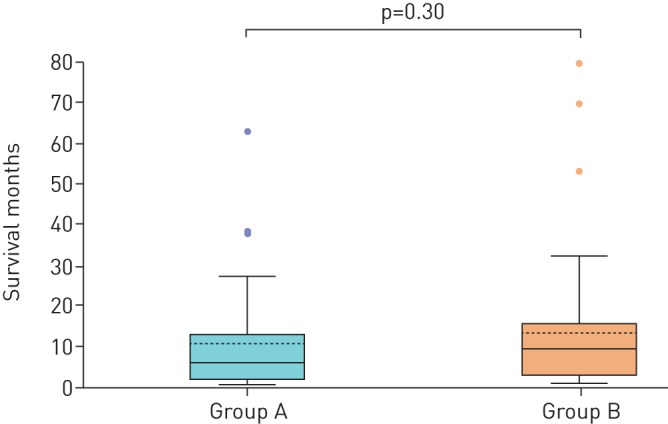
Patients with central airway obstruction (CAO) from advanced lung cancer present with significant morbidity and are assumed to have lower survival. Hence, they are offered only palliative support. We asked if patients who have advanced lung cancer with CAO (recanalised and treated) will behave similarly to those with advanced lung cancer without CAO. This study was a retrospective review of the medical records of the patients managed for advanced lung cancer during 2010 and 2015 at our institution. 85 patients were studied. Median survival and 1-, 2- and 5-year survival were 5.8 months, 30.3%, 11.7% and 2.3% 9.3 months, 35.7%, 9.6% and 4.7%, respectively, in the CAO and no CAO groups (p=0.30). More patients presented with respiratory failure (15 (35%) none; p=0.0001) and required assisted mechanical ventilation (10 (23.3%) none; p=0.001) in the CAO group compared with the no CAO group. Fewer patients received chemotherapy in the CAO group (11 (25.5%)) compared with the no CAO group (23 (54.7%); p=0.008). There was no difference in survival among patients with advanced lung cancer whether they presented with CAO or without CAO. Survival was similar to those without CAO in patients with recanalised CAO despite greater morbidity and lesser use of chemotherapy, strongly advocating bronchoscopic recanalisation of CAO. These findings dispel the nihilism associated with such cases.
晚期肺癌导致中央气道阻塞(CAO)的患者具有较高的发病率,且生存期较短。因此,他们仅接受姑息治疗。我们想了解晚期肺癌合并CAO(已再通并接受治疗)的患者与无CAO的晚期肺癌患者的表现是否相似。本研究回顾性分析了2010年至2015年在我院接受治疗的晚期肺癌患者的病历。共研究了85例患者。CAO组和无CAO组的中位生存期及1年、2年和5年生存率分别为5.8个月、30.3%、11.7%和2.3%,以及9.3个月、35.7%、9.6%和4.7%(p=0.30)。与无CAO组相比,CAO组更多患者出现呼吸衰竭(15例(35%)对0例;p=0.0001)且需要机械通气辅助(10例(23.3%)对0例;p=0.001)。与无CAO组(23例(54.7%))相比,CAO组接受化疗的患者更少(11例(25.5%);p=0.008)。晚期肺癌患者无论是否合并CAO,其生存率无差异。尽管CAO患者发病率更高且化疗使用率更低,但再通CAO的患者生存率与无CAO患者相似,这强烈支持对CAO进行支气管镜再通治疗。这些发现消除了与此类病例相关的虚无主义观念。