Briars Graham L, Gordon Gillian Suzanne, Lawrence Andrew, Turner Andrew, Perry Sharon, Pillbrow Dan, Walston Florence Einstein, Molyneux Paul
Paediatric Gastroenterology, Norfolk and Norwich University Hospital NHS Foundation Trust, Norwich, UK.
Faculty of Medicine and Health Sciences, University of East Anglia, Norwich, UK.
BMJ Paediatr Open. 2017 Oct 25;1(1):e000075. doi: 10.1136/bmjpo-2017-000075. eCollection 2017.
To determine whether during-exercise rehydration improves swimming performance and whether sports drink or water have differential effects on performance.
Randomised controlled multiple crossover trial.
A UK competitive swimming club.
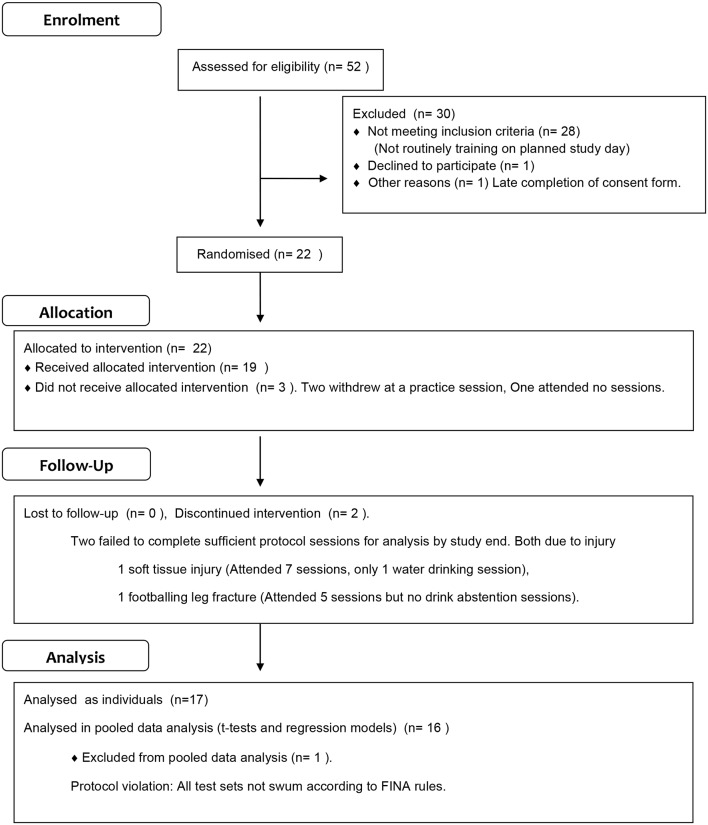
19 club-level competitive swimmers, median age (range) 13 (11-17) years.
Subjects were scheduled to drink ad libitum commercial isotonic sports drink (3.9 g sugars and 0.13 g salt per 100 mL) or water (three sessions each) or no drink (six sessions) in the course of twelve 75 min training sessions, each of which was followed by a 30 min test set of ten 100 m maximum-effort freestyle sprints each starting at 3 min intervals.
Times for the middle 50 m of each sprint measured using electronic timing equipment in a Federation Internationale de Natation (FINA)-compliant six-lane 25 m competition swimming pool.
Software-generated individual random session order in sealed envelopes. Analysis subset of eight sessions randomly selected by software after data collection completed.
Participants blind to drink allocation until session start.
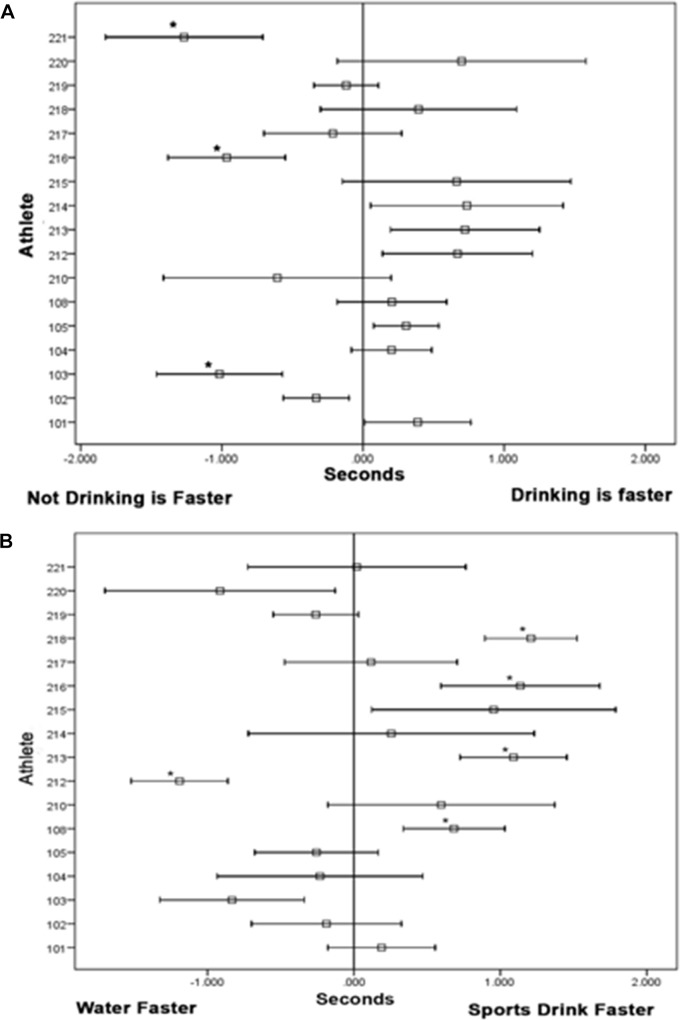
In the analysis data set of 1118 swims, there was no significant difference between swim times for drinking and not drinking nor between drinking water or a sports drink. Mean (SEM) 50 m time for no-drink swims was 38.077 (0.128) s and 38.105 (0.131) s for drink swims, p=0.701. Mean 50 m times were 38.031 (0.184) s for drinking sports drink and 38.182 (0.186) s for drinking water, p=0.073. Times after not drinking were 0.027 s faster than after drinking (95% CI 0.186 s faster to 0.113 s slower). Times after drinking sports drink were 0.151 s faster than after water (95% CI 0.309 s faster to 0.002 s slower). Mean (SEM) dehydration from exercise was 0.42 (0.11)%.
Drinking water or sports drink over 105 min of sustained effort swimming training does not improve swimming performance.
ISRCTN: 49860006.
确定运动期间补液是否能提高游泳成绩,以及运动饮料和水对成绩是否有不同影响。
随机对照多交叉试验。
英国一家竞技游泳俱乐部。
19名俱乐部级竞技游泳运动员,年龄中位数(范围)13岁(11 - 17岁)。
在12次75分钟的训练课程中,受试者按计划随意饮用市售等渗运动饮料(每100毫升含3.9克糖和0.13克盐)或水(各3次)或不饮水(6次)。每次训练后进行30分钟的测试组,包括10次全力100米自由泳冲刺,每次间隔3分钟出发。
在符合国际泳联(FINA)标准的六泳道25米比赛游泳池中,使用电子计时设备测量每次冲刺中间50米的时间。
软件生成的个体随机训练顺序,装在密封信封中。数据收集完成后,软件随机选择8次训练作为分析子集。
参与者在训练开始前对饮料分配不知情。
在1118次游泳的分析数据集中,饮水组和不饮水组的游泳时间之间以及饮用运动饮料和水之间均无显著差异。不饮水游泳的平均(标准误)50米时间为38.077(0.128)秒,饮水游泳为38.105(0.131)秒,p = 0.701。饮用运动饮料的平均50米时间为38.031(0.184)秒,饮水为38.182(0.186)秒,p = 0.073。不饮水后的时间比饮水后快0.027秒(95%置信区间:快0.186秒至慢0.113秒)。饮用运动饮料后的时间比饮水后快0.151秒(95%置信区间:快0.309秒至慢0.002秒)。运动导致的平均(标准误)脱水率为0.42(0.11)%。
在105分钟的持续耐力游泳训练中饮水或运动饮料并不能提高游泳成绩。
ISRCTN:49860006。