Stöckl Heidi, Dekel Bianca, Morris-Gehring Alison, Watts Charlotte, Abrahams Naeemah
London School of Hygiene and Tropical Medicine, London, UK.
South African Medical Research Council, Cape Town, South Africa.
BMJ Paediatr Open. 2017 Aug 11;1(1):e000112. doi: 10.1136/bmjpo-2017-000112. eCollection 2017.
This study aims to describe child homicide perpetrators and estimate their global and regional proportion to inform prevention strategies to reduce child homicide mortality worldwide.
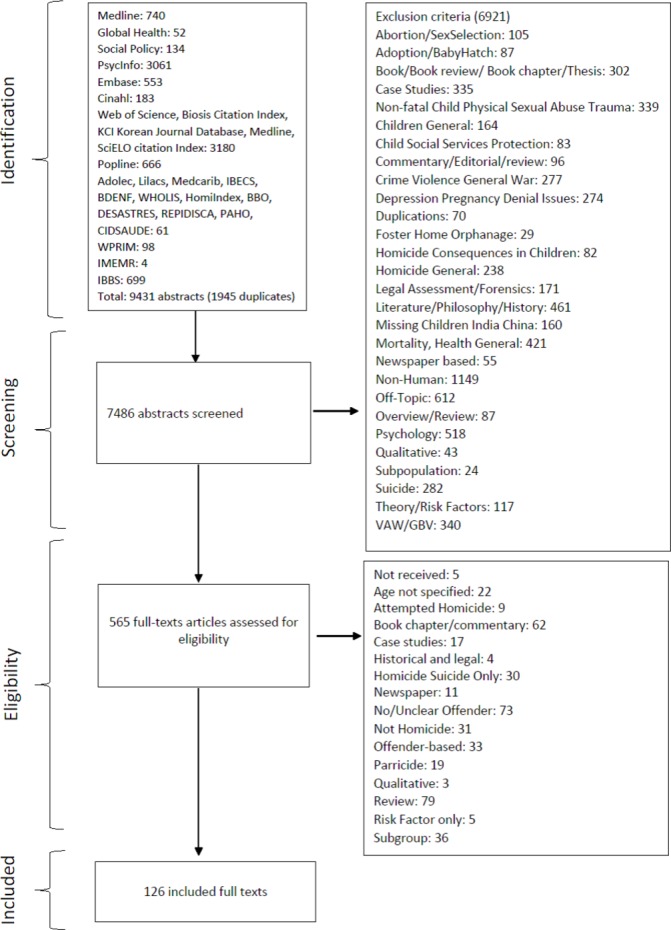
A systematic review of 9431 studies derived from 18 databases led to the inclusion of 126 studies after double screening. All included studies reported a number or proportion of child homicides perpetrators. 169 countries and homicide experts were surveyed in addition. The median proportion for each perpetrator category was calculated by region and overall and by age groups and sex.
Data were obtained for 44 countries. Overall, parents committed 56.5% (IQR 23.7-69.6) of child homicides, 58.4% (0.0-66.7) of female and 46.8% (14.1-63.8) of male child homicides. Acquaintances committed 12.6% (5.9-31.3) of child homicides. Almost a tenth (9.2% (IQR 0.0-21.9) of child homicides had missing information on the perpetrator. The largest proportion of parental homicides of children was found in high-income countries (64.2%; 44.7-71.8) and East Asia and Pacific Region (61.7%; 46.7-78.6). Parents committed the majority (77.8% (61.5-100.0)) of homicides of children under the age of 1 year. For adolescents, acquaintances were the main group of homicide perpetrators (36.9%, 6.6-51.8). There is a notable lack of studies from low-income and middle-income countries and children above the age of 1 year.
Children face the highest risk of homicide by parents and someone they know. Increased investment into the compilation of routine data on child homicide, and the perpetrators of this homicide is imperative for understanding and ultimately reducing child homicide mortality worldwide.
PROSPERO registration number: CRD42015030125.
本研究旨在描述杀害儿童的犯罪者,并估计其在全球和区域范围内的比例,为制定预防策略提供依据,以降低全球儿童杀人死亡率。
对来自18个数据库的9431项研究进行系统综述,经过双重筛选后纳入126项研究。所有纳入研究均报告了杀害儿童犯罪者的数量或比例。此外,还对169个国家和杀人问题专家进行了调查。按地区、总体以及年龄组和性别计算了每个犯罪者类别的中位数比例。
获取了44个国家的数据。总体而言,父母实施了56.5%(四分位距23.7 - 69.6)的儿童杀人案件,其中杀害女童的案件中父母占58.4%(0.0 - 66.7),杀害男童的案件中父母占46.8%(14.1 - 63.8)。熟人实施了12.6%(5.9 - 31.3)的儿童杀人案件。近十分之一(9.2%,四分位距0.0 - 21.9)的儿童杀人案件在犯罪者信息方面存在缺失。在高收入国家(64.2%;44.7 - 71.8)以及东亚和太平洋地区(61.7%;46.7 - 78.6),父母杀害儿童的比例最高。在1岁以下儿童的杀人案件中,父母占大多数(77.8%,61.5 - 100.0)。对于青少年而言,熟人是杀人犯罪者的主要群体(36.9%,6.6 - 51.8)。低收入和中等收入国家以及1岁以上儿童的相关研究明显不足。
儿童面临来自父母和熟人的最高杀人风险。加大对儿童杀人案件常规数据以及此类杀人案件犯罪者信息汇编的投入,对于了解并最终降低全球儿童杀人死亡率至关重要。
PROSPERO注册号:CRD42015030125。