Downie Lilian, Halliday Jane L, Burt Rachel A, Lunke Sebastian, Lynch Elly, Martyn Melissa, Poulakis Zeffie, Gaff Clara, Sung Valerie, Wake Melissa, Hunter Matthew, Saunders Kerryn, Rose Elizabeth, Rehm Heidi L, Amor David J
Victorian Clinical Genetics Services, Victoria, Melbourne, Australia.
Murdoch Children's Research Institute, Victoria, Melbourne, Australia.
BMJ Paediatr Open. 2017 Sep 14;1(1):e000119. doi: 10.1136/bmjpo-2017-000119. eCollection 2017.
The aetiology of congenital hearing loss is heterogeneous, and in many infants a genetic cause is suspected. Parents face a diagnostic odyssey when searching for a cause of their infant's hearing loss. Through the Melbourne Genomics Health Alliance, a prospective cohort of infants will be offered whole-exome sequencing (WES) with targeted analysis in conjunction with chromosome microarray to determine the genetic causes of congenital hearing loss. Parents will also be offered the opportunity to receive additional results from their infant's WES.
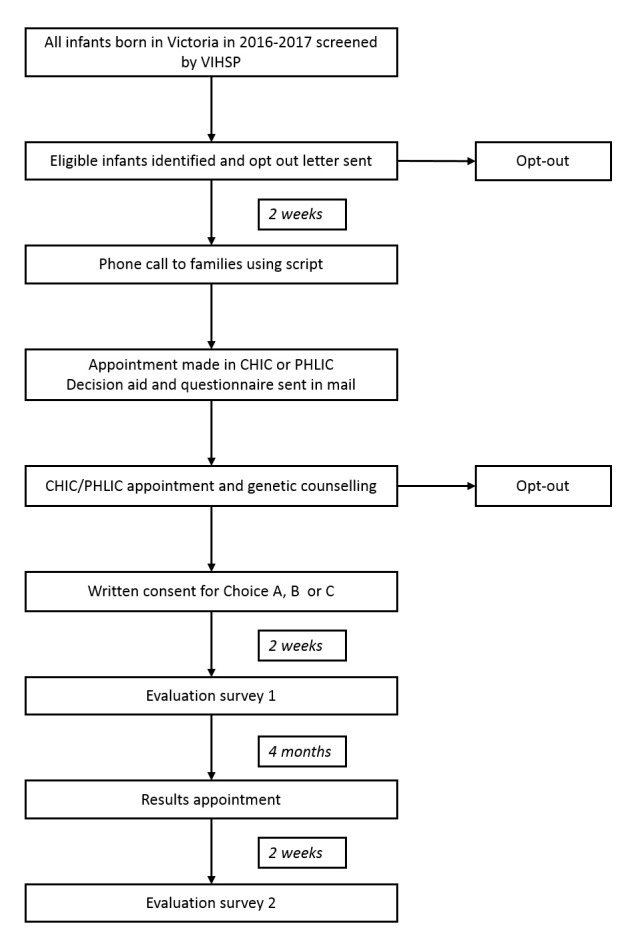
Eligible infants will be identified through the Victorian Infant Hearing Screening Program and offered an appointment in a paediatrician-run clinic, a genetics assessment and enrolment in the Victorian Childhood Hearing Impairment Longitudinal Databank. If parents consent to WES, genes causing deafness will be analysed and they can choose to obtain additional findings. For the additional results component, a modified laboratory protocol has been designed for reporting of results in the absence of a relevant phenotype. Parents' experience of being offered WES will be evaluated using surveys.
This project will provide descriptive analysis of the genetic aetiology of congenital hearing loss in this cohort and may provide data on genotype-phenotype correlations. Additionally, choices regarding additional findings will be analysed. Participants will represent a diverse cross section of the population, increasing the ability to generalise results beyond the study group. Evaluation surveys will allow analysis of preferences around counselling, usefulness of a decision aid and adequacy of information provision.
先天性听力损失的病因具有异质性,许多婴儿被怀疑存在遗传原因。在寻找婴儿听力损失的病因时,父母面临着一段诊断历程。通过墨尔本基因组学健康联盟,将为一组前瞻性队列中的婴儿提供全外显子组测序(WES)以及结合染色体微阵列的靶向分析,以确定先天性听力损失的遗传原因。还将为父母提供机会获取其婴儿WES的其他结果。
符合条件的婴儿将通过维多利亚州婴儿听力筛查项目进行识别,并在儿科医生开设的诊所预约就诊、接受遗传学评估并纳入维多利亚州儿童听力障碍纵向数据库。如果父母同意进行WES,将对导致耳聋的基因进行分析,他们可以选择获取其他结果。对于其他结果部分,已设计了一种改进的实验室方案,用于在不存在相关表型的情况下报告结果。将通过调查评估父母接受WES的体验。
该项目将对该队列中先天性听力损失的遗传病因进行描述性分析,并可能提供基因型-表型相关性的数据。此外,将分析关于其他结果的选择。参与者将代表人群的不同横截面,提高将结果推广到研究组之外的能力。评估调查将允许分析围绕咨询的偏好、决策辅助工具的有用性以及信息提供的充分性。