Tsang Tracey W, Laing-Aiken Zoe, Latimer Jane, Fitzpatrick James, Oscar June, Carter Maureen, Elliott Elizabeth J
The University of Sydney, Discipline of Child and Adolescent Health, Sydney Medical School, The Children's Hospital at Westmead, Westmead, New South Wales, Australia.
The George Institute for Global Health, Sydney Medical School, The University of Sydney, Sydney, New South Wales, Australia.
BMJ Paediatr Open. 2017 Sep 11;1(1):e000137. doi: 10.1136/bmjpo-2017-000137. eCollection 2017.
To examine the three facial features of fetal alcohol syndrome (FAS) in a cohort of Australian Aboriginal children from two-dimensional digital facial photographs to: (1) assess intrarater and inter-rater reliability; (2) identify the racial norms with the best fit for this population; and (3) assess agreement with clinician direct measures.
Photographs and clinical data for 106 Aboriginal children (aged 7.4-9.6 years) were sourced from the . Fifty-eight per cent had a confirmed prenatal alcohol exposure and 13 (12%) met the Canadian 2005 criteria for FAS/partial FAS. Photographs were analysed using the FAS Facial Photographic Analysis Software to generate the mean PFL three-point ABC-Score, five-point lip and philtrum ranks and four-point face rank in accordance with the 4-Digit Diagnostic Code. Intrarater and inter-rater reliability of digital ratings was examined in two assessors. Caucasian or African American racial norms for PFL and lip thickness were assessed for best fit; and agreement between digital and direct measurement methods was assessed.
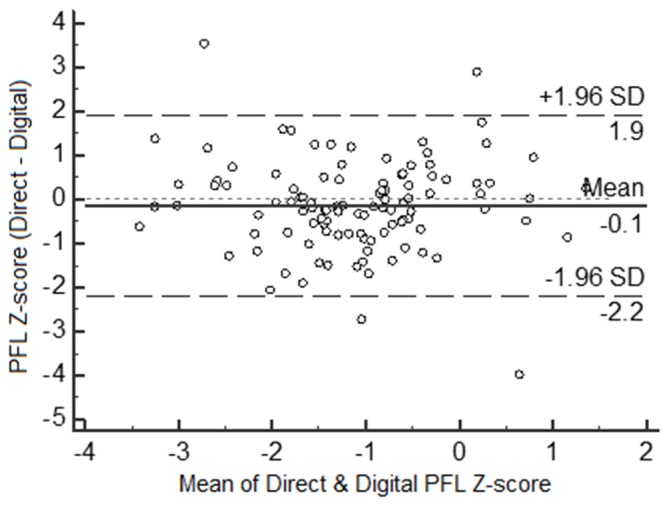
Reliability of digital measures was substantial within (kappa: 0.70-1.00) and between assessors (kappa: 0.64-0.89). Clinician and digital ratings showed moderate agreement (kappa: 0.47-0.58). Caucasian PFL norms and the African American Lip-Philtrum Guide 2 provided the best fit for this cohort.
In an Aboriginal cohort with a high rate of FAS, assessment of facial dysmorphology using digital methods showed substantial inter- and intrarater reliability. Digital measurement of features has high reliability and until data are available from a larger population of Aboriginal children, the African American Lip-Philtrum Guide 2 and Caucasian (Strömland) PFL norms provide the best fit for Australian Aboriginal children.
通过二维数字面部照片,研究澳大利亚原住民儿童队列中胎儿酒精综合征(FAS)的三个面部特征,以:(1)评估评分者内和评分者间的可靠性;(2)确定最适合该人群的种族规范;(3)评估与临床医生直接测量结果的一致性。
从……获取了106名原住民儿童(年龄7.4 - 9.6岁)的照片和临床数据。58%的儿童有确诊的产前酒精暴露史,13名(12%)符合2005年加拿大FAS/部分FAS标准。使用FAS面部照片分析软件对照片进行分析,以根据4位数字诊断代码生成平均PFL三点ABC评分、五点唇部和人中等级以及四点面部等级。在两名评估者中检查数字评分的评分者内和评分者间可靠性。评估白种人或非裔美国人PFL和唇部厚度的种族规范以确定最佳拟合度;并评估数字测量方法与直接测量方法之间的一致性。
数字测量的可靠性在评估者内部(kappa:0.70 - 1.00)和评估者之间(kappa:0.64 - 0.89)都很高。临床医生和数字评分显示出中等程度的一致性(kappa:0.47 - 0.58)。白种人PFL规范和非裔美国人唇部 - 人中指南2最适合该队列。
在FAS发生率较高的原住民队列中,使用数字方法对面部畸形进行评估显示出较高的评分者间和评分者内可靠性。面部特征的数字测量具有高可靠性,在获得更多澳大利亚原住民儿童的数据之前,非裔美国人唇部 - 人中指南2和白种人(斯特伦兰德)PFL规范最适合澳大利亚原住民儿童。