a Edward A. Doisy Department of Biochemistry and Molecular Biology , Saint Louis University School of Medicine , St. Louis , MO , USA.
Nucleus. 2018 Jan 1;9(1):258-275. doi: 10.1080/19491034.2018.1454168.
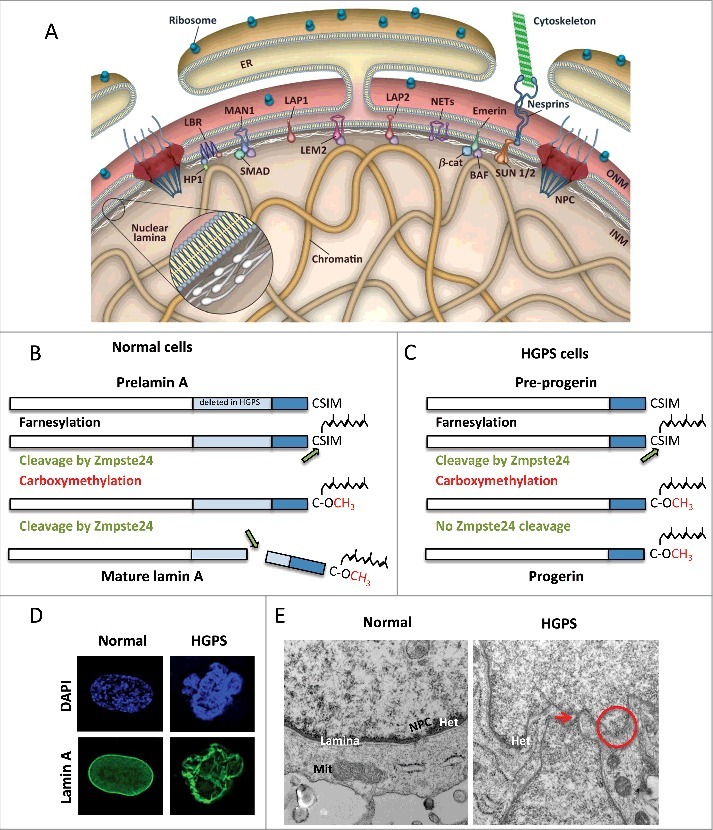
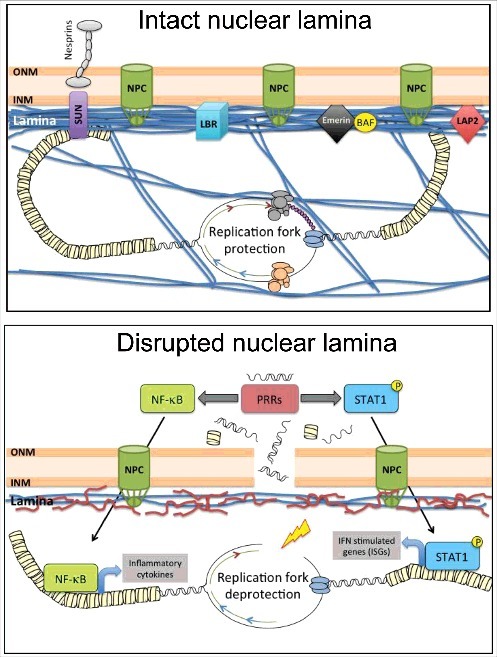
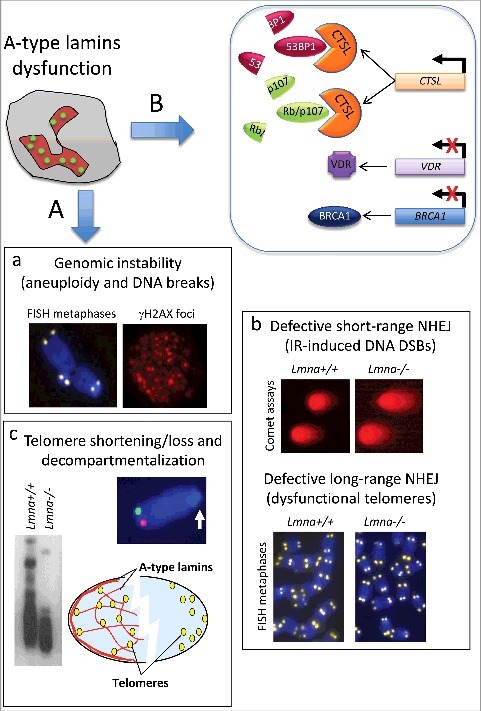
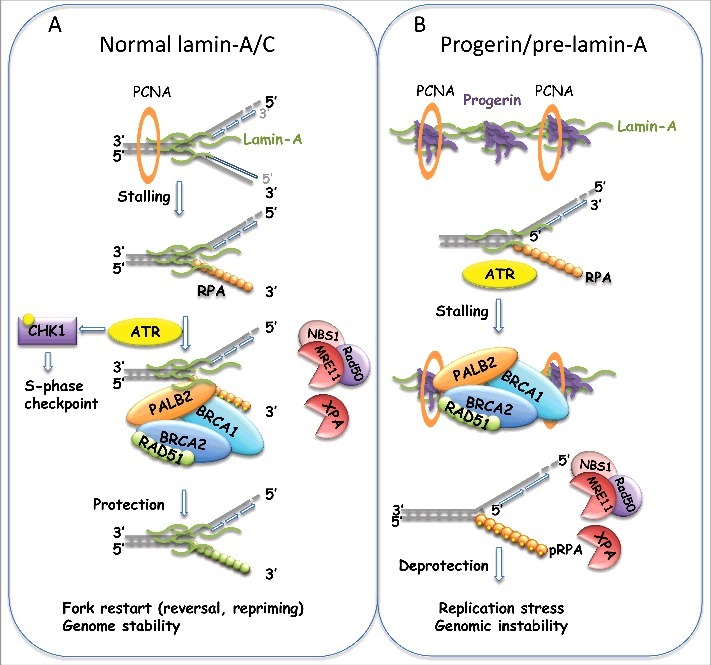
Mammalian nuclei are equipped with a framework of intermediate filaments that function as a karyoskeleton. This nuclear scaffold, formed primarily by lamins (A-type and B-type), maintains the spatial and functional organization of the genome and of sub-nuclear compartments. Over the past decade, a body of evidence has highlighted the significance of these structural nuclear proteins in the maintenance of nuclear architecture and mechanical stability, as well as genome function and integrity. The importance of these structures is now unquestioned given the wide range of degenerative diseases that stem from LMNA gene mutations, including muscular dystrophy disorders, peripheral neuropathies, lipodystrophies, and premature aging syndromes. Here, we review our knowledge about how alterations in nuclear lamins, either by mutation or reduced expression, impact cellular mechanisms that maintain genome integrity. Despite the fact that DNA replication is the major source of DNA damage and genomic instability in dividing cells, how alterations in lamins function impact replication remains minimally explored. We summarize recent studies showing that lamins play a role in DNA replication, and that the DNA damage that accumulates upon lamins dysfunction is elicited in part by deprotection of replication forks. We also discuss the emerging model that DNA damage and replication stress are "sensed" at the cytoplasm by proteins that normally survey this space in search of foreign nucleic acids. In turn, these cytosolic sensors activate innate immune responses, which are materializing as important players in aging and cancer, as well as in the response to cancer immunotherapy.
哺乳动物细胞核内装备有一个由中间丝构成的框架,作为核骨架发挥作用。这种核基质主要由核纤层蛋白(A 型和 B 型)构成,维持基因组和亚核区室的空间和功能组织。在过去的十年中,大量证据强调了这些结构核蛋白在维持核架构和机械稳定性以及基因组功能和完整性方面的重要性。鉴于从 LMNA 基因突变引起的广泛退行性疾病,包括肌肉营养不良症、周围神经病、脂肪营养不良症和早衰综合征,这些结构的重要性现在已毋庸置疑。在这里,我们回顾了我们关于核纤层蛋白的改变(无论是突变还是表达减少)如何影响维持基因组完整性的细胞机制的知识。尽管 DNA 复制是有丝分裂细胞中 DNA 损伤和基因组不稳定性的主要来源,但核纤层蛋白功能的改变如何影响复制的机制仍知之甚少。我们总结了最近的研究表明,核纤层蛋白在 DNA 复制中发挥作用,并且在核纤层蛋白功能障碍时积累的 DNA 损伤部分是由复制叉的去保护引起的。我们还讨论了一个新兴模型,即 DNA 损伤和复制应激通过通常在细胞质中检测该空间以寻找外来核酸的蛋白质在细胞质中被“感知”。反过来,这些细胞质传感器激活先天免疫反应,这些反应在衰老和癌症以及癌症免疫治疗的反应中表现为重要的参与者。