Department of Human Nutrition, University of Warmia and Mazury in Olsztyn, Sloneczna 45f, 10-718 Olsztyn, Poland.
Department of Surgery, University of Warmia and Mazury in Olsztyn, 11-041 Olsztyn, Poland.
Nutrients. 2018 Apr 11;10(4):470. doi: 10.3390/nu10040470.
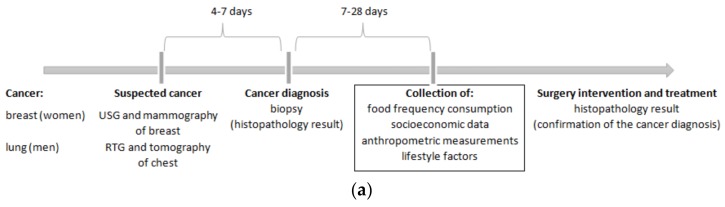
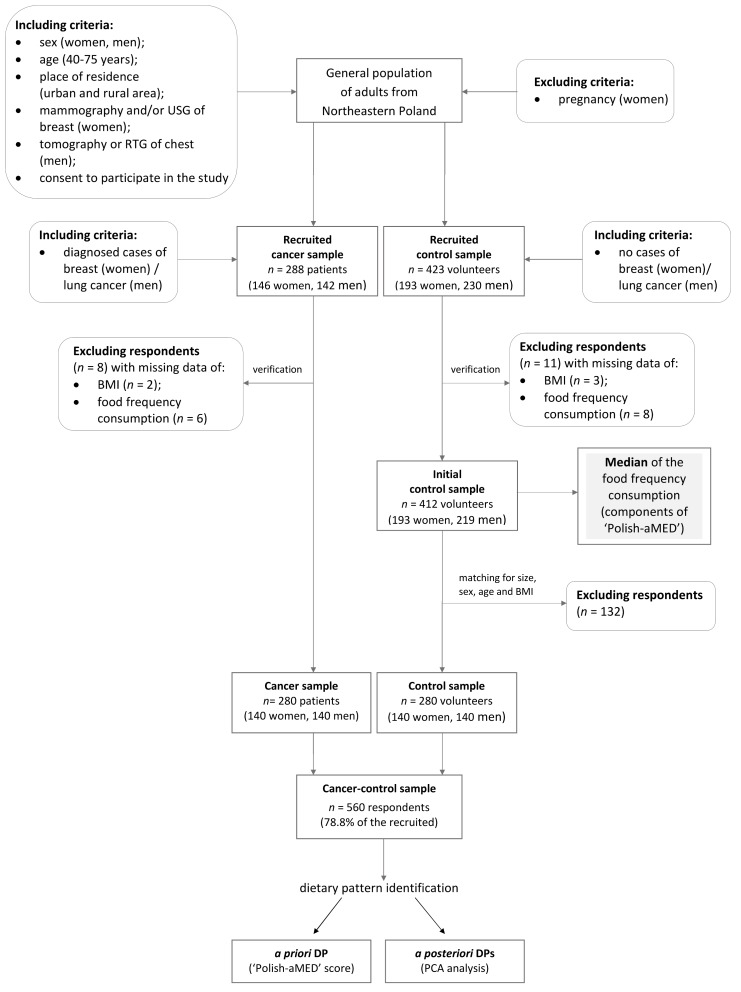
Lung cancer in men and breast cancer in women are the most commonly diagnosed cancers in Poland and worldwide. Results of studies involving dietary patterns (DPs) and breast or lung cancer risk in European countries outside the Mediterranean Sea region are limited and inconclusive. This study aimed to develop a 'Polish-adapted Mediterranean Diet' ('Polish-aMED') score, and then study the associations between the 'Polish-aMED' score and -derived dietary patterns with breast or lung cancer risk in adult Poles. This pooled analysis of two case-control studies involved 560 subjects (280 men, 280 women) aged 40-75 years from Northeastern Poland. Diagnoses of breast cancer in 140 women and lung cancer in 140 men were found. The food frequency consumption of 21 selected food groups was collected using a 62-item Food Frequency Questionnaire (FFQ)-6. The 'Polish-adapted Mediterranean Diet' score which included eight items-vegetables, fruit, whole grain, fish, legumes, nuts and seeds-as well as the ratio of vegetable oils to animal fat and red and processed meat was developed (range: 0-8 points). Three DPs were identified in a Principal Component Analysis: 'Prudent', 'Non-healthy', 'Dressings and sweetened-low-fat dairy'. In a multiple logistic regression analysis, two models were created: crude, and adjusted for age, sex, type of cancer, Body Mass Index (BMI), socioeconomic status (SES) index, overall physical activity, smoking status and alcohol abuse. The risk of breast or lung cancer was lower in the average (3-5 points) and high (6-8 points) levels of the 'Polish-aMED' score compared to the low (0-2 points) level by 51% (odds ratio (OR): 0.49; 95% confidence interval (Cl): 0.30-0.80; < 0.01; adjusted) and 63% (OR: 0.37; 95% Cl: 0.21-0.64; < 0.001; adjusted), respectively. In the middle and upper tertiles compared to the bottom tertile of the 'Prudent' DP, the risk of cancer was lower by 38-43% (crude) but was not significant after adjustment for confounders. In the upper compared to the bottom tertile of the 'Non-healthy' DP, the risk of cancer was higher by 65% (OR: 1.65; 95% Cl: 1.05-2.59; < 0.05; adjusted). In conclusion, the Polish adaptation of the Mediterranean diet could be considered for adults living in non-Mediterranean countries for the prevention of the breast or lung cancers. Future studies should explore the role of a traditional Mediterranean diet fitted to local dietary patterns of non-Mediterranean Europeans in cancer prevention.
男性肺癌和女性乳腺癌是波兰和全球最常见的癌症。在欧洲地中海以外地区进行的涉及饮食模式(DPs)和乳腺癌或肺癌风险的研究结果有限且不确定。本研究旨在制定“波兰适应的地中海饮食”(“波兰-aMED”)评分,然后研究“波兰-aMED”评分与源自成人波兰人的乳腺癌或肺癌风险之间的关联。这是两项病例对照研究的汇总分析,涉及来自波兰东北部的 560 名受试者(280 名男性,280 名女性),年龄在 40-75 岁之间。在 140 名女性中发现乳腺癌诊断,在 140 名男性中发现肺癌诊断。使用包含 62 个食物组的 62 项食物频率问卷(FFQ)-6 收集了 21 种选定食物组的食物频率消耗情况。开发了一种包括 8 个项目的“波兰适应的地中海饮食”评分-蔬菜,水果,全谷物,鱼,豆类,坚果和种子-以及蔬菜油与动物脂肪和红色与加工肉的比例(范围:0-8 分)。在主成分分析中确定了三种 DPs:“谨慎”,“非健康”,“调味料和加糖低脂乳制品”。在多因素逻辑回归分析中,创建了两个模型:原始模型和调整后的模型,包括年龄,性别,癌症类型,体重指数(BMI),社会经济地位(SES)指数,总体身体活动,吸烟状况和酗酒。与低(0-2 分)水平相比,“波兰-aMED”评分的平均(3-5 分)和高(6-8 分)水平与乳腺癌或肺癌的风险分别降低了 51%(优势比(OR):0.49; 95%置信区间(Cl):0.30-0.80; < 0.01; 调整)和 63%(OR:0.37; 95%Cl:0.21-0.64; < 0.001; 调整)。与 DP 的中下三分位相比,“谨慎”DP 的中高位的癌症风险降低了 38-43%(原始),但在调整混杂因素后并不显著。与 DP 的下三分位相比,“非健康”DP 的上三分位的癌症风险增加了 65%(OR:1.65; 95%Cl:1.05-2.59; < 0.05; 调整)。总之,对于居住在非地中海国家的成年人,可考虑采用波兰版的地中海饮食来预防乳腺癌或肺癌。未来的研究应探讨适合非地中海欧洲人当地饮食模式的传统地中海饮食在癌症预防中的作用。