Oliveira Jessica Silva Santos de, Santos Gabriela da Silva, Moraes João Alfredo, Saliba Alessandra Mattos, Barja-Fidalgo Thereza Christina, Mattos-Guaraldi Ana Luíza, Nagao Prescilla Emy
Departamento de Biologia Celular, Instituto de Biologia Roberto Alcântara Gomes, Universidade do Estado do Rio de Janeiro, Rio de Janeiro, RJ, Brasil.
Faculdade de Ciências Médicas, Universidade do Estado do Rio de Janeiro, Rio de Janeiro, RJ, Brasil.
Mem Inst Oswaldo Cruz. 2018;113(6):e140421. doi: 10.1590/0074-02760170421. Epub 2018 Apr 5.
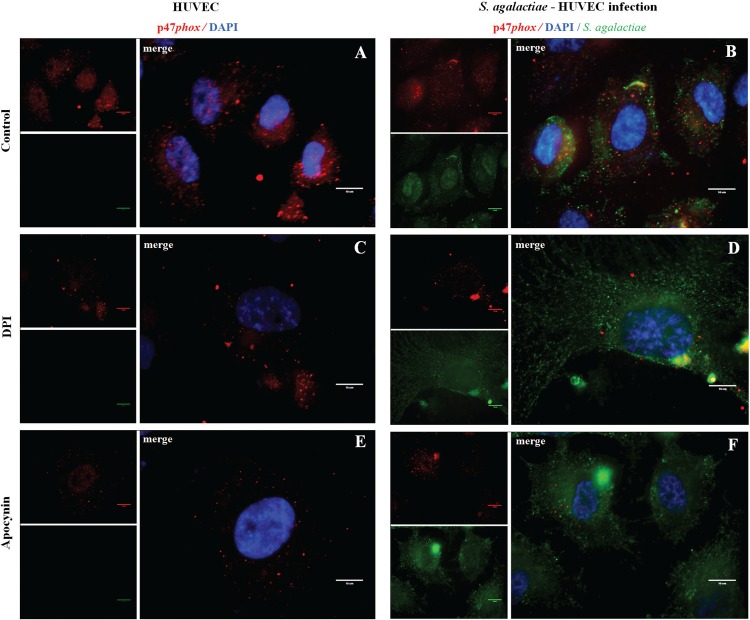
BACKGROUND Streptococcus agalactiae can causes sepsis, pneumonia, and meningitis in neonates, the elderly, and immunocompromised patients. Although the virulence properties of S. agalactiae have been partially elucidated, the molecular mechanisms related to reactive oxygen species (ROS) generation in infected human endothelial cells need further investigation. OBJECTIVES This study aimed to evaluate the influence of oxidative stress in human umbilical vein endothelial cells (HUVECs) during S. agalactiae infection. METHODS ROS production during S. agalactiae-HUVEC infection was detected using the probe CM-H2DCFDA. Microfilaments labelled with phalloidin-FITC and p47phox-Alexa 546 conjugated were analysed by immunofluorescence. mRNA levels of p47phox (NADPH oxidase subunit) were assessed using Real Time qRT-PCR. The adherence and intracellular viability of S. agalactiae in HUVECs with or without pre-treatment of DPI, apocynin (NADPH oxidase inhibitors), and LY294002 (PI3K inhibitor) were evaluated by penicillin/gentamicin exclusion. Phosphorylation of p47phox and Akt activation by S. agalactiae were evaluated by immunoblotting analysis. FINDINGS Data showed increased ROS production 15 min after HUVEC infection. Real-Time qRT-PCR and western blotting performed in HUVEC infected with S. agalactiae detected alterations in mRNA levels and activation of p47phox. Pre-treatment of endothelial cells with NADPH oxidase (DPI and apocynin) and PI3K/Akt pathway (LY294002) inhibitors reduced ROS production, bacterial intracellular viability, and generation of actin stress fibres in HUVECs infected with S. agalactiae. CONCLUSIONS ROS generation via the NADPH oxidase pathway contributes to invasion of S. agalactiae in human endothelial cells accompanied by cytoskeletal reorganisation through the PI3K/Akt pathway, which provides novel evidence for the involvement of oxidative stress in S. agalactiae pathogenesis.
无乳链球菌可在新生儿、老年人和免疫功能低下患者中引起败血症、肺炎和脑膜炎。尽管无乳链球菌的毒力特性已得到部分阐明,但与感染的人内皮细胞中活性氧(ROS)生成相关的分子机制仍需进一步研究。
本研究旨在评估无乳链球菌感染期间氧化应激对人脐静脉内皮细胞(HUVECs)的影响。
使用探针CM-H2DCFDA检测无乳链球菌-HUVEC感染期间的ROS产生。通过免疫荧光分析用鬼笔环肽-FITC和p47phox-Alexa 546偶联物标记的微丝。使用实时定量逆转录聚合酶链反应(Real Time qRT-PCR)评估p47phox(NADPH氧化酶亚基)的mRNA水平。通过青霉素/庆大霉素排除法评估有无预先用二苯基碘(DPI)、阿朴吗啡(NADPH氧化酶抑制剂)和LY294002(PI3K抑制剂)预处理的HUVECs中无乳链球菌的黏附及细胞内存活情况。通过免疫印迹分析评估无乳链球菌对p47phox的磷酸化作用和Akt激活情况。
数据显示HUVEC感染后15分钟ROS产生增加。在感染无乳链球菌的HUVEC中进行的实时定量逆转录聚合酶链反应和蛋白质印迹检测到mRNA水平的改变和p47phox的激活。用NADPH氧化酶(DPI和阿朴吗啡)和PI3K/Akt途径(LY294002)抑制剂预处理内皮细胞可减少感染无乳链球菌的HUVECs中的ROS产生、细菌细胞内存活及肌动蛋白应激纤维的生成。
通过NADPH氧化酶途径产生的ROS有助于无乳链球菌侵入人内皮细胞,并通过PI3K/Akt途径伴随细胞骨架重组,这为氧化应激参与无乳链球菌发病机制提供了新证据。