Hu Ting, Liu Cuiwei, Li Qiuhui, Xiong Jie, Ma Yuxi, Wu Gang, Zhao Yanxia
Cancer Center, Huazhong University of Science and Technology, Tongji Medical College, Union Hospital, Wuhan China.
Medicine (Baltimore). 2018 Apr;97(15):e0349. doi: 10.1097/MD.0000000000010349.
Brain metastasis (BM) is a rising challenge in forward-looking oncology, as its treatment choices are very limited, especially, after the failure of local treatment schemes.
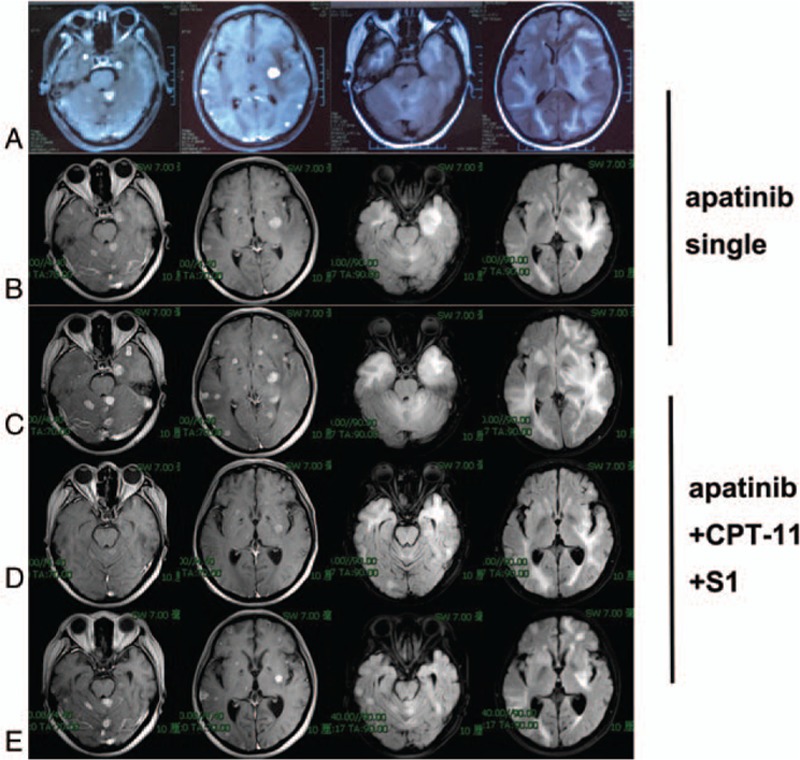
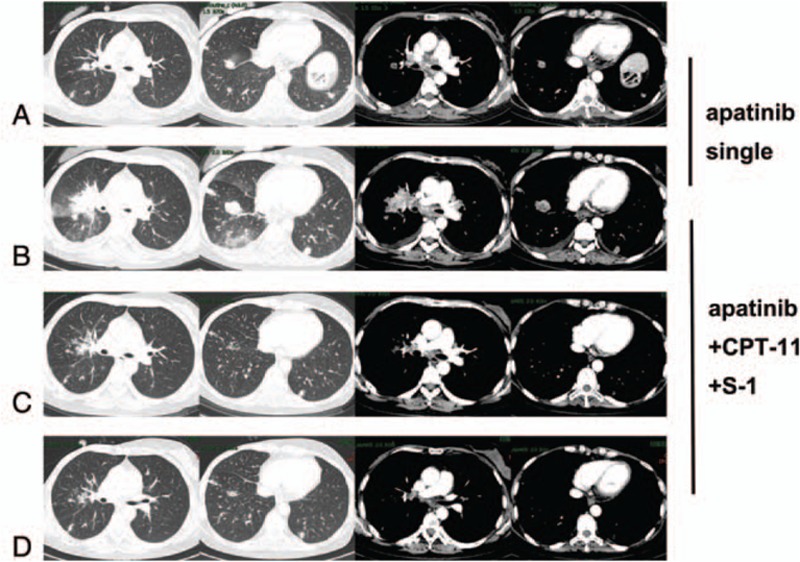
We report on a 39-year-old Chinese woman who was diagnosed with stage IV triple-negative breast cancer(TNBC) with multiple brain, lung, and bone metastases. She had previously, undergone whole-brain radiation therapy. Paclitaxel, platinum, UTD1, capecitabine, gemcitabine, vinorelbine, and single-agent apatinib were then administered as first- to fifth-line therapies. She exhibited progression each time after a short period of disease stabilization.
Triple-negative breast cancer.
The patient chose treatment with apatinib+CPT-11+S-1 as the sixth-line therapy.
A remarkable response of the brain, and lung metastases, and alleviation of the brain edema were achieved, and these effects persisted for 7 months.
We describe the significant anti-tumor effect of apatinib + CPT-11 + S-1 against BMs from breast cancer. This report is the first to suggest potential approaches to BM treatment using this scheme and describes the effects of an apatinib-containing regimen on BMs.
脑转移(BM)在前沿肿瘤学领域是一个日益严峻的挑战,因为其治疗选择非常有限,尤其是在局部治疗方案失败后。
我们报告了一名39岁的中国女性,她被诊断为IV期三阴性乳腺癌(TNBC),伴有多发脑、肺和骨转移。她之前接受过全脑放射治疗。随后,紫杉醇、铂类、UTD1、卡培他滨、吉西他滨、长春瑞滨和单药阿帕替尼作为一线至五线治疗药物使用。每次在疾病短暂稳定后,她都出现了病情进展。
三阴性乳腺癌。
患者选择阿帕替尼+伊立替康+S-1作为第六线治疗方案。
脑和肺转移灶有显著反应,脑水肿减轻,且这些效果持续了7个月。
我们描述了阿帕替尼+伊立替康+S-1对乳腺癌脑转移的显著抗肿瘤作用。本报告首次提出使用该方案治疗脑转移的潜在方法,并描述了含阿帕替尼方案对脑转移的疗效。