Ifakara Health Institute, Dar es Salaam, United Republic of Tanzania.
Swiss Tropical and Public Health Institute, Basel, Switzerland.
Immun Inflamm Dis. 2018 Jun;6(2):345-353. doi: 10.1002/iid3.222. Epub 2018 Apr 11.
The rising prevalence of Diabetes mellitus (DM) in high TB-endemic countries may adversely affect sustainability of TB control since DM constitutes a risk factor for development of active tuberculosis (TB). The impact of DM on TB specific adaptive immune responses remains poorly addressed, particularly in people living in Sub-Saharan countries. We performed a functional characterization of TB specific cellular immune response in Tanzanian subjects with active or latent Mycobacterium tuberculosis (Mtb) infection stratified by their diabetic status.
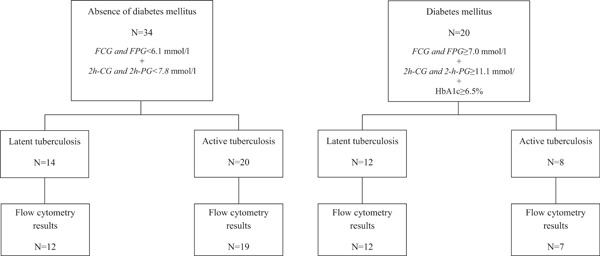
HIV negative active TB patients (≥18 years) with Xpert MTB/RIF positive pulmonary TB were included before starting TB treatment in Dar es Salaam, Tanzania between April and December 2013. HIV negative healthy controls latently infected with TB but without past TB history were also included. Active and latent TB patients were stratified in two groups according to their diabetic status. Peripheral Blood Mononuclear cells were stimulated with either live M. bovis BCG or Mtb-specific peptide pools and analyzed by intracellular cytokine staining and polychromatic flow cytometry.
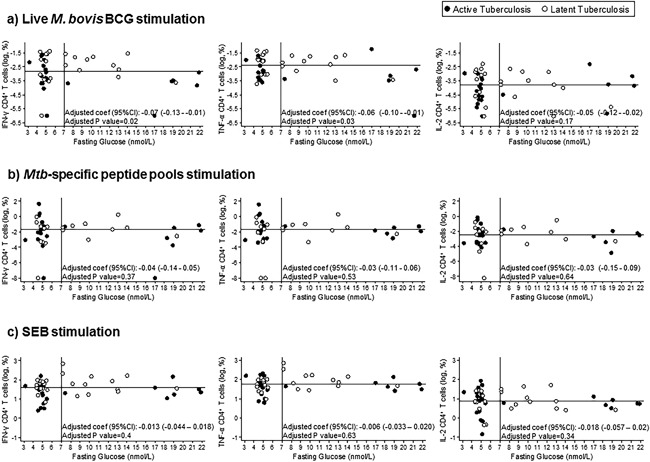
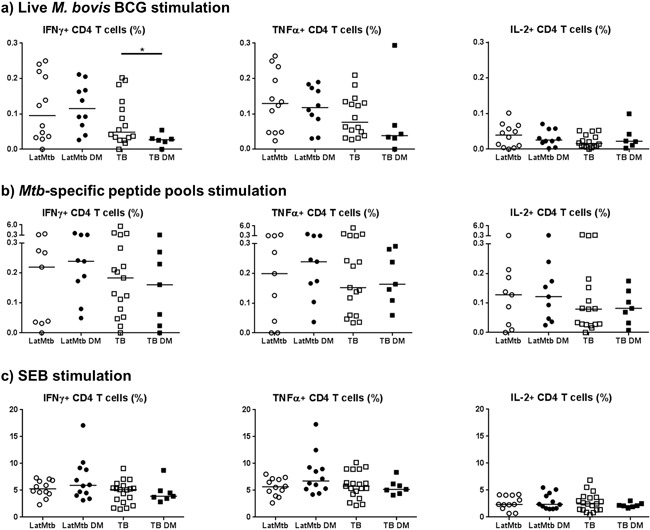
Our results show a lower frequency of IFN-γ CD4 T cells in patients with active TB and DM compared to patients with active TB only after live M. bovis BCG (p = 0.04) but not after Mtb peptide pools re-stimulation. Irrespective of TB status, level of glycaemia is selectively inversely correlated with IFN-γ and TNF-α CD4 T cell production (p = 0.02 and p = 0.03) after live M. bovis BCG stimulation.
These results support the hypothesis that hyperglycaemia negatively impacts antigen processing and/or presentation of whole mycobacteria delaying secretion of key cytokines involved in TB immunity.
在高结核病流行国家,糖尿病(DM)的患病率不断上升,可能会对结核病控制的可持续性产生不利影响,因为 DM 是发展为活动性结核病(TB)的一个危险因素。DM 对 TB 特异性适应性免疫反应的影响仍未得到充分解决,特别是在撒哈拉以南国家的人群中。我们对坦桑尼亚有或没有潜伏性结核分枝杆菌(Mtb)感染的 DM 患者进行了结核特异性细胞免疫反应的功能特征分析,这些患者根据其糖尿病状态进行了分层。
2013 年 4 月至 12 月期间,在坦桑尼亚达累斯萨拉姆,我们纳入了 Xpert MTB/RIF 阳性肺结核的 HIV 阴性活动性 TB 患者(≥18 岁),这些患者在开始抗 TB 治疗前有或没有潜伏性 TB 感染。我们还纳入了 HIV 阴性但没有 TB 病史的健康对照者。根据他们的糖尿病状态,将活动性和潜伏性 TB 患者分为两组。用活牛分枝杆菌 BCG 或 Mtb 特异性肽库刺激外周血单核细胞,并用细胞内细胞因子染色和多色流式细胞术进行分析。
我们的结果显示,与仅患有活动性 TB 的患者相比,患有活动性 TB 和 DM 的患者在接受活牛分枝杆菌 BCG 刺激后,IFN-γ CD4 T 细胞的频率较低(p=0.04),但在接受 Mtb 肽库再刺激后则不然。无论 TB 状态如何,血糖水平与 IFN-γ和 TNF-α CD4 T 细胞产生呈选择性负相关(p=0.02 和 p=0.03),这与活牛分枝杆菌 BCG 刺激后有关。
这些结果支持了这样一种假设,即高血糖会对整个分枝杆菌的抗原加工和/或呈递产生负面影响,从而延迟与 TB 免疫相关的关键细胞因子的分泌。