National Institute for Communicable Disease Control and Prevention, Chinese Center for Disease Control and Prevention/State Key Laboratory for Infectious Disease Prevention and Control, Beijing, China ; Collaborative Innovation Center for Diagnosis and Treatment of Infectious Diseases, Hangzhou, China.
PLoS One. 2013 Aug 19;8(8):e71243. doi: 10.1371/journal.pone.0071243. eCollection 2013.
Although the Bacillus Calmette-Guérin (BCG) vaccine against tuberculosis (TB) has been available for more than 75 years, one third of the world's population is still infected with Mycobacterium tuberculosis and approximately 2 million people die of TB every year. To reduce this immense TB burden, a clearer understanding of the functional genes underlying the action of BCG and the development of new vaccines are urgently needed.
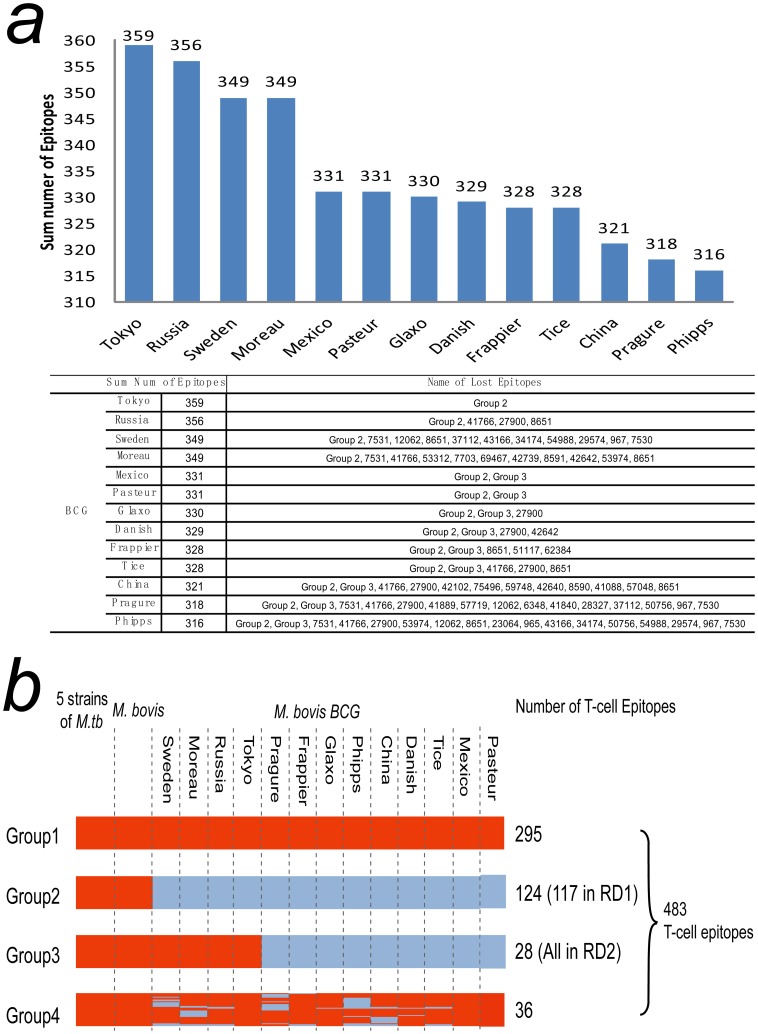
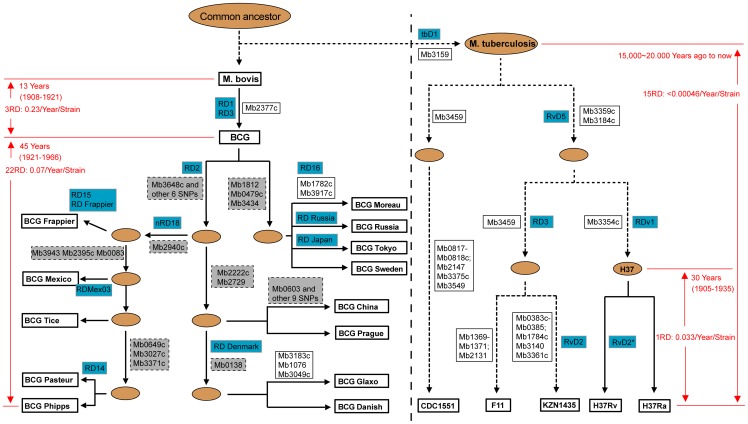
Comparative genomic analysis of 19 M. tuberculosis complex strains showed that BCG strains underwent repeated human manipulation, had higher region of deletion rates than those of natural M. tuberculosis strains, and lost several essential components such as T-cell epitopes. A total of 188 BCG strain T-cell epitopes were lost to various degrees. The non-virulent BCG Tokyo strain, which has the largest number of T-cell epitopes (359), lost 124. Here we propose that BCG strain protection variability results from different epitopes. This study is the first to present BCG as a model organism for genetics research. BCG strains have a very well-documented history and now detailed genome information. Genome comparison revealed the selection process of BCG strains under human manipulation (1908-1966).
Our results revealed the cause of BCG vaccine strain protection variability at the genome level and supported the hypothesis that the restoration of lost BCG Tokyo epitopes is a useful future vaccine development strategy. Furthermore, these detailed BCG vaccine genome investigation results will be useful in microbial genetics, microbial engineering and other research fields.
尽管卡介苗(BCG)预防结核病(TB)已有 75 多年的历史,但全球仍有三分之一的人口感染结核分枝杆菌,每年约有 200 万人死于结核病。为了减轻这一巨大的结核病负担,迫切需要更清楚地了解 BCG 作用的功能基因,并开发新的疫苗。
对 19 株结核分枝杆菌复合群菌株进行比较基因组分析表明,BCG 菌株经历了反复的人类操作,其缺失区域的比例高于天然结核分枝杆菌菌株,并且失去了几个重要的组成部分,如 T 细胞表位。共有 188 个 BCG 菌株 T 细胞表位不同程度地丢失。非毒性 BCG 东京株具有最多的 T 细胞表位(359 个),丢失了 124 个。我们提出,BCG 菌株的保护变异性是由于不同的表位造成的。本研究首次将 BCG 作为遗传研究的模式生物进行研究。BCG 菌株有着非常详细的历史和现在的详细基因组信息。基因组比较揭示了 BCG 菌株在人类操作下(1908-1966 年)的选择过程。
我们的研究结果揭示了 BCG 疫苗菌株在基因组水平上保护变异性的原因,并支持了这样一种假设,即恢复丢失的 BCG 东京表位是一种有用的未来疫苗开发策略。此外,这些详细的 BCG 疫苗基因组研究结果将有助于微生物遗传学、微生物工程和其他研究领域。