Institute of Image Communication and Information Processing, Shanghai Jiao Tong University, Shanghai 200240, China.
Sensors (Basel). 2018 Apr 7;18(4):1126. doi: 10.3390/s18041126.
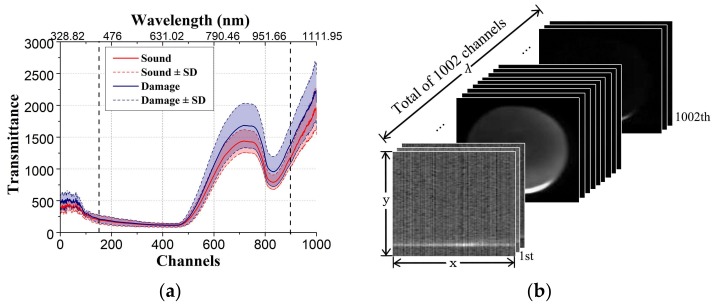
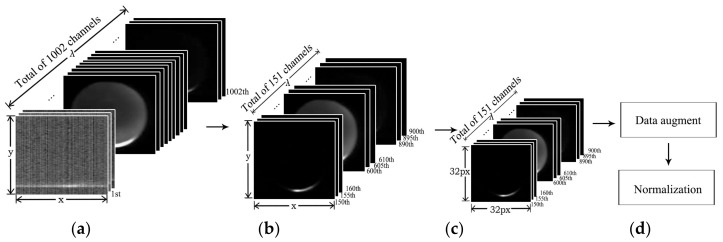
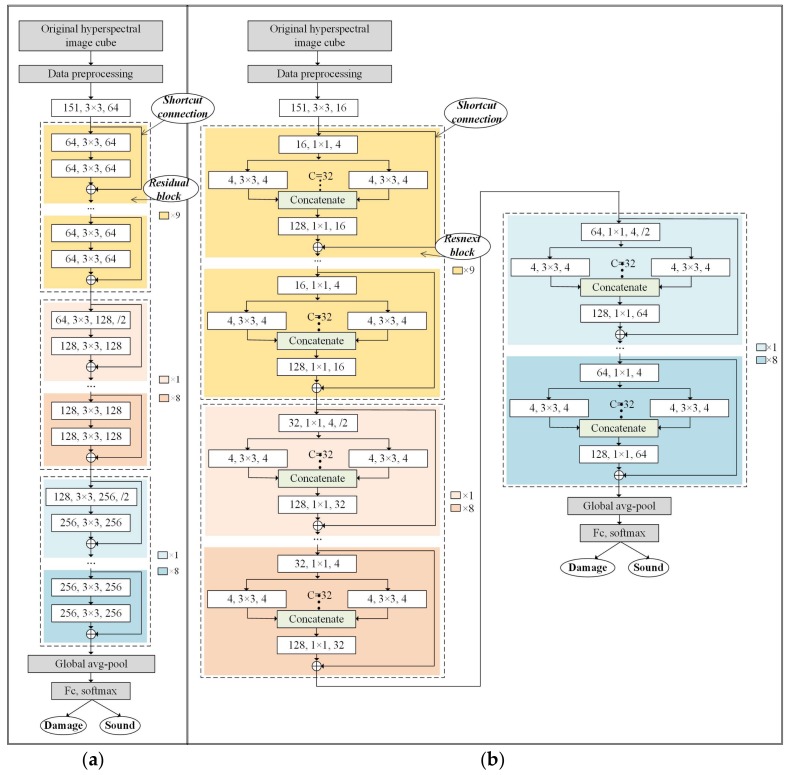
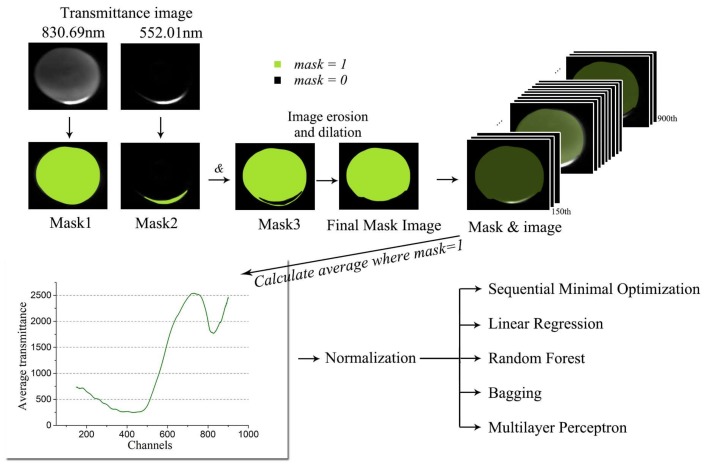
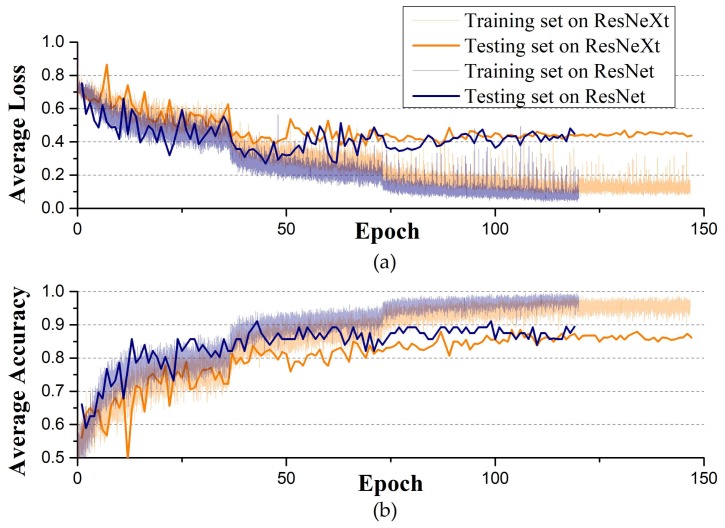
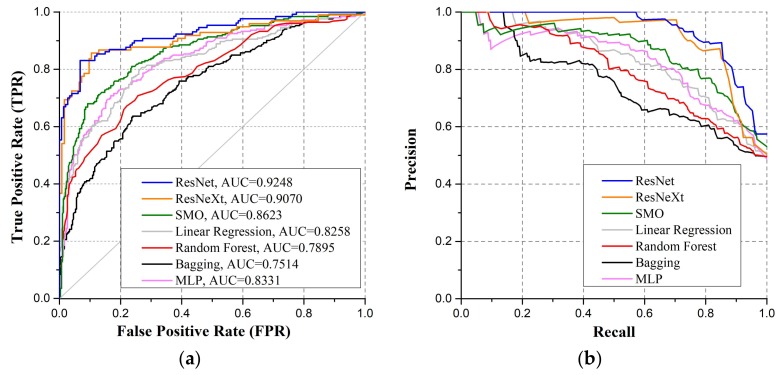
Deep learning has become a widely used powerful tool in many research fields, although not much so yet in agriculture technologies. In this work, two deep convolutional neural networks (CNN), viz. Residual Network (ResNet) and its improved version named ResNeXt, are used to detect internal mechanical damage of blueberries using hyperspectral transmittance data. The original structure and size of hypercubes are adapted for the deep CNN training. To ensure that the models are applicable to hypercube, we adjust the number of filters in the convolutional layers. Moreover, a total of 5 traditional machine learning algorithms, viz. Sequential Minimal Optimization (SMO), Linear Regression (LR), Random Forest (RF), Bagging and Multilayer Perceptron (MLP), are performed as the comparison experiments. In terms of model assessment, k-fold cross validation is used to indicate that the model performance does not vary with the different combination of dataset. In real-world application, selling damaged berries will lead to greater interest loss than discarding the sound ones. Thus, precision, recall, and F1-score are also used as the evaluation indicators alongside accuracy to quantify the false positive rate. The first three indicators are seldom used by investigators in the agricultural engineering domain. Furthermore, ROC curves and Precision-Recall curves are plotted to visualize the performance of classifiers. The fine-tuned ResNet/ResNeXt achieve average accuracy and F1-score of 0.8844/0.8784 and 0.8952/0.8905, respectively. Classifiers SMO/ LR/RF/Bagging/MLP obtain average accuracy and F1-score of 0.8082/0.7606/0.7314/0.7113/0.7827 and 0.8268/0.7796/0.7529/0.7339/0.7971, respectively. Two deep learning models achieve better classification performance than the traditional machine learning methods. Classification for each testing sample only takes 5.2 ms and 6.5 ms respectively for ResNet and ResNeXt, indicating that the deep learning framework has great potential for online fruit sorting. The results of this study demonstrate the potential of deep CNN application on analyzing the internal mechanical damage of fruit.
深度学习已经成为许多研究领域广泛使用的强大工具,尽管在农业技术领域还没有那么多。在这项工作中,使用了两种深度卷积神经网络(CNN),即残差网络(ResNet)及其改进版本 ResNeXt,使用高光谱透射数据检测蓝莓的内部机械损伤。为了确保模型适用于超立方体,我们调整了卷积层中的滤波器数量。此外,还进行了总共 5 种传统机器学习算法,即顺序最小优化(SMO)、线性回归(LR)、随机森林(RF)、袋装和多层感知器(MLP),作为比较实验。在模型评估方面,使用 k 折交叉验证来表示模型性能不会随数据集的不同组合而变化。在实际应用中,销售受损的浆果会比丢弃完好的浆果导致更大的利益损失。因此,除了准确性之外,还使用精度、召回率和 F1 分数作为评估指标来量化误报率。前三个指标在农业工程领域的研究人员中很少使用。此外,绘制 ROC 曲线和精度-召回率曲线来可视化分类器的性能。微调的 ResNet/ResNeXt 分别达到 0.8844/0.8784 和 0.8952/0.8905 的平均准确率和 F1 分数。分类器 SMO/LR/RF/袋装/MLP 获得 0.8082/0.7606/0.7314/0.7113/0.7827 和 0.8268/0.7796/0.7529/0.7339/0.7971 的平均准确率和 F1 分数。两个深度学习模型的分类性能优于传统的机器学习方法。对于每个测试样本,ResNet 和 ResNeXt 的分类分别仅需 5.2 毫秒和 6.5 毫秒,这表明深度学习框架在在线水果分拣方面具有很大的潜力。这项研究的结果表明了深度卷积神经网络在分析水果内部机械损伤方面的应用潜力。