1 Department of Neurology, Chinese PLA General Hospital, Beijing, China.
2 School of Medicine, Nankai University, Tianjin, China.
Mol Pain. 2018 Jan-Dec;14:1744806918767697. doi: 10.1177/1744806918767697. Epub 2018 Apr 12.
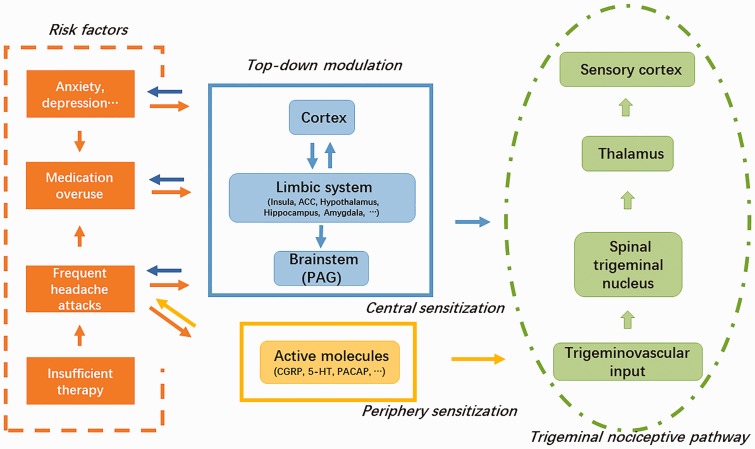
Chronic migraine is a common chronic daily headache featured by frequent headache attacks with at least 15 headache days per month, which brings great disease burden to both the sufferers and the society. Transformed from episodic migraine, the pathophysiology of chronic migraine is not fully understood, even though several risk factors have been associated with migraine progression. Recent studies have identified both structural and functional alterations in some brain regions of chronic migraine patients indicating that maladaptation of the top-down pain modulation and subsequent sensitization of trigeminal system may be important in the pathogenesis of chronic migraine. Moreover, biochemical analysis has confirmed several molecules related to chronic migraine, which may serve as biomarkers and potential therapeutic targets. Chronic migraine is undertreated because of its poor treatment response and limited therapy options. In this article, we reviewed the latest data to outline the clinical feature, pathophysiological mechanism, and management of chronic migraine, in the expectation to provide direction for future research and finally to take good care of chronic migraine patients.
慢性偏头痛是一种常见的慢性每日头痛,其特征为每月至少 15 天头痛发作,给患者和社会带来了巨大的疾病负担。慢性偏头痛由发作性偏头痛转变而来,其病理生理学尚未完全阐明,尽管已经有几个风险因素与偏头痛进展相关。最近的研究已经确定了慢性偏头痛患者一些大脑区域的结构和功能改变,表明上位疼痛调节的适应不良和随后三叉神经系统的敏化可能在慢性偏头痛的发病机制中起重要作用。此外,生化分析已经证实了与慢性偏头痛相关的几种分子,这些分子可能作为生物标志物和潜在的治疗靶点。由于慢性偏头痛的治疗反应较差和治疗选择有限,其治疗往往不足。本文综述了最新数据,概述了慢性偏头痛的临床特征、病理生理机制和治疗管理,以期为未来的研究提供方向,最终为慢性偏头痛患者提供更好的护理。