Institute of Biotechnology, University of Helsinki, P.O. Box 56 (Viikinkaari 5), FI-00014, Helsinki, Finland.
Faculty of Medicine and Life Sciences, Tampere, Finland.
BMC Bioinformatics. 2018 Apr 11;19(1):130. doi: 10.1186/s12859-018-2122-5.
In-depth study of the intron retention levels of transcripts provide insights on the mechanisms regulating pre-mRNA splicing efficiency. Additionally, detailed analysis of retained introns can link these introns to post-transcriptional regulation or identify aberrant splicing events in human diseases.
We present IntEREst, Intron-Exon Retention Estimator, an R package that supports rigorous analysis of non-annotated intron retention events (in addition to the ones annotated by RefSeq or similar databases), and support intra-sample in addition to inter-sample comparisons. It accepts binary sequence alignment/map (.bam) files as input and determines genome-wide estimates of intron retention or exon-exon junction levels. Moreover, it includes functions for comparing subsets of user-defined introns (e.g. U12-type vs U2-type) and its plotting functions allow visualization of the distribution of the retention levels of the introns. Statistical methods are adapted from the DESeq2, edgeR and DEXSeq R packages to extract the significantly more or less retained introns. Analyses can be performed either sequentially (on single core) or in parallel (on multiple cores). We used IntEREst to investigate the U12- and U2-type intron retention in human and plant RNAseq dataset with defects in the U12-dependent spliceosome due to mutations in the ZRSR2 component of this spliceosome. Additionally, we compared the retained introns discovered by IntEREst with that of other methods and studies.
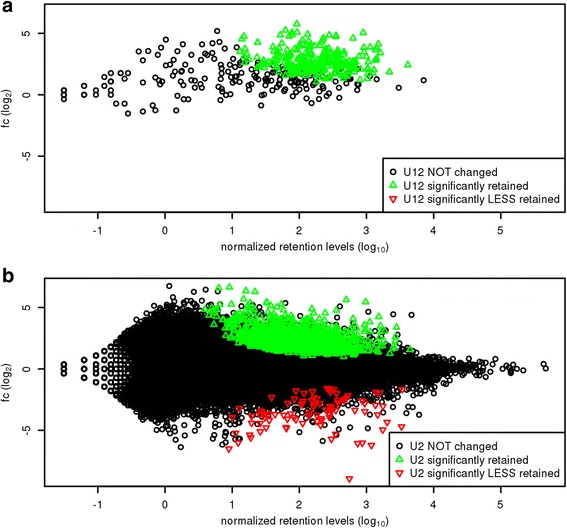
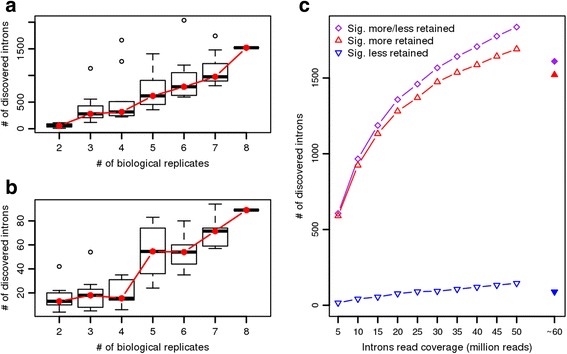
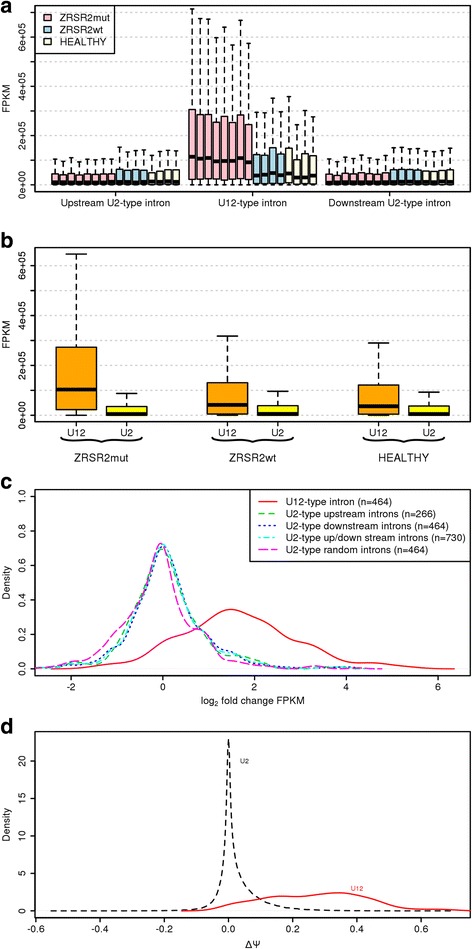
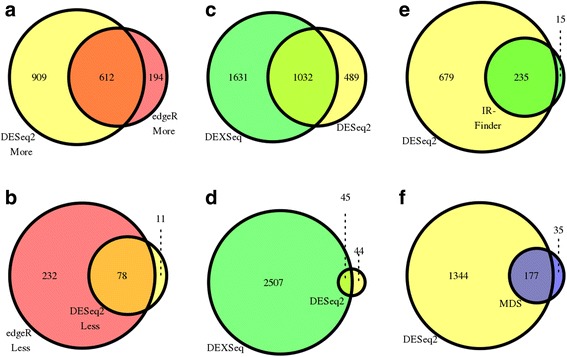
IntEREst is an R package for Intron retention and exon-exon junction levels analysis of RNA-seq data. Both the human and plant analyses show that the U12-type introns are retained at higher level compared to the U2-type introns already in the control samples, but the retention is exacerbated in patient or plant samples carrying a mutated ZRSR2 gene. Intron retention events caused by ZRSR2 mutation that we discovered using IntEREst (DESeq2 based function) show considerable overlap with the retained introns discovered by other methods (e.g. IRFinder and edgeR based function of IntEREst). Our results indicate that increase in both the number of biological replicates and the depth of sequencing library promote the discovery of retained introns, but the effect of library size gradually decreases with more than 35 million reads mapped to the introns.
深入研究转录本的内含子保留水平可以深入了解调节前体 mRNA 剪接效率的机制。此外,对保留内含子的详细分析可以将这些内含子与转录后调控联系起来,或者在人类疾病中识别异常剪接事件。
我们提出了 IntEREst,即内含子-外显子保留估算器,这是一个 R 包,支持对非注释内含子保留事件(除了 RefSeq 或类似数据库注释的事件)进行严格分析,并支持样本内比较以及样本间比较。它接受二进制序列比对/映射 (.bam) 文件作为输入,并确定全基因组内含子保留或外显子-外显子连接水平的估计值。此外,它还包括用于比较用户定义的内含子子集(例如 U12 型与 U2 型)的功能,其绘图功能允许可视化内含子保留水平的分布。统计方法是从 DESeq2、edgeR 和 DEXSeq R 包中改编而来的,用于提取显著更多或更少保留的内含子。分析可以顺序(在单个核上)或并行(在多个核上)进行。我们使用 IntEREst 研究了由于 U12 依赖性剪接体中 ZRSR2 成分的突变导致 U12 依赖性剪接体缺陷的人类和植物 RNAseq 数据集的 U12 型和 U2 型内含子保留情况。此外,我们还将 IntEREst 发现的保留内含子与其他方法和研究进行了比较。
IntEREst 是一个用于分析 RNA-seq 数据中内含子保留和外显子-外显子连接水平的 R 包。人类和植物的分析都表明,与对照样本中的 U2 型内含子相比,U12 型内含子的保留水平更高,但在携带突变 ZRSR2 基因的患者或植物样本中,保留水平加剧。我们使用 IntEREst(基于 DESeq2 的功能)发现的由 ZRSR2 突变引起的内含子保留事件与其他方法(例如,IRFinder 和基于 IntEREst 的 edgeR 功能)发现的保留内含子有相当大的重叠。我们的结果表明,增加生物重复的数量和测序文库的深度可以促进保留内含子的发现,但随着映射到内含子的读段数超过 3500 万,文库大小的影响逐渐减小。