Fratini Sara, Ragionieri Lapo, Deli Temim, Harrer Alexandra, Marino Ilaria A M, Cannicci Stefano, Zane Lorenzo, Schubart Christoph D
Department of Biology, University of Florence, via Madonna del Piano 6, Sesto Fiorentino, Firenze, 50019, Italy.
Institute for Zoology, Functional Peptidomics, University of Cologne, Cologne, Germany.
BMC Evol Biol. 2016 Jul 26;16:150. doi: 10.1186/s12862-016-0720-2.
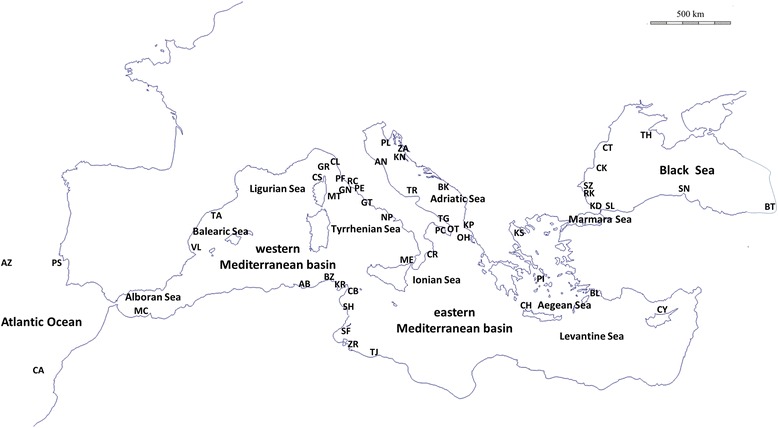
The extent of genetic structure of a species is determined by the amount of current gene flow and the impact of historical and demographic factors. Most marine invertebrates have planktonic larvae and consequently wide potential dispersal, so that genetic uniformity should be common. However, phylogeographic investigations reveal that panmixia is rare in the marine realm. Phylogeographic patterns commonly coincide with geographic transitions acting as barriers to gene flow. In the Mediterranean Sea and adjoining areas, the best known barriers are the Atlantic-Mediterranean transition, the Siculo-Tunisian Strait and the boundary between Aegean and Black seas. Here, we perform the so far broadest phylogeographic analysis of the crab Pachygrapsus marmoratus, common across the north-eastern Atlantic Ocean, Mediterranean and Black seas. Previous studies revealed no or weak genetic structuring at meso-geographic scale based on mtDNA, while genetic heterogeneity at local scale was recorded with microsatellites, even if without clear geographic patterns. Continuing the search for phylogeographic signal, we here enlarge the mtDNA dataset including 51 populations and covering most of the species' distribution range.
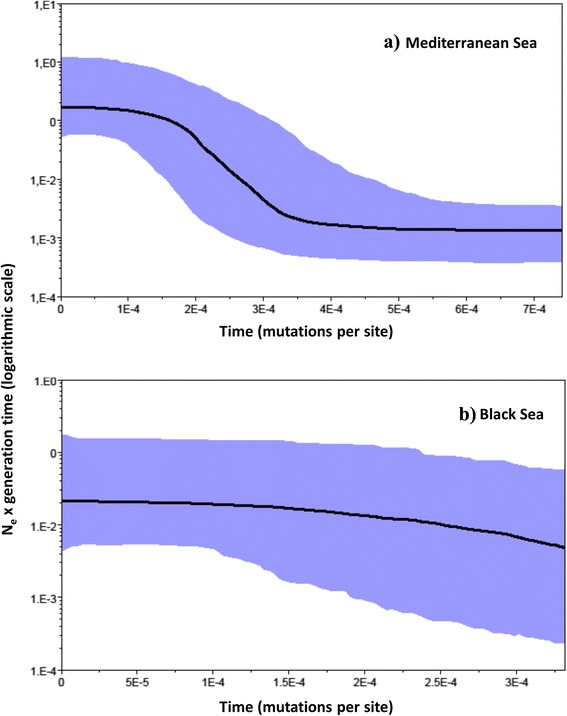
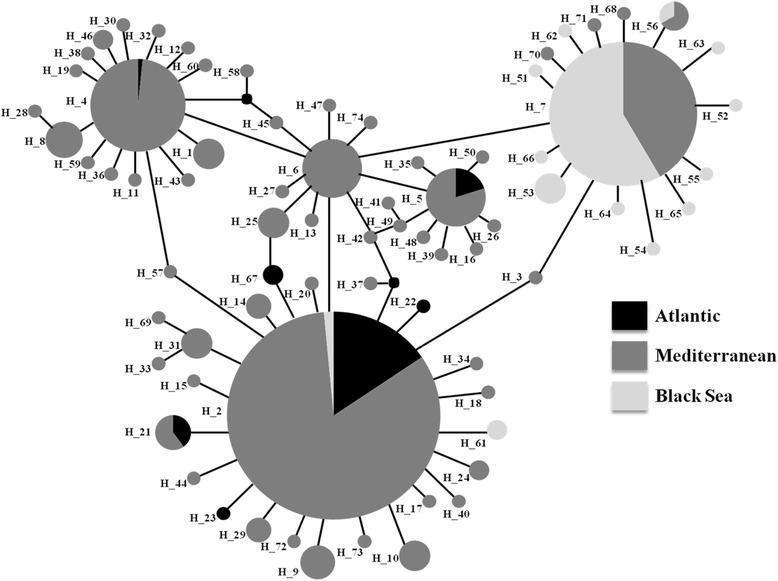
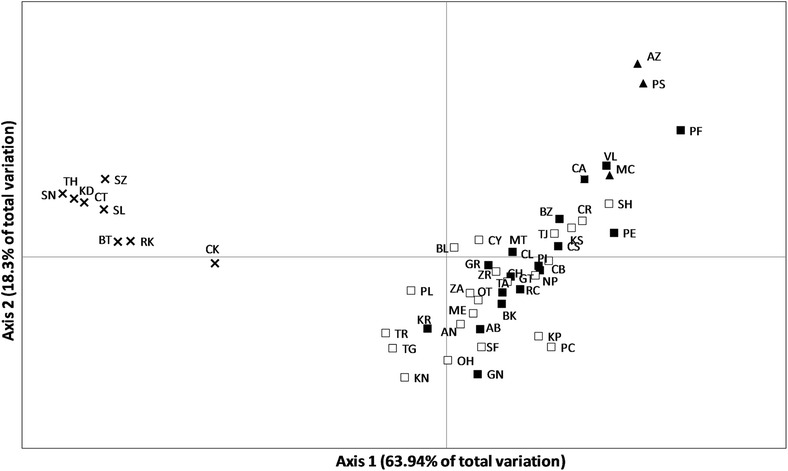
This enlarged dataset provides new evidence of three genetically separable groups, corresponding to the Portuguese Atlantic Ocean, Mediterranean Sea plus Canary Islands, and Black Sea. Surprisingly, hierarchical AMOVA and Principal Coordinates Analysis agree that our Canary Islands population is closer to western Mediterranean populations than to mainland Portugal and Azores populations. Within the Mediterranean Sea, we record genetic homogeneity, suggesting that population connectivity is unaffected by the transition between the western and eastern Mediterranean. The Mediterranean metapopulation seems to have experienced a relatively recent expansion around 100,000 years ago.
Our results suggest that the phylogeographic pattern of P. marmoratus is shaped by the geological history of Mediterranean and adjacent seas, restricted current gene flow among different marginal seas, and incomplete lineage sorting. However, they also caution from exclusively testing well-known biogeographic barriers, thereby neglecting other possible phylogeographic patterns. Mostly, this study provides evidence that a geographically exhaustive dataset is necessary to detect shallow phylogeographic structure within widespread marine species with larval dispersal, questioning all studies where species have been categorized as panmictic based on numerically and geographically limited datasets.
一个物种的遗传结构程度由当前基因流的数量以及历史和人口因素的影响所决定。大多数海洋无脊椎动物具有浮游幼虫,因此具有广泛的潜在扩散能力,所以遗传一致性应该较为常见。然而,系统发育地理学研究表明,随机交配在海洋领域中很少见。系统发育地理模式通常与作为基因流障碍的地理过渡相吻合。在地中海及毗邻地区,最著名的障碍是大西洋 - 地中海过渡区、西西里 - 突尼斯海峡以及爱琴海和黑海之间的边界。在此,我们对在东北大西洋、地中海和黑海均有分布的大理石厚纹蟹进行了迄今为止最广泛的系统发育地理学分析。先前的研究基于线粒体DNA揭示在中地理尺度上没有或仅有微弱的遗传结构,而利用微卫星标记在局部尺度上记录到了遗传异质性,即便没有明确的地理模式。为了继续寻找系统发育地理信号,我们在此扩大了线粒体DNA数据集,包括51个种群,覆盖了该物种分布范围的大部分区域。
这个扩大后的数据集提供了三个遗传上可分离群体的新证据,分别对应葡萄牙大西洋区域、地中海加加那利群岛以及黑海。令人惊讶的是,层次化AMOVA分析和主坐标分析均表明,我们的加那利群岛种群与地中海西部种群的亲缘关系比与葡萄牙大陆和亚速尔群岛种群更近。在地中海内部,我们记录到了遗传一致性,这表明种群连通性不受地中海西部和东部之间过渡的影响。地中海复合种群似乎在大约10万年前经历了一次相对较新的扩张。
我们的结果表明,大理石厚纹蟹的系统发育地理模式是由地中海及邻近海域的地质历史、不同边缘海之间当前有限的基因流以及不完全的谱系分选所塑造的。然而,这些结果也提醒我们不要仅仅测试著名的生物地理障碍,从而忽略其他可能的系统发育地理模式。总体而言,本研究提供了证据表明,对于具有幼虫扩散能力的广泛分布海洋物种,要检测其浅层系统发育地理结构,需要一个涵盖地理范围详尽的数据集,这对所有基于数量和地理范围有限的数据集将物种归类为随机交配的研究提出了质疑。