Hegde Harihar Vishwanath, Bandi Joshiraj, Mudakanagoudar Mahantesh S, Honnannavar Kiran A
Department of Anaesthesiology, SDM College of Medical Sciences and Hospital, Dharwad, Karnataka, India.
Indian J Anaesth. 2018 Mar;62(3):173-181. doi: 10.4103/ija.IJA_691_17.
Airway used in prone position should be efficacious and safe. The Streamlined Liner of the Pharynx Airway (SLIPA™) and Laryngeal Mask Airway-ProSeal (PLMA) provide better airway seal and protection against aspiration. We planned to evaluate the performance of SLIPA™, PLMA and endotracheal tube (ETT) in prone position.
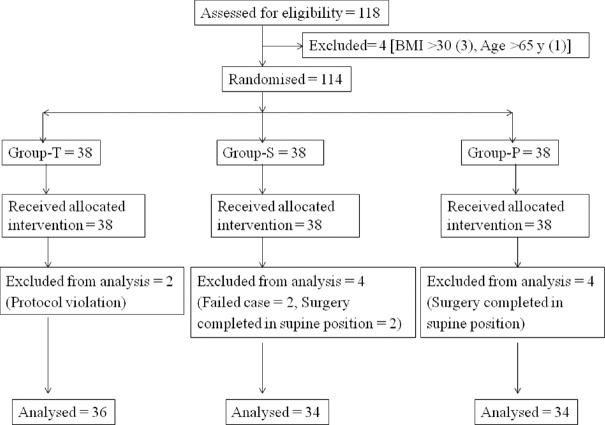
114 adult patients undergoing elective surgery in prone position under general anaesthesia were randomised into Group-T (ETT), Group-S (SLIPA™) and Group-P (PLMA). Airways were inserted in supine position and patients turned prone subsequently. Airway characteristics, ventilatory parameters and complications were noted. One-way analysis of variance, Mann-Whitney U-test and Chi-square or Fisher's exact test were used.
Tidal volumes, peak airway pressure and compliance were comparable at all times. Leak pressure was significantly higher ( < 0.001) in Group-T (mean leak pressure = 40 cmHO) when compared to Group-S and Group-P at all the times of recording, and there was no significant difference between Group-S and Group-P. The number of patients requiring airway/neck manipulation in prone position was significantly higher ( < 0.001) in Group-S (19 [55.9%]) when the three groups were compared (none in Group-T) and in comparison with Group-P (5 [14.7%], < 0.001). On airway removal, the incidence of complications and airway reaction was significantly higher in Group-T. Group-S had a significantly higher incidence of dysphagia at 2 h postoperatively.
ETT was most efficacious. SLIPA™ and PLMA were efficacious, safe and less stimulating to the airway during removal. More patients required SLIPA™ airway/neck manipulation.
俯卧位通气时使用的气道应有效且安全。咽气道流线型衬垫(SLIPA™)和喉罩气道-双管型(PLMA)能提供更好的气道密封效果并防止误吸。我们计划评估SLIPA™、PLMA和气管内导管(ETT)在俯卧位时的性能。
114例在全身麻醉下接受择期俯卧位手术的成年患者被随机分为T组(ETT)、S组(SLIPA™)和P组(PLMA)。气道在仰卧位时插入,随后患者转为俯卧位。记录气道特征、通气参数和并发症。采用单因素方差分析、曼-惠特尼U检验和卡方检验或费舍尔精确检验。
潮气量、气道峰压和顺应性在各时间点均具有可比性。在所有记录时间点,T组的漏气压力均显著高于S组和P组(<0.001)(平均漏气压力=40 cmH₂O),S组和P组之间无显著差异。在比较三组时,S组(19例[55.9%])在俯卧位时需要气道/颈部操作的患者数量显著高于T组(无)(<0.001),与P组(5例[14.7%])相比也显著更高(<0.001)。在拔除气道时,T组并发症和气道反应的发生率显著更高。S组术后2小时吞咽困难的发生率显著更高。
ETT最为有效。SLIPA™和PLMA有效、安全,且在拔除时对气道的刺激较小。更多患者需要对SLIPA™进行气道/颈部操作。