Baracchi David, Rigosi Elisa, de Brito Sanchez Gabriela, Giurfa Martin
Centre de Recherches sur la Cognition Animale, Centre de Biologie Intégrative (CBI), Université Toulouse III Paul Sabatier, Toulouse, France.
Centre National de la Recherche Scientifique, Université Paul Sabatier, Toulouse, France.
Front Psychol. 2018 Mar 28;9:425. doi: 10.3389/fpsyg.2018.00425. eCollection 2018.
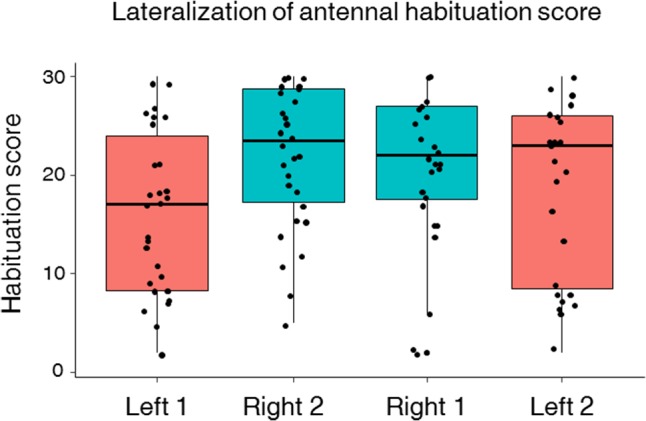
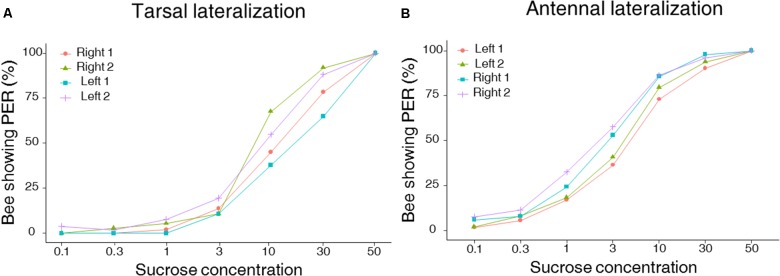
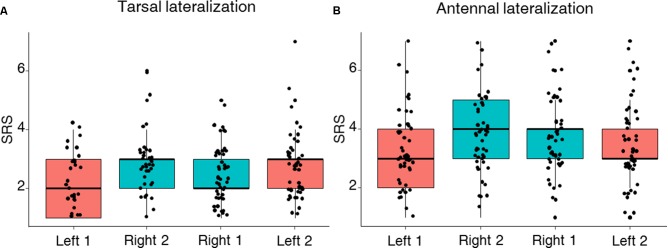
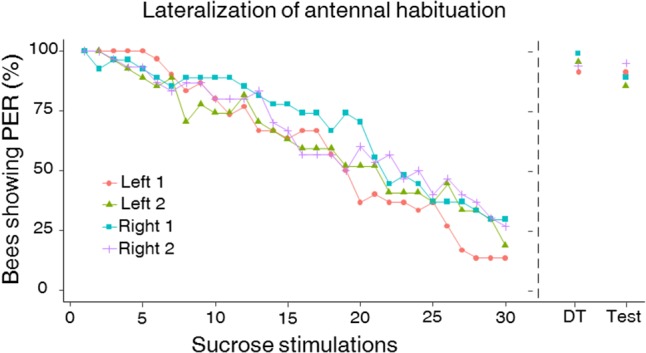
Lateralization is a fundamental property of the human brain that affects perceptual, motor, and cognitive processes. It is now acknowledged that left-right laterality is widespread across vertebrates and even some invertebrates such as fruit flies and bees. Honeybees, which learn to associate an odorant (the conditioned stimulus, CS) with sucrose solution (the unconditioned stimulus, US), recall this association better when trained using their right antenna than they do when using their left antenna. Correspondingly, olfactory sensilla are more abundant on the right antenna and odor encoding by projection neurons of the right antennal lobe results in better odor differentiation than those of the left one. Thus, lateralization arises from asymmetries both in the peripheral and central olfactory system, responsible for detecting the CS. Here, we focused on the US component and studied if lateralization exists in the gustatory system of . We investigated whether sucrose sensitivity is lateralized both at the level of the antennae and the fore-tarsi in two independent groups of bees. Sucrose sensitivity was assessed by presenting bees with a series of increasing concentrations of sucrose solution delivered either to the left or the right antenna/tarsus and measuring the proboscis extension response to these stimuli. Bees experienced two series of stimulations, one on the left and the other on the right antenna/tarsus. We found that tarsal responsiveness was similar on both sides and that the order of testing affects sucrose responsiveness. On the contrary, antennal responsiveness to sucrose was higher on the right than on the left side, and this effect was independent of the order of antennal stimulation. Given this asymmetry, we also investigated antennal lateralization of habituation to sucrose. We found that the right antenna was more resistant to habituation, which is consistent with its higher sucrose sensitivity. Our results reveal that the gustatory system presents a peripheral lateralization that affects stimulus detection and non-associative learning. Contrary to the olfactory system, which is organized in two distinct brain hemispheres, gustatory receptor neurons converge into a single central region termed the subesophagic zone (SEZ). Whether the SEZ presents lateralized gustatory processing remains to be determined.
偏侧化是人类大脑的一种基本特性,会影响感知、运动和认知过程。现在人们认识到,左右偏侧性在脊椎动物中广泛存在,甚至在一些无脊椎动物如果蝇和蜜蜂中也存在。蜜蜂学会将一种气味剂(条件刺激,CS)与蔗糖溶液(非条件刺激,US)联系起来,当使用其右触角进行训练时,比使用左触角时能更好地回忆起这种联系。相应地,右触角上的嗅觉感受器更丰富,右触角叶的投射神经元对气味的编码导致比左触角叶更好的气味辨别。因此,偏侧化源于负责检测CS的外周和中枢嗅觉系统中的不对称性。在这里,我们关注非条件刺激成分,并研究了蜜蜂的味觉系统中是否存在偏侧化。我们在两组独立的蜜蜂中研究了蔗糖敏感性在触角和前跗节水平上是否存在偏侧化。通过向蜜蜂的左或右触角/跗节提供一系列浓度递增的蔗糖溶液,并测量对这些刺激的喙伸展反应来评估蔗糖敏感性。蜜蜂经历了两组刺激,一组在左触角/跗节,另一组在右触角/跗节。我们发现跗节两侧的反应性相似,并且测试顺序会影响蔗糖反应性。相反,触角对蔗糖的反应性右侧高于左侧,并且这种效应与触角刺激顺序无关。鉴于这种不对称性,我们还研究了对蔗糖习惯化过程中的触角偏侧化。我们发现右触角对习惯化更具抵抗力,这与其较高的蔗糖敏感性一致。我们的结果表明,味觉系统存在一种外周偏侧化,它会影响刺激检测和非联想学习。与在两个不同脑半球中组织的嗅觉系统相反,味觉受体神经元汇聚到一个称为咽下神经节(SEZ)的单一中央区域。SEZ是否存在偏侧化的味觉处理仍有待确定。