• 文献检索
  • 文档翻译
  • 深度研究
  • 学术资讯
  • Suppr Zotero 插件Zotero 插件
  • 邀请有礼
  • 套餐&价格
  • 历史记录
应用&插件
Suppr Zotero 插件Zotero 插件浏览器插件Mac 客户端Windows 客户端微信小程序
定价
高级版会员购买积分包购买API积分包
服务
文献检索文档翻译深度研究API 文档MCP 服务
关于我们
关于 Suppr公司介绍联系我们用户协议隐私条款
关注我们

Suppr 超能文献

核心技术专利:CN118964589B侵权必究
粤ICP备2023148730 号-1Suppr @ 2026

文献检索

告别复杂PubMed语法,用中文像聊天一样搜索,搜遍4000万医学文献。AI智能推荐,让科研检索更轻松。

立即免费搜索

文件翻译

保留排版,准确专业,支持PDF/Word/PPT等文件格式,支持 12+语言互译。

免费翻译文档

深度研究

AI帮你快速写综述,25分钟生成高质量综述,智能提取关键信息,辅助科研写作。

立即免费体验

蜜蜂的厌恶味觉学习和感知。

Aversive gustatory learning and perception in honey bees.

机构信息

Centre de Recherches sur la Cognition Animale (CRCA), Centre de Biologie Intégrative (CBI), Université de Toulouse; CNRS, UPS, 31062, Toulouse cedex 9, France.

Queen Mary University of London, School of Biological and Chemical Sciences, Biological and Experimental Psychology, Mile End Road, London, E1 4NS, United Kingdom.

出版信息

Sci Rep. 2018 Jan 22;8(1):1343. doi: 10.1038/s41598-018-19715-1.

DOI:10.1038/s41598-018-19715-1
PMID:29358592
原文链接:https://pmc.ncbi.nlm.nih.gov/articles/PMC5778057/
Abstract

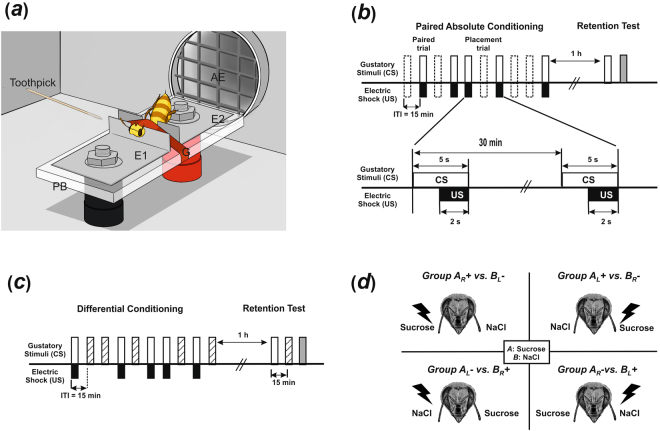
Taste perception allows discriminating edible from non-edible items and is crucial for survival. In the honey bee, the gustatory sense has remained largely unexplored, as tastants have been traditionally used as reinforcements rather than as stimuli to be learned and discriminated. Here we provide the first characterization of antennal gustatory perception in this insect using a novel conditioning protocol in which tastants are dissociated from their traditional food-reinforcement role to be learned as predictors of punishment. We found that bees have a limited gustatory repertoire via their antennae: they discriminate between broad gustatory modalities but not within modalities, and are unable to differentiate bitter substances from water. Coupling gustatory conditioning with blockade of aminergic pathways in the bee brain revealed that these pathways are not restricted to encode reinforcements but may also encode conditioned stimuli. Our results reveal unknown aspects of honey bee gustation, and bring new elements for comparative analyses of gustatory perception in animals.

摘要

味觉感知使生物能够区分可食用与不可食用的物品,对生存至关重要。在蜜蜂中,由于味觉刺激物传统上被用作强化物,而不是用于学习和区分的刺激物,因此其味觉感知在很大程度上仍未被探索。在这里,我们使用一种新颖的条件反射协议,首次对这种昆虫的触角味觉感知进行了描述,该协议将味觉刺激物与其传统的食物强化作用分离,以作为惩罚的预测因子进行学习。我们发现,蜜蜂通过其触角具有有限的味觉感受能力:它们可以区分广泛的味觉模态,但不能在模态内进行区分,并且无法将苦味物质与水区分开。将味觉条件反射与蜜蜂大脑中的胺能途径阻断相结合的结果表明,这些途径不仅局限于编码强化物,还可能编码条件刺激。我们的研究结果揭示了蜜蜂味觉的未知方面,并为动物味觉感知的比较分析带来了新的元素。
https://cdn.ncbi.nlm.nih.gov/pmc/blobs/0399/5778057/9be4ffe81ef3/41598_2018_19715_Fig5_HTML.jpg
https://cdn.ncbi.nlm.nih.gov/pmc/blobs/0399/5778057/7a9185e46fb7/41598_2018_19715_Fig1_HTML.jpg
https://cdn.ncbi.nlm.nih.gov/pmc/blobs/0399/5778057/4df361beb001/41598_2018_19715_Fig2_HTML.jpg
https://cdn.ncbi.nlm.nih.gov/pmc/blobs/0399/5778057/26efe84c4c4d/41598_2018_19715_Fig3_HTML.jpg
https://cdn.ncbi.nlm.nih.gov/pmc/blobs/0399/5778057/d3ac7b6067ff/41598_2018_19715_Fig4_HTML.jpg
https://cdn.ncbi.nlm.nih.gov/pmc/blobs/0399/5778057/9be4ffe81ef3/41598_2018_19715_Fig5_HTML.jpg
https://cdn.ncbi.nlm.nih.gov/pmc/blobs/0399/5778057/7a9185e46fb7/41598_2018_19715_Fig1_HTML.jpg
https://cdn.ncbi.nlm.nih.gov/pmc/blobs/0399/5778057/4df361beb001/41598_2018_19715_Fig2_HTML.jpg
https://cdn.ncbi.nlm.nih.gov/pmc/blobs/0399/5778057/26efe84c4c4d/41598_2018_19715_Fig3_HTML.jpg
https://cdn.ncbi.nlm.nih.gov/pmc/blobs/0399/5778057/d3ac7b6067ff/41598_2018_19715_Fig4_HTML.jpg
https://cdn.ncbi.nlm.nih.gov/pmc/blobs/0399/5778057/9be4ffe81ef3/41598_2018_19715_Fig5_HTML.jpg

相似文献

1
Aversive gustatory learning and perception in honey bees.蜜蜂的厌恶味觉学习和感知。
Sci Rep. 2018 Jan 22;8(1):1343. doi: 10.1038/s41598-018-19715-1.
2
Learning context modulates aversive taste strength in honey bees.学习环境调节蜜蜂的厌恶性味觉强度。
J Exp Biol. 2015 Mar;218(Pt 6):949-59. doi: 10.1242/jeb.117333.
3
Taste perception in honey bees.蜜蜂的味觉感知。
Chem Senses. 2011 Oct;36(8):675-92. doi: 10.1093/chemse/bjr040. Epub 2011 May 26.
4
How to know which food is good for you: bumblebees use taste to discriminate between different concentrations of food differing in nutrient content.如何知道哪种食物对你有益:大黄蜂利用味觉来区分不同营养成分、浓度各异的食物。
J Exp Biol. 2015 Jul;218(Pt 14):2233-40. doi: 10.1242/jeb.118554.
5
Peripheral taste detection in honey bees: What do taste receptors respond to?蜜蜂外周味觉检测:味觉受体对什么做出反应?
Eur J Neurosci. 2021 Jul;54(2):4417-4444. doi: 10.1111/ejn.15265. Epub 2021 May 14.
6
Early olfactory, but not gustatory processing, is affected by the selection of heritable cognitive phenotypes in honey bee.早期嗅觉,而非味觉处理,受遗传认知表型选择影响。
J Comp Physiol A Neuroethol Sens Neural Behav Physiol. 2021 Jan;207(1):17-26. doi: 10.1007/s00359-020-01451-5. Epub 2020 Nov 17.
7
Visual associative learning in restrained honey bees with intact antennae.有完整触角束缚的蜜蜂的视觉联想学习。
PLoS One. 2012;7(6):e37666. doi: 10.1371/journal.pone.0037666. Epub 2012 Jun 6.
8
The tarsal taste of honey bees: behavioral and electrophysiological analyses.蜜蜂跗节味觉:行为学与电生理学分析
Front Behav Neurosci. 2014 Feb 4;8:25. doi: 10.3389/fnbeh.2014.00025. eCollection 2014.
9
Central gustatory projections and side-specificity of operant antennal muscle conditioning in the honeybee.蜜蜂中味觉中枢投射与操作性触角肌条件反射的侧别特异性
J Comp Physiol A Neuroethol Sens Neural Behav Physiol. 2007 May;193(5):523-35. doi: 10.1007/s00359-007-0208-z. Epub 2007 Jan 31.
10
Tactile conditioning and movement analysis of antennal sampling strategies in honey bees (Apis mellifera L.).蜜蜂(西方蜜蜂)触角采样策略的触觉条件反射与运动分析
J Vis Exp. 2012 Dec 12(70):e50179. doi: 10.3791/50179.

引用本文的文献

1
Context-dependent effects of formic acid on olfactory learning and generalisation in ants.甲酸对蚂蚁嗅觉学习和泛化的情境依赖性影响。
Sci Rep. 2025 Jul 10;15(1):24891. doi: 10.1038/s41598-025-10996-x.
2
Impact of odorants on perception of sweetness by honey bees.气味物质对蜜蜂感知甜味的影响。
PLoS One. 2023 Dec 27;18(12):e0290129. doi: 10.1371/journal.pone.0290129. eCollection 2023.
3
Floral volatiles evoke partially similar responses in both florivores and pollinators and are correlated with non-volatile reward chemicals.

本文引用的文献

1
Olfactory experience shapes the evaluation of odour similarity in ants: a behavioural and computational analysis.嗅觉体验塑造蚂蚁对气味相似性的评估:行为与计算分析
Proc Biol Sci. 2016 Aug 31;283(1837). doi: 10.1098/rspb.2016.0551.
2
Roles of OA1 octopamine receptor and Dop1 dopamine receptor in mediating appetitive and aversive reinforcement revealed by RNAi studies.通过 RNAi 研究揭示 OA1 章鱼胺受体和 Dop1 多巴胺受体在介导味觉和厌恶强化中的作用。
Sci Rep. 2016 Jul 14;6:29696. doi: 10.1038/srep29696.
3
Salt preferences of honey bee water foragers.
花香挥发物在传粉者和食花动物中引起部分相似的反应,并与非挥发性奖励化学物质相关联。
Ann Bot. 2023 Oct 4;132(1):1-14. doi: 10.1093/aob/mcad064.
4
Gustation in insects: taste qualities and types of evidence used to show taste function of specific body parts.昆虫的味觉:用于证明特定身体部位味觉功能的味觉质量和证据类型。
J Insect Sci. 2023 Mar 1;23(2). doi: 10.1093/jisesa/iead018.
5
[An antennal electric signal detection system based on template matching].[一种基于模板匹配的触角电信号检测系统]
Sheng Wu Yi Xue Gong Cheng Xue Za Zhi. 2022 Aug 25;39(4):767-775. doi: 10.7507/1001-5515.202112049.
6
Responsiveness to Sugar Solutions in the Moth : Parameters Affecting Proboscis Extension.蛾对糖溶液的反应:影响喙伸展的参数
Front Physiol. 2019 Nov 26;10:1423. doi: 10.3389/fphys.2019.01423. eCollection 2019.
7
Inhibitory learning of phototaxis by honeybees in a passive-avoidance task.在被动回避任务中,蜜蜂对趋光性的抑制性学习。
Learn Mem. 2019 Sep 16;26(10):1-12. doi: 10.1101/lm.050120.119. Print 2019 Oct.
8
Lateralization of Sucrose Responsiveness and Non-associative Learning in Honeybees.蜜蜂中蔗糖反应性和非联想学习的偏侧化
Front Psychol. 2018 Mar 28;9:425. doi: 10.3389/fpsyg.2018.00425. eCollection 2018.
蜜蜂采水者的盐分偏好。
J Exp Biol. 2016 Mar;219(Pt 6):790-6. doi: 10.1242/jeb.132019. Epub 2016 Jan 28.
4
Molecular neurobiology of Drosophila taste.果蝇味觉的分子神经生物学
Curr Opin Neurobiol. 2015 Oct;34:140-8. doi: 10.1016/j.conb.2015.06.001. Epub 2015 Jun 21.
5
Gustatory learning and processing in the Drosophila mushroom bodies.果蝇蕈形体中的味觉学习与处理
J Neurosci. 2015 Apr 15;35(15):5950-8. doi: 10.1523/JNEUROSCI.3930-14.2015.
6
Learning context modulates aversive taste strength in honey bees.学习环境调节蜜蜂的厌恶性味觉强度。
J Exp Biol. 2015 Mar;218(Pt 6):949-59. doi: 10.1242/jeb.117333.
7
Sweet taste and nutrient value subdivide rewarding dopaminergic neurons in Drosophila.甜味和营养价值细分果蝇中产生奖赏效应的多巴胺能神经元。
Curr Biol. 2015 Mar 16;25(6):751-758. doi: 10.1016/j.cub.2015.01.036. Epub 2015 Feb 26.
8
Drosophila sugar receptors in sweet taste perception, olfaction, and internal nutrient sensing.果蝇甜味感知、嗅觉及体内营养传感中的糖受体
Curr Biol. 2015 Mar 2;25(5):621-627. doi: 10.1016/j.cub.2014.12.058. Epub 2015 Feb 19.
9
Neural correlates of water reward in thirsty Drosophila.口渴果蝇中水奖赏的神经关联
Nat Neurosci. 2014 Nov;17(11):1536-42. doi: 10.1038/nn.3827. Epub 2014 Sep 28.
10
Toxins induce 'malaise' behaviour in the honeybee (Apis mellifera).毒素会诱发蜜蜂(西方蜜蜂)出现“不适”行为。
J Comp Physiol A Neuroethol Sens Neural Behav Physiol. 2014 Oct;200(10):881-90. doi: 10.1007/s00359-014-0932-0. Epub 2014 Aug 23.