Riquelme-Barrios Sebastián, Pereira-Montecinos Camila, Valiente-Echeverría Fernando, Soto-Rifo Ricardo
Molecular and Cellular Virology Laboratory, Virology Program, Institute of Biomedical Sciences, Faculty of Medicine, Universidad de Chile, Santiago, Chile.
Front Microbiol. 2018 Mar 28;9:576. doi: 10.3389/fmicb.2018.00576. eCollection 2018.
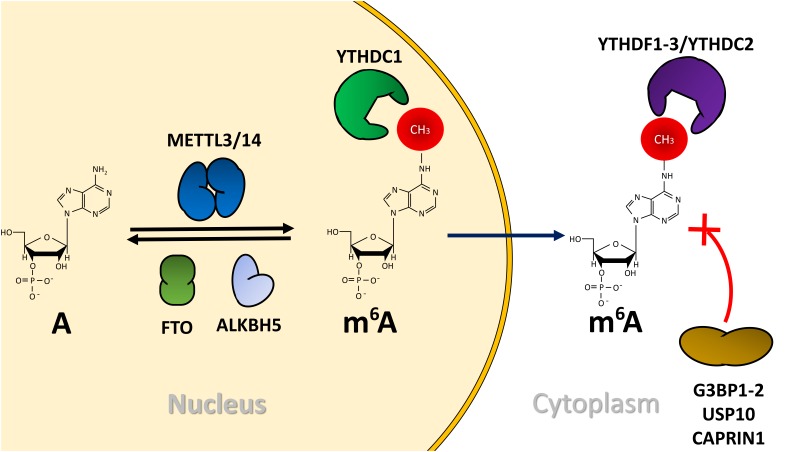
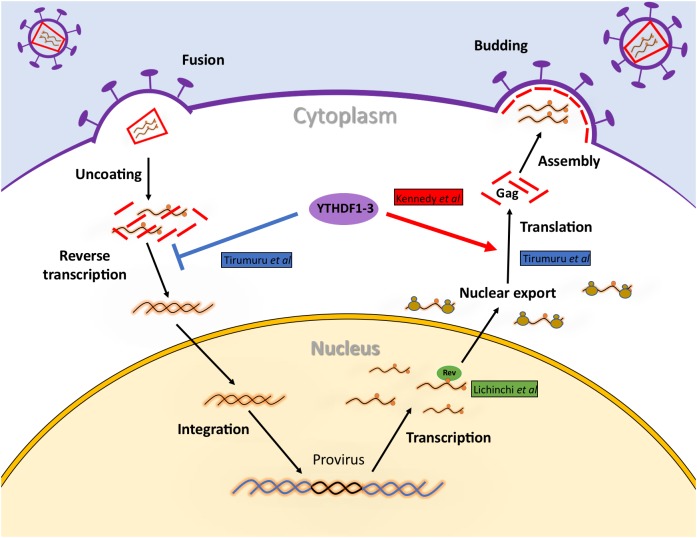
N-methyladenosine (mA) is the most abundant internal modification present in Eukaryotic mRNA. The functions of this chemical modification are mediated by mA-binding proteins (mA readers) and regulated by methyltransferases (mA writers) and demethylases (mA erasers), which together are proposed to be responsible of a new layer of post-transcriptional control of gene expression. Despite the presence of mA in a retroviral genome was reported more than 40 years ago, the recent development of sequencing-based technologies allowing the mapping of mA in a transcriptome-wide manner made it possible to identify the topology and dynamics of mA during replication of HIV-1 as well as other viruses. As such, three independent groups recently reported the presence of mA along the HIV-1 genomic RNA (gRNA) and described the impact of cellular mA writers, erasers and readers on different steps of viral RNA metabolism and replication. Interestingly, while two groups reported a positive role of mA at different steps of viral gene expression it was also proposed that the presence of mA within the gRNA reduces viral infectivity by inducing the early degradation of the incoming viral genome. This review summarizes the recent advances in this emerging field and discusses the relevance of mA during HIV-1 replication.
N6-甲基腺苷(mA)是真核生物信使核糖核酸(mRNA)中含量最丰富的内部修饰。这种化学修饰的功能由mA结合蛋白(mA阅读蛋白)介导,并受甲基转移酶(mA书写蛋白)和去甲基化酶(mA擦除蛋白)调控,它们共同构成基因表达转录后调控的新层面。尽管40多年前就报道了逆转录病毒基因组中存在mA,但基于测序技术的最新发展使得以全转录组方式定位mA成为可能,从而能够确定HIV-1以及其他病毒复制过程中mA的拓扑结构和动态变化。因此,最近有三个独立的研究小组报道了HIV-1基因组RNA(gRNA)上存在mA,并描述了细胞内mA书写蛋白、擦除蛋白和阅读蛋白对病毒RNA代谢和复制不同步骤的影响。有趣的是,虽然有两个研究小组报道了mA在病毒基因表达不同步骤中发挥的积极作用,但也有人提出,gRNA中mA的存在会通过诱导进入的病毒基因组早期降解来降低病毒感染性。本综述总结了这一新兴领域的最新进展,并讨论了mA在HIV-1复制过程中的相关性。