Geiker Nina Rica Wium, Veller Mette, Kjoelbaek Louise, Jakobsen Jette, Ritz Christian, Raben Anne, Astrup Arne, Lorenzen Janne Kunchel, Larsen Lesli H, Bügel Susanne
1Clinical Nutrition Research Unit, Copenhagen University Hospital Herlev-Gentofte, Kildegårdsvej 28, DK-2900 Hellerup, Denmark.
2Department of Nutrition, Exercise and Sports, University of Copenhagen, Rolighedsvej 30, DK-2000 Frederiksberg, Denmark.
Nutr Metab (Lond). 2018 Apr 10;15:24. doi: 10.1186/s12986-018-0263-1. eCollection 2018.
Obesity is associated with vitamin insufficiency and low grade inflammation. The purpose of this study was to investigate the effect of weight loss on folate, retinol, vitamin B, D and E status and the degree of inflammation.
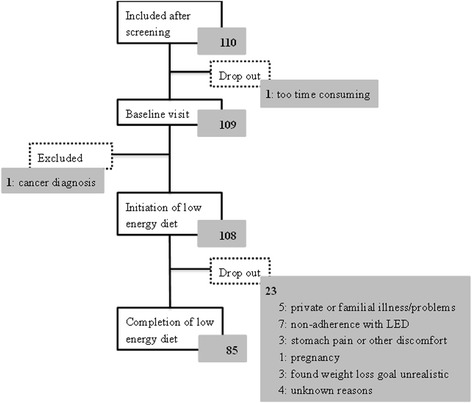
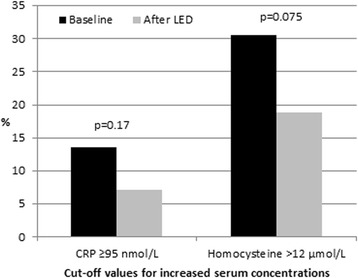
Out of 110, 85 individuals (75% women) aged 39 ± 11 years with a mean ± SD BMI of 33 ± 4 kg/m, completed an eight-week low energy diet (LED). Serum concentration of folate, retinol, B, D and E and C-reactive protein and homocysteine (Hcy) were measured at baseline and at end of the LED.
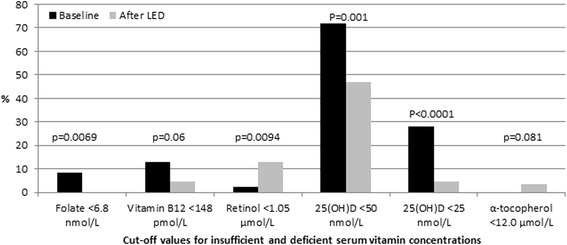
At baseline, 8% of the participants were deficient in folate, 13% in vitamin B, 2% in retinol, 28% in vitamin D (72% were insufficient in vitamin D), and none were deficient in vitamin E. At baseline, BMI was inversely associated with retinol ( < 0.05) as was total and abdominal fat percentage with folate ( < 0.05); further BMI and measures of adiposity were positively associated with CRP ( < 0.01) and Hcy ( < 0.05). Homocysteine was inversely associated with all vitamins but retinol ( < 0.001). After the LED, the participants lost a mean [95% confidence intervals] of 12.3 [- 13.1,-11.6] kg. The serum concentration of folate, vitamin B and D were increased ( < 0.001) after the LED whereas the concentration of retinol and vitamin E were reduced ( < 0.001).
Eight-weeks LED resulted in 13% weight loss and an increase in the serum concentrations of folate, vitamin B and D. Baseline adiposity was inversely associated with folate and retinol, and positively associated with markers of inflammation.
Ethical Committee of Copenhagen as no. H-4-2013-135, NCT01561131.
肥胖与维生素缺乏和低度炎症相关。本研究的目的是调查体重减轻对叶酸、视黄醇、维生素B、D和E水平以及炎症程度的影响。
在110名年龄为39±11岁、平均体重指数(BMI)为33±4kg/m²的个体(75%为女性)中,85人完成了为期八周的低能量饮食(LED)。在基线时以及低能量饮食结束时测量血清中叶酸、视黄醇、维生素B、D、E以及C反应蛋白和同型半胱氨酸(Hcy)的浓度。
在基线时,8%的参与者叶酸缺乏,13%的参与者维生素B缺乏,2%的参与者视黄醇缺乏,28%的参与者维生素D缺乏(72%的参与者维生素D不足),且无人维生素E缺乏。在基线时,BMI与视黄醇呈负相关(P<0.05),总体脂肪百分比和腹部脂肪百分比与叶酸呈负相关(P<0.05);此外,BMI和肥胖指标与C反应蛋白呈正相关(P<0.01),与同型半胱氨酸呈正相关(P<0.05)。同型半胱氨酸与除视黄醇外的所有维生素呈负相关(P<0.001)。低能量饮食后,参与者平均减重[95%置信区间]12.3[-13.1,-11.6]kg。低能量饮食后,血清中叶酸、维生素B和D的浓度升高(P<0.001),而视黄醇和维生素E的浓度降低(P<0.001)。
为期八周的低能量饮食导致体重减轻13%,血清中叶酸、维生素B和D的浓度升高。基线肥胖与叶酸和视黄醇呈负相关,与炎症标志物呈正相关。
哥本哈根伦理委员会,编号H-4-2013-135,NCT01561131。