Kwiatkowski Andrzej P, Stępińska Gabriela, Stanowski Edward, Paśnik Krzysztof
Department of General, Oncological, Metabolic and Thoracic Surgery, Military Institute of Medicine, Warsaw, Poland.
First Faculty of Medicine, Medical University of Warsaw, Warsaw, Poland.
Wideochir Inne Tech Maloinwazyjne. 2018 Mar;13(1):27-32. doi: 10.5114/wiitm.2018.72748. Epub 2018 Jan 16.
Implementation of the laparoscopic approach in colorectal surgery has not happened as rapidly as in cholecystectomy, because of concerns about oncological safety. The results of controlled trials in multiple centers showed the method to be safe. Consequently, surgeons decided to try the approach with colorectal surgery. This process, in our clinic, began in earnest about four years ago.
To analyze and present the clinical outcomes of applying the laparoscopic approach to colorectal surgery in a single center.
We retrospectively identified patients from a hospital database who underwent colorectal surgery - laparoscopic and open - between 2013 and 2016. Our focus was on laparoscopic cases. Study points included operative time, duration of the hospital stay, postoperative mortality and rates of complications, conversion, reoperation and readmission.
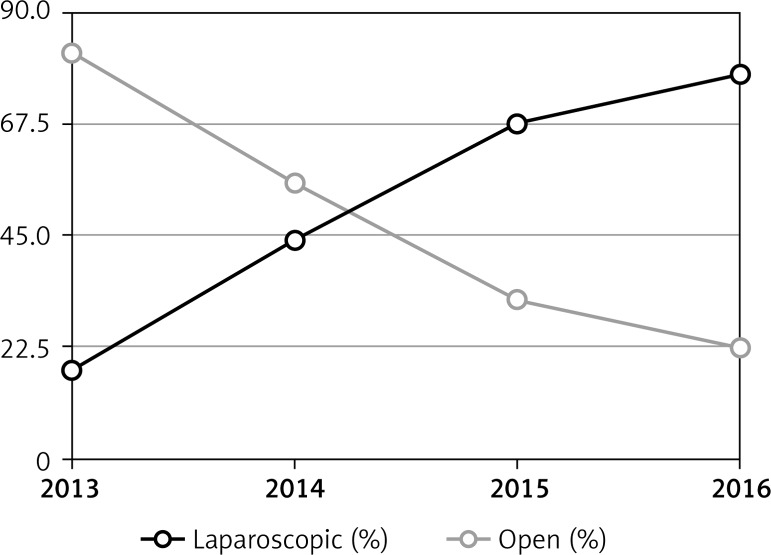
Of 534 cases considered, the results showed that the relation between open and laparoscopic procedures had reversed, in favor of the latter method (2013: open: 82% vs. laparoscopic: 18%; 2016: open: 22.4% vs. laparoscopic: 77.6%). The most commonly performed procedure was right hemicolectomy. The total complication rate was 22%. The total rate of conversion to open surgery was 9.3%. The postoperative mortality rate was 3%.
Use of the laparoscopic approach in colorectal surgery has increased in recent years world-wide - including in Poland - but the technique is still underused. Rapid implementation of the miniinvasive method in colorectal surgery, in centers with previous laparoscopic experience, is not only safe and feasible, but also highly recommended.
由于对肿瘤学安全性的担忧,腹腔镜手术在结直肠手术中的应用并未像在胆囊切除术中那样迅速普及。多个中心的对照试验结果表明该方法是安全的。因此,外科医生决定在结直肠手术中尝试这种方法。在我们诊所,这个过程大约在四年前就正式开始了。
分析并展示在单一中心应用腹腔镜手术治疗结直肠疾病的临床结果。
我们从医院数据库中回顾性筛选出2013年至2016年间接受结直肠手术(包括腹腔镜手术和开放手术)的患者。我们重点关注腹腔镜手术病例。研究要点包括手术时间、住院时间、术后死亡率以及并发症、中转开腹、再次手术和再次入院的发生率。
在534例纳入研究的病例中,结果显示开放手术与腹腔镜手术的比例发生了逆转,腹腔镜手术更占优势(2013年:开放手术:82% 对腹腔镜手术:18%;2016年:开放手术:22.4% 对腹腔镜手术:77.6%)。最常进行的手术是右半结肠切除术。总并发症发生率为22%。中转开腹手术的总发生率为9.3%。术后死亡率为3%。
近年来,腹腔镜手术在结直肠手术中的应用在全球范围内(包括波兰)有所增加,但该技术仍未得到充分利用。在有腹腔镜手术经验的中心,快速在结直肠手术中应用微创方法不仅安全可行,而且强烈推荐。