1Institute of Infectious Diseases and Epidemiology, Tan Tock Seng Hospital, 11 Jalan Tan Tock Seng, Singapore, 304833 Singapore.
2National University of Singapore, 21 Lower Kent Ridge Road, Singapore, 119077 Singapore.
Antimicrob Resist Infect Control. 2018 Apr 10;7:51. doi: 10.1186/s13756-018-0343-z. eCollection 2018.
In May 2015, we noticed an increase in carbapenem-resistant (CRAB) infections in the Medical Intensive Care Unit (MICU). To investigate this, we studied the extent of environmental contamination and subsequent onward clonal transmission of CRAB.
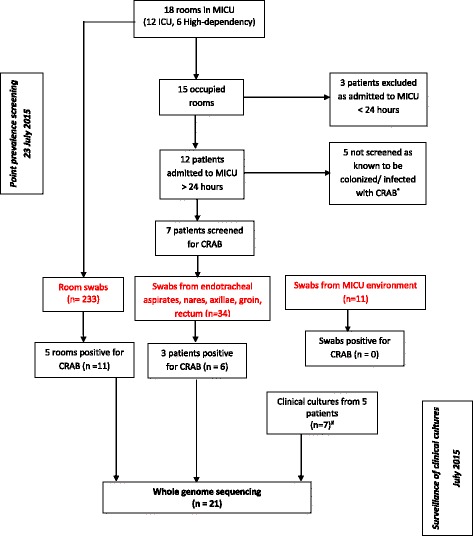
We conducted a one-day point prevalence screening (PPS) of the patients and environment in the MICU. We screened patients using endotracheal tube aspirates and swabs from nares, axillae, groin, rectum, wounds, and exit sites of drains. We collected environmental samples from patients' rooms and environment outside the patients' rooms. CRAB isolates from the PPS and clinical samples over the subsequent one month were studied for genetic relatedness by whole genome sequencing (WGS).
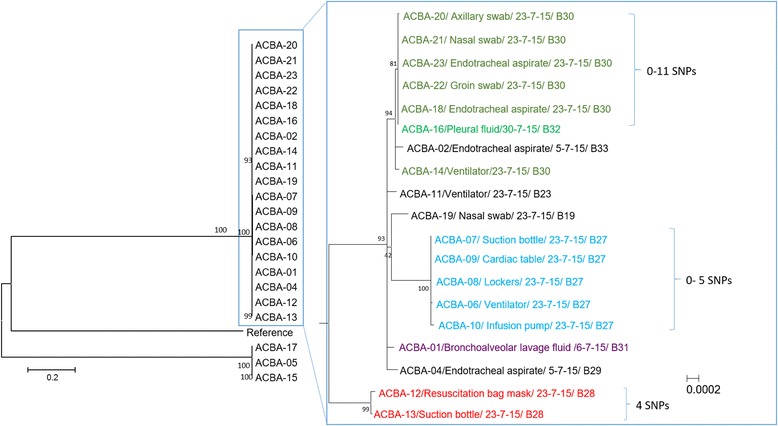
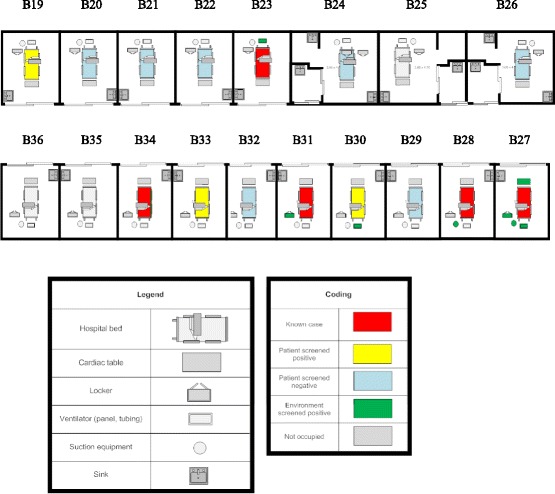
We collected 34 samples from seven patients and 244 samples from the environment. On the day of PPS, we identified 8 CRAB carriers: 3 who screened positive and 5 previously known clinical infections. We detected environmental contamination in nearly two-thirds of the rooms housing patients with CRAB. WGS demonstrated genetic clustering of isolates within rooms but not across rooms. We analysed 4 CRAB isolates from clinical samples following the PPS. One genetically-related CRAB was identified in the respiratory sample of a patient with nosocomial pneumonia, who was admitted to the MICU five days after the PPS.
The extensive environmental colonization of CRAB by patients highlights the importance of environmental hygiene. The transmission dynamics of CRAB needs further investigation.
2015 年 5 月,我们注意到重症监护病房(MICU)中耐碳青霉烯肠杆菌(CRAB)感染的增加。为了调查这一情况,我们研究了环境污染的程度以及随后的 CRAB 克隆传播。
我们对 MICU 中的患者和环境进行了为期一天的点患病率筛查(PPS)。我们使用气管内抽吸物和来自鼻腔、腋窝、腹股沟、直肠、伤口和引流管出口部位的拭子对患者进行筛查。我们从患者房间和患者房间外的环境中收集环境样本。对 PPS 后的一个月内的临床样本和 CRAB 分离株进行全基因组测序(WGS),以研究遗传相关性。
我们从 7 名患者中收集了 34 个样本和 244 个环境样本。在 PPS 当天,我们发现了 8 名 CRAB 携带者:3 名筛查阳性和 5 名先前已知的临床感染。我们在近三分之二的 CRAB 患者居住的房间中检测到了环境污染。WGS 显示了室内分离株的遗传聚类,但未显示跨房间的遗传聚类。我们分析了 PPS 后从 4 个临床样本中分离出的 CRAB 菌株。在一名因医院获得性肺炎而入住 MICU 的患者的呼吸道样本中,我们发现了一个遗传相关的 CRAB,该患者在 PPS 后五天入院。
患者对 CRAB 的广泛环境定植突出了环境卫生的重要性。CRAB 的传播动力学需要进一步研究。