Jatoi Ismail, Benson John R, Kunkler Ian
1Department of Surgery, University of Texas Health Science Center, San Antonio, Texas USA.
2Cambridge Breast Unit, Addenbrooke's Hospital, Cambridge and Faculty of Medical Sciences, Anglia Ruskin University, Cambridge, UK.
NPJ Breast Cancer. 2018 Apr 3;4:8. doi: 10.1038/s41523-018-0061-y. eCollection 2018.
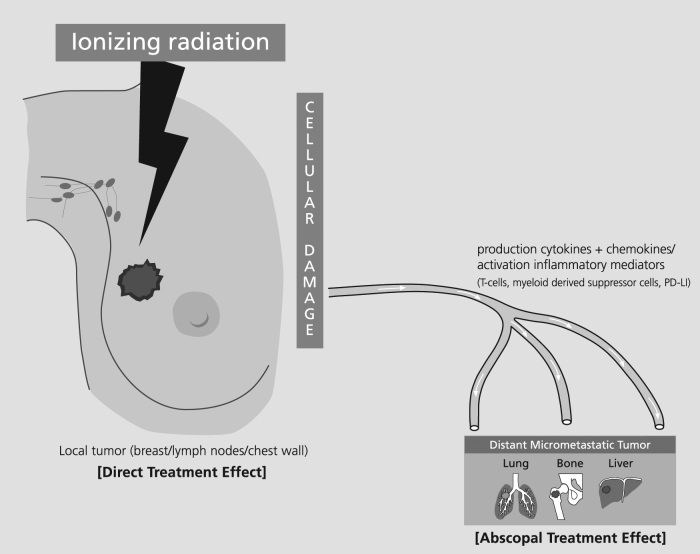
Radiotherapy is an integral component of loco-regional therapy for breast cancer. Randomized controlled trials indicate that increasing the extent of extirpative surgery primarily reduces the risk of local recurrences, while the addition of radiotherapy to surgery can also reduce the risk of distant recurrences, thereby lowering breast cancer-specific mortality. This may suggest an "abscopal" effect beyond the immediate zone of loco-regional irradiation that favorably perturbs the natural history of distant micrometastases. Immunological phenomena such as "immunogenic cell death" provide a plausible mechanistic link between the local and systemic effects of radiation. Radiotherapy treatment can stimulate both pro-immunogenic and immunosuppressive pathways with a potential net beneficial effect on anti-tumor immune activity. Upregulation of programmed cell death ligand (PD-L1) by radiotherapy is an immunosuppressive pathway that could be approached with anti-PD-L1 therapy with potential further improvement in survival. The world overview of randomized trials indicates that the breast cancer mortality reduction from adjuvant radiotherapy is delayed relative to that of adjuvant systemic treatments, and similar delays in the separation of survival curves are evident in the majority of randomized immunotherapy trials demonstrating treatment efficacy. In this article, we hypothesize that an abscopal effect may explain the benefit of radiotherapy in reducing breast cancer mortality, and that It might be possible to harness and augment this effect with systemic agents to reduce the risk of late recurrences.
放射治疗是乳腺癌局部区域治疗的一个重要组成部分。随机对照试验表明,扩大根治性手术范围主要降低局部复发风险,而手术联合放射治疗也可降低远处复发风险,从而降低乳腺癌特异性死亡率。这可能提示在局部区域照射的直接区域之外存在一种“远隔效应”,这种效应有利于干扰远处微转移的自然病程。诸如“免疫原性细胞死亡”等免疫现象为辐射的局部和全身效应之间提供了一个合理的机制联系。放射治疗可刺激促免疫原性和免疫抑制途径,对抗肿瘤免疫活性可能产生净有益效应。放射治疗上调程序性细胞死亡配体(PD-L1)是一种免疫抑制途径,可通过抗PD-L1治疗来解决,这可能进一步提高生存率。随机试验的全球综述表明,辅助放射治疗降低乳腺癌死亡率的作用相对于辅助全身治疗有所延迟,并且在大多数证明治疗有效的随机免疫治疗试验中,生存曲线分离的延迟情况也很明显。在本文中,我们假设远隔效应可能解释放射治疗在降低乳腺癌死亡率方面的益处,并且有可能利用全身药物来增强这种效应,以降低晚期复发风险。