Gertrude H. Sergievsky Center, College of Physicians and Surgeons, Columbia University, New York, New York.
Department of Epidemiology, Mailman School of Public Health, Columbia University, New York, New York.
PLoS One. 2018 Apr 12;13(4):e0195514. doi: 10.1371/journal.pone.0195514. eCollection 2018.
The latent viral reservoir is the major obstacle to achieving HIV remission and necessitates life-long antiretroviral therapy (ART) for HIV-infected individuals. Studies in adults and children have found that initiating ART soon after infection is associated with a reduction in the size of the HIV-1 reservoir. Here we quantified cell-associated HIV-1 DNA in early-treated but currently older HIV-infected children suppressed on ART.
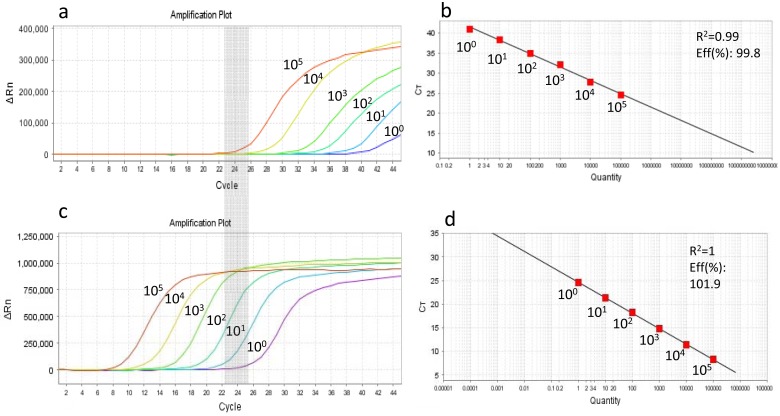
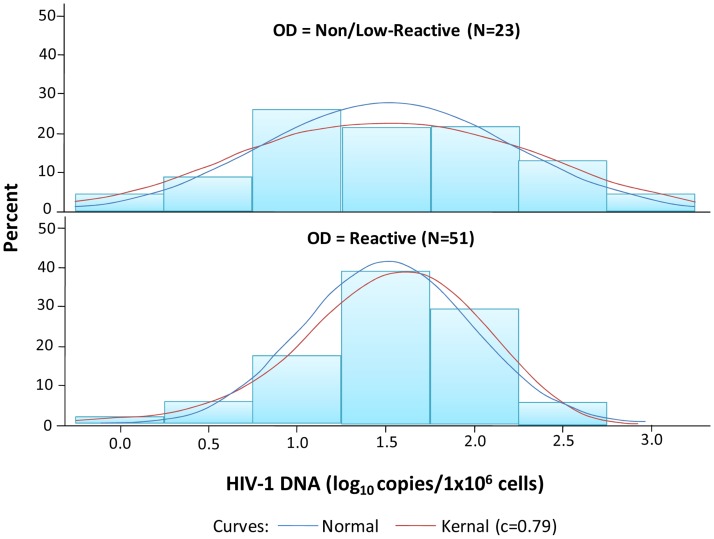
The study participants comprised of a cohort of 146 early-treated children with HIV-1 RNA <50 copies/ml enrolled as part of a clinical trial in Johannesburg, South Africa. A stored buffy coat sample collected after a median 4.3 years on ART and where HIV-1 RNA was <50 copies/ml was tested for cell-associated HIV-1 DNA levels. An in-house, semi-nested real-time quantitative hydrolysis probe PCR assay to detect total HIV-1 subtype C proviral DNA was used. Children were followed prospectively for up to 3 years after this measurement to investigate subsequent HIV-1 RNA rebound/failure while remaining on ART. Age at ART initiation, HIV-1 RNA decline prior to HIV-1 DNA measurement and other factors were investigated.
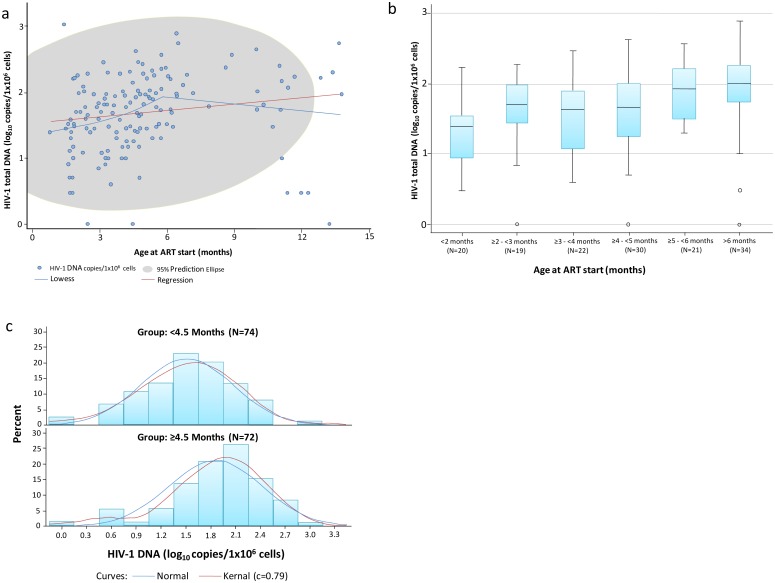
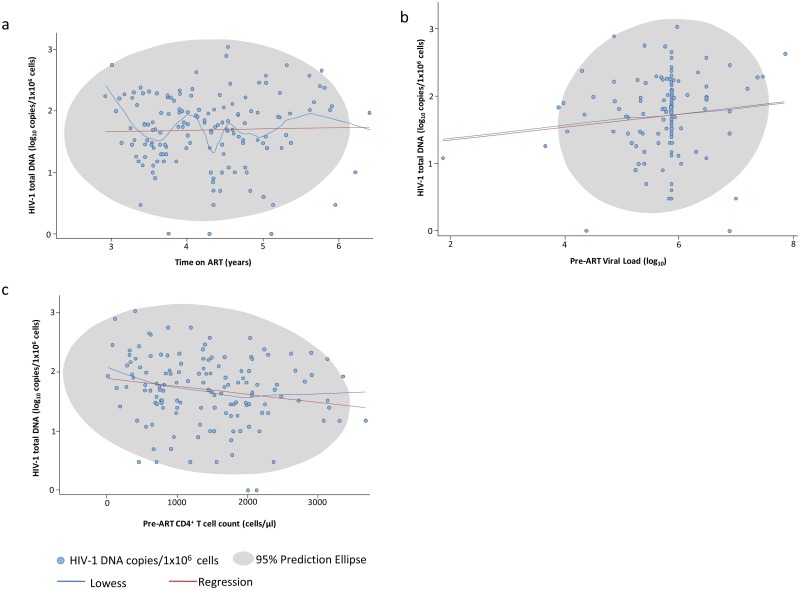
A gradient between age at ART initiation and later HIV-1 DNA levels was observed. When ART was started <2 months of age, the lowest levels of cell-associated HIV-1 DNA (median 1.4 log10copies/106 cells, interquartile range [IQR] 0.95-1.55) were observed compared to ART started at 2-4 months (median 1.68, IQR 1.26-1.97) or 5-14 months of age (median1.98, IQR 1.69-2.25). A low CD4 T-cell count pre-treatment predicted higher levels of HIV-1 DNA on later testing. The probability of HIV-1 RNA rebound >50 copies/ml whilst on ART within 3 years after the DNA measurement was 2.07 (95% CI: 1.352-3.167) times greater if the HIV-1 DNA level was above the median of 55 copies/106 cells.
Cell-associated HIV-1 DNA levels measured after more than 4 years on ART were lower the younger the age of the child when ART was initiated. This marker of the size of the viral reservoir also predicted subsequent viral rebound/treatment failure while ART was sustained. The results provide additional evidence of the benefits of prompt diagnosis and early ART initiation in newborns and infants.
潜伏的病毒库是实现 HIV 缓解的主要障碍,因此 HIV 感染者需要终身接受抗逆转录病毒治疗(ART)。成人和儿童的研究发现,在感染后尽快开始 ART 治疗与减少 HIV-1 储存库的大小有关。在此,我们定量检测了正在接受 ART 治疗且病毒载量得到抑制的年龄较大的 HIV 感染儿童体内的细胞相关 HIV-1 DNA。
本研究纳入了南非约翰内斯堡一项临床试验中的 146 名 HIV-1 RNA<50 拷贝/ml 的早期治疗 HIV 感染儿童,这些儿童在接受 ART 治疗 4.3 年后的中位时间采集了储存的血斑样本,且此时 HIV-1 RNA<50 拷贝/ml,用于检测细胞相关 HIV-1 DNA 水平。使用内部半巢式实时定量水解探针 PCR 检测方法检测 HIV-1 亚型 C 全长前病毒 DNA。对这些儿童进行了长达 3 年的前瞻性随访,以研究他们在继续接受 ART 治疗的情况下,随后 HIV-1 RNA 反弹/失败的情况。研究分析了 ART 开始时的年龄、HIV-1 DNA 检测前 HIV-1 RNA 下降情况以及其他因素。
观察到 ART 开始时的年龄与后期 HIV-1 DNA 水平之间存在梯度。与 2-4 个月(中位数 1.68,IQR 1.26-1.97)或 5-14 个月(中位数 1.98,IQR 1.69-2.25)时相比,ART 开始于<2 个月时,细胞相关 HIV-1 DNA 的水平最低(中位数 1.4 log10 拷贝/106 细胞,IQR 0.95-1.55)。治疗前 CD4 T 细胞计数低预示着后期 HIV-1 DNA 检测值较高。在 DNA 测量后 3 年内,当 HIV-1 DNA 水平高于 55 拷贝/106 细胞的中位数时,ART 治疗期间 HIV-1 RNA 反弹>50 拷贝/ml 的概率增加了 2.07 倍(95%CI:1.352-3.167)。
在接受 ART 治疗 4 年以上后测量的细胞相关 HIV-1 DNA 水平越低,ART 开始时儿童的年龄越小。这种病毒库大小的标志物也预测了在持续接受 ART 治疗的情况下病毒的后续反弹/治疗失败。结果提供了更多证据表明,在新生儿和婴儿中及时诊断和早期开始 ART 治疗的益处。