Tagarro Alfredo, Domínguez-Rodríguez Sara, Cotton Mark, Otwombe Kennedy, Klein Nigel, Lain Maria Grazia, Nhampossa Tacilta, Maiga Almoustapha Issiaka, Barnabas Shaun, Vaz Paula, Violari Avy, Fernández-Luis Sheila, Behuhuma Osee, Sylla Mariam, López-Varela Elisa, Naniche Denise, Janse-Van-Rensburg Anita, Liberty Afaaf, Ramsagar Nastassja, Smit Theresa, Makhari Senamile, Ismael Nalia, Giaquinto Carlo, Rossi Paolo, Kuhn Louise, Palma Paolo, Spyer Moira, Lichterfeld Mathias, Nastuoli Eleni, Giannuzzi Viviana, Ballesteros Alvaro, Cotugno Nicola, Morrocchi Elena, Oletto Andrea, Traoré Fatoumata Tata, Dobbels Els, Akhalwaya Yasmeen, Ording-Jespersen Gregory, Foster Caroline, Rabie Helena, Amuge Pauline, Brehin Camille, Pahwa Savita, Coulibaly Yacouba Aba, Rojo Pablo
Fundación de Investigación Biomédica Hospital 12 de Octubre, Instituto de Investigación 12 de Octubre (imas12), Madrid, Spain.
Department of Pediatrics, Infanta Sofía University Hospital, Fundación para la Investigación Biomédica e Innovación Hospital Universitario Infanta Sofía y Hospital del Henares (FIIB HUIS HHEN), Madrid, Spain.
EClinicalMedicine. 2024 May 23;73:102648. doi: 10.1016/j.eclinm.2024.102648. eCollection 2024 Jul.
Even with increasing access to rapid HIV diagnosis and early antiretroviral therapy (ART) initiation, infants living with HIV seem to have adverse outcomes. We assessed the probability of death, viral suppression, and other HIV-related events in the first three years of life among early-treated children with perinatally-acquired HIV in South Africa, Mozambique, and Mali.
We enrolled a cohort of infants who initiated ART within the initial 6 months of life and within 3 months of diagnosis. These children were monitored 2, 6, 12 and 24 weeks after enrolment, followed by biannual check-ups up to 4 years after enrolment. We assessed the probability of death, viral load (VL) suppression, severe immunosuppression (according to WHO guidelines), and engagement in care using Kaplan-Meier plots, and hazard ratios for these outcomes using multivariable Cox regression models.
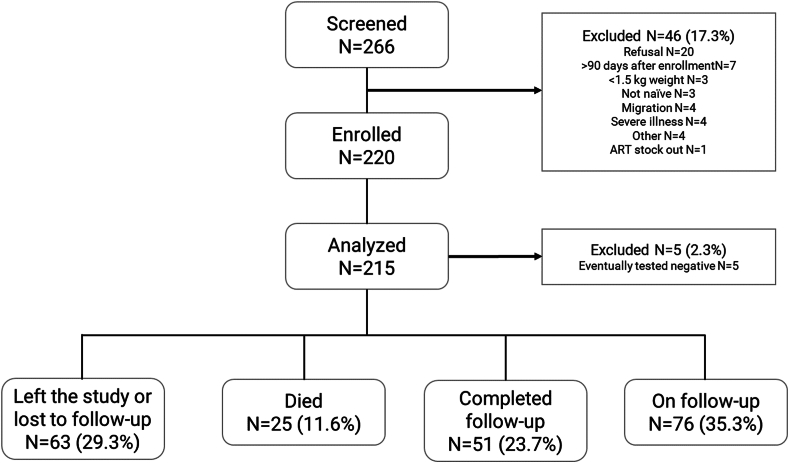
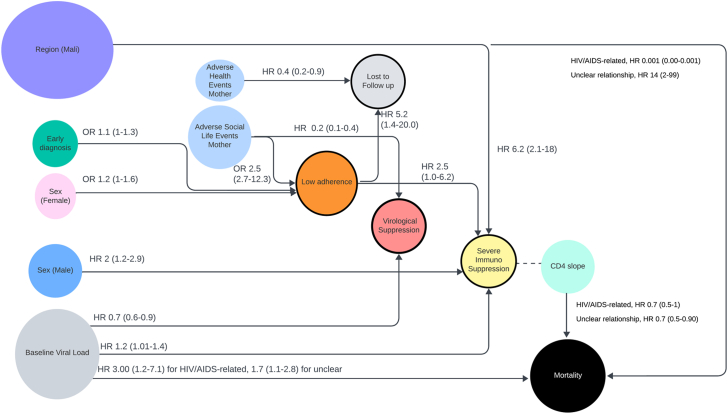
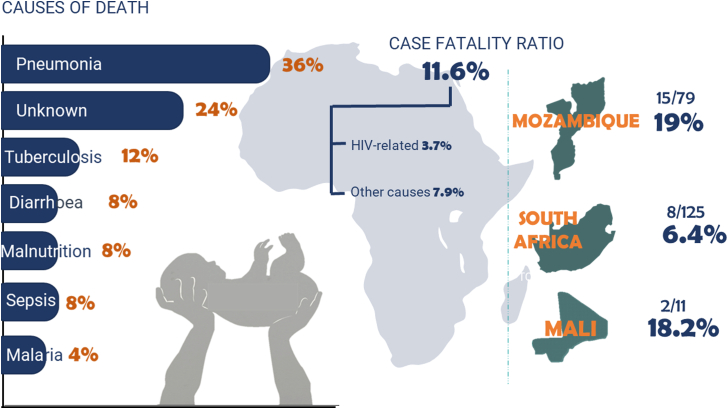
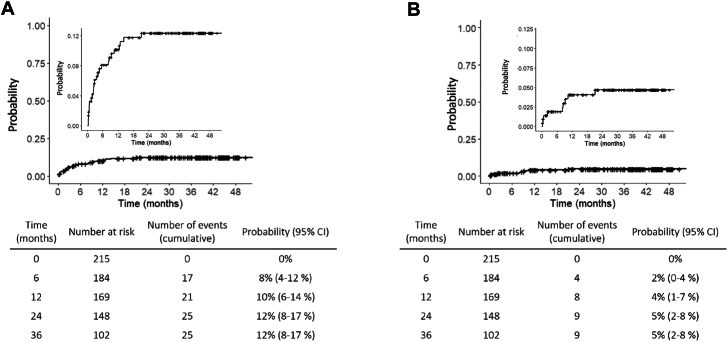
Two hundred and fifteen infants were enrolled and monitored for a median of 34 months [IQR, 16.3; 44.1]. ART initiation occurred at a median of 34 days of age [IQR, 26.0; 73.0]. The probability of death at 1 year of ART was 10% (95% CI, 6-14), increased to 12% (95% CI, 8-17) at 2 and remained in 12% at 3 years. The main risk factor for HIV/AIDS-related mortality was baseline viral load [HR: 2.98 (95% CI, 1.25-7.12)]. Sixty-one of 146 (42%) children achieved sustained virological control below lower limit of detection for any ≥1 year period between enrolment and 4 years after enrolment. Viral suppression during follow-up was inversely associated with baseline viral load [Hazard Ratio (HR): 0.72 (95% CI, 0.58-0.89] and adverse maternal social events [HR: 0.26 (95% CI, 0.15-0.45)]. Adherence to ART was assessed as optimal in 81% of the visits. Female sex at birth, lower age at diagnosis and maternal adverse social life events were risk factors for low adherence [Odds ratio, OR 1.25 (95% CI, 1.00-1.56); 1.12 (95% CI, 1.01-1.27) and 2.52 (95% CI, 2.16-12.37), respectively].
Despite early ART, mortality remains high in infants. High baseline VL and adverse maternal social environment increased the risk of poor outcomes. Sustained supportive strategies are essential during and after pregnancy, to achieve better survival.
Early Treated Perinatally HIV Infected Individuals: Improving Children's Actual Life (EPIICAL) is a research consortium funded by ViiV Healthcare and led by Penta Foundation. The funder was not involved in the analysis and interpretation of data, writing of the report, or the decision to submit the paper for publication. The corresponding authors had access to all data and take final responsibility for the decision to submit.
尽管获得快速艾滋病毒诊断和早期抗逆转录病毒治疗(ART)的机会不断增加,但感染艾滋病毒的婴儿似乎仍有不良结局。我们评估了南非、莫桑比克和马里围产期感染艾滋病毒且接受早期治疗的儿童在生命最初三年中的死亡、病毒抑制及其他与艾滋病毒相关事件的发生概率。
我们纳入了一组在出生后最初6个月内且诊断后3个月内开始接受ART的婴儿队列。这些儿童在入组后2周、6周、12周和24周接受监测,之后在入组后4年内每半年进行一次检查。我们使用Kaplan-Meier曲线评估死亡、病毒载量(VL)抑制、严重免疫抑制(根据世界卫生组织指南)及接受治疗的概率,并使用多变量Cox回归模型评估这些结局的风险比。
共纳入215名婴儿,中位监测时间为34个月[四分位间距(IQR),16.3;44.1]。开始ART的中位年龄为34天[IQR,26.0;73.0]。接受ART 1年时的死亡概率为10%(95%置信区间,6 - 14),2年时升至12%(95%置信区间,8 - 17),3年时仍为12%。与艾滋病毒/艾滋病相关死亡的主要危险因素是基线病毒载量[风险比(HR):2.98(95%置信区间,1.25 - 7.12)]。146名儿童中有61名(42%)在入组至入组后4年期间的任何≥1年时间段内实现了病毒载量持续抑制至检测下限以下。随访期间的病毒抑制与基线病毒载量呈负相关[风险比(HR):0.72(95%置信区间,0.58 - 0.89)]以及与不良的母亲社会事件相关[HR:0.26(95%置信区间,0.15 - 0.45)]。在81%的访视中,ART依从性被评估为最佳。出生时为女性、诊断时年龄较小以及母亲不良社会生活事件是依从性低的危险因素[比值比(OR)分别为1.25(95%置信区间,1.00 - 1.56);1.12(95%置信区间,1.01 - 1.27)和2.52(95%置信区间,2.16 - 12.37)]。
尽管早期接受ART,但婴儿死亡率仍然很高。高基线VL和不良的母亲社会环境增加了不良结局的风险。在孕期及产后持续采取支持性策略对于实现更好的生存至关重要。
围产期艾滋病毒感染个体早期治疗:改善儿童实际生活(EPIICAL)是一个由ViiV Healthcare资助、由五边形基金会牵头的研究联盟。资助者未参与数据分析和解读以及报告撰写,也未参与提交论文发表的决策。通讯作者可以获取所有数据,并对提交论文的决策承担最终责任。