REACH Ethiopia, P.O. Box 303, Hawassa, Ethiopia.
Liverpool School of Tropical Medicine, Liverpool, UK.
BMC Pregnancy Childbirth. 2018 Apr 12;18(1):96. doi: 10.1186/s12884-018-1721-5.
In 2015 the maternal mortality ratio for Ethiopia was 353 per 100,000 live births. Large numbers of women do not use maternal health services. This study aimed to identify factors influencing the use of maternal health services at the primary health care unit (PHCU) level in rural communities in Sidama zone, south Ethiopia in order to design quality improvement interventions.
We conducted a qualitative study in six woredas in 2013: 14 focus group discussions (FGDs) and 44 in-depth interviews with purposefully selected community members (women, male, traditional birth attendants, local kebele administrators), health professionals and health extension workers (HEWs) at PHCUs. We digitally recorded, transcribed and thematically analysed the interviews and FGDs using Nvivo. The 'three delay model' informed the analytical process and discussion of barriers to the use of maternal health services.
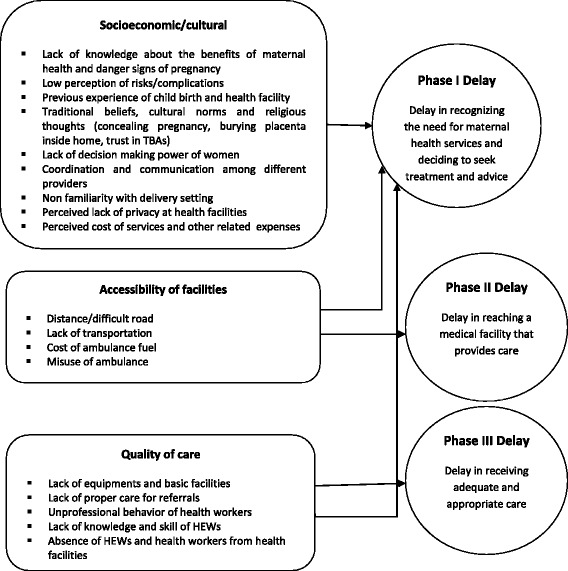
Lack of knowledge on danger signs and benefits of maternal health services; cultural and traditional beliefs; trust in TBAs; lack of decision making power of women, previous negative experiences with health facilities; fear of going to an unfamiliar setting; lack of privacy and perceived costs of maternal health services were the main factors causing the first delay in deciding to seek care. Transport problems in inaccessible areas were the main contributing factor for the second delay on reaching care facilities. Lack of logistic supplies and equipment, insufficient knowledge and skills and unprofessional behaviour of health workers were key factors for the third delay in accessing quality care.
Use of maternal health services at the PHCU level in Sidama zone is influenced by complex factors within the community and health system. PHCUs should continue to implement awareness creation activities to improve knowledge of the community on complications of pregnancy and benefits of maternal health services. The health system has to be responsive to community's cultural norms and practices. The mangers of the woreda health office and health centres should take into account the available budgets; work on ensuring the necessary logistics and supplies to be in place at PHCU.
2015 年,埃塞俄比亚的孕产妇死亡率为每 10 万例活产 353 例。大量妇女未使用孕产妇保健服务。本研究旨在确定在埃塞俄比亚南部锡达马地区农村社区的初级卫生保健单位(PHCU)一级影响孕产妇保健服务使用的因素,以便设计质量改进干预措施。
我们于 2013 年在六个沃里德进行了一项定性研究:14 次焦点小组讨论(FGD)和 44 次深入访谈,访谈对象为有目的地选择的社区成员(妇女、男性、传统助产妇、当地的基贝拉管理员)、卫生专业人员和在 PHCU 的卫生推广工作者(HEW)。我们使用 Nvivo 对访谈和 FGD 进行了数字记录、转录和主题分析。“三延误模型”为分析过程和讨论使用孕产妇保健服务的障碍提供了信息。
缺乏对孕产妇健康服务的危险信号和益处的了解;文化和传统信仰;对传统助产妇的信任;妇女缺乏决策权,以前对卫生机构有负面体验;害怕去一个陌生的环境;缺乏隐私和对孕产妇保健服务的费用感知是导致决定寻求护理的第一个延误的主要因素。在难以到达的地区的交通问题是到达护理设施的第二个延误的主要原因。后勤供应和设备不足、知识和技能不足以及卫生工作者的不专业行为是获取优质护理的第三个延误的关键因素。
在锡达马地区,PHCU 一级的孕产妇保健服务的使用受到社区和卫生系统内部复杂因素的影响。PHCU 应继续开展提高社区对妊娠并发症和孕产妇保健服务益处的认识的宣传活动。卫生系统必须对社区的文化规范和习俗做出反应。沃里德卫生办公室和卫生中心的管理人员应考虑到可用预算;努力确保 PHCU 配备必要的后勤和供应品。