School of Public Health, Haramaya University, Harar, Oromia Region, Ethiopia.
Department of Public Health, Debre berihan University, Debre berihan, Amhara Region, Ethiopia.
PLoS One. 2019 Mar 15;14(3):e0212227. doi: 10.1371/journal.pone.0212227. eCollection 2019.
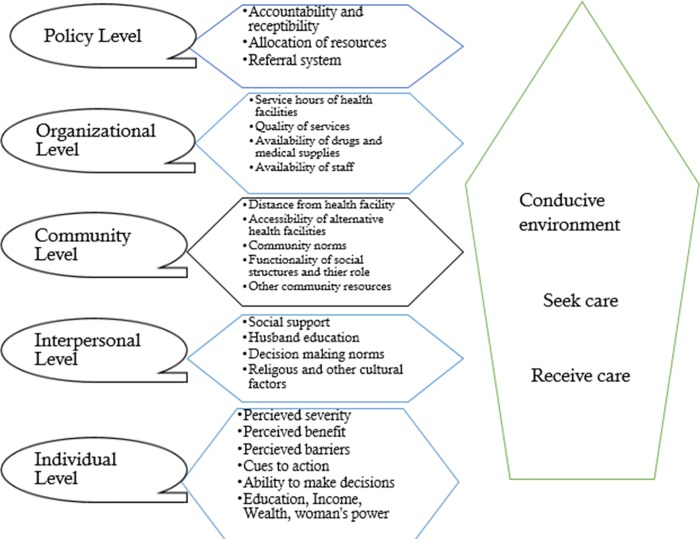
Health-seeking behaviours are influenced by internal and external contributing factors. Internal factors include attitudes, beliefs and core values, life adaptation skills, psychological disposition whereas external factors include social support, media, socio-cultural, political, economic and biological aspects, health care systems, environmental stressors and societal laws and regulations. This study was meant to explore factors affecting health-seeking behaviors in the Somali regional state of Ethiopia. The study employed a cross-sectional study design using qualitative data collection tools. Data were collected from 50 individual interviews and 17 focused group discussions (FGD) on women of reproductive age and their partners, health extension workers (HEWs), health care providers and health administrators. To ensure representativeness, the region was categorized into three zones based on their settlement characteristics as agrarian, pastoralist and semi-pastoralist. Two districts (one from high and the other from low performance areas) were selected from each category. The data were entered, coded, categorized and analyzed using NVIVO version 11 software. The Socio-ecologic Model (SEM) was used for categorization.
Using the social ecological model, the following major barriers for health seeking behaviors were identified. Low socio-demographic and economic status, poor exposure to health information or mass media, detrimental preferences of breast feeding methods and short acting family planning (FP) methods were identified barriers at the individual level; male dominance in decision making, the influence of the husband and society and the role of word of mouth were identified barriers at the interpersonal level and lack of acceptance, fear of modern health practices, unclean health facility environment, lack of well-equipped facilities shortage of trained staffs and barriers relating to distance and transportation were barriers identified at organizational and policy level.
Overall, factors at various level affected health seeking behaviors of the Somali community. Socio-demographic and economic factors, non-responsive bureaucratic system, shortages or absence of medical supplies and human resources, lack of supportive supervision, a shortage of water and electricity at the health facility and an unclean service delivery environment are significant barriers to health-seeking behaviors for the community.
健康寻求行为受到内部和外部因素的影响。内部因素包括态度、信念和核心价值观、生活适应技能、心理倾向,而外部因素包括社会支持、媒体、社会文化、政治、经济和生物方面、医疗保健系统、环境压力和社会法律和法规。本研究旨在探讨影响埃塞俄比亚索马里地区健康寻求行为的因素。该研究采用了横断面研究设计,使用定性数据收集工具。数据来自 50 名个体访谈和 17 次焦点小组讨论(FGD),参与者为育龄妇女及其伴侣、卫生推广工作者(HEWs)、卫生保健提供者和卫生行政人员。为了确保代表性,该地区根据其定居特征分为三个区,分别是农业区、牧民区和半牧民区。从每个类别中选择两个区(一个来自表现良好的地区,另一个来自表现不佳的地区)。数据使用 NVIVO 版本 11 软件进行输入、编码、分类和分析。使用社会生态学模型(SEM)进行分类。
使用社会生态学模型,确定了以下健康寻求行为的主要障碍。低社会人口和经济地位、缺乏健康信息或大众媒体的接触、母乳喂养方法和短效计划生育(FP)方法的不利偏好被确定为个体层面的障碍;决策中的男性主导地位、丈夫和社会的影响以及口碑的作用被确定为人际层面的障碍;接受度低、对现代卫生实践的恐惧、卫生机构环境不卫生、缺乏设备齐全的设施、缺乏训练有素的工作人员以及与距离和交通有关的障碍被确定为组织和政策层面的障碍。
总的来说,各种层面的因素都影响了索马里社区的健康寻求行为。社会人口和经济因素、反应迟钝的官僚系统、医疗用品和人力资源的短缺或缺乏、缺乏支持性监督、卫生机构缺乏水电以及不卫生的服务提供环境是社区健康寻求行为的重大障碍。