National Center for Chronic and Non-Communicable Disease Control and Prevention, Chinese Center for Disease Control and Prevention, Beijing, China.
Department of Epidemiology and Biostatistics, School of Public Health, Peking University, Beijing, China.
Lancet Respir Med. 2018 Jun;6(6):421-430. doi: 10.1016/S2213-2600(18)30103-6. Epub 2018 Apr 9.
Because of the rapid change in economic development and lifestyle in China, and the ageing population, concerns have grown that chronic obstructive pulmonary disease (COPD) could become epidemic. An up-to-date nationwide estimation of COPD prevalence in China is needed.
We did a cross-sectional survey of a nationally representative sample of individuals from mainland China aged 40 years or older. The primary outcome was COPD, defined according to the 2017 Global Initiative for Chronic Obstructive Lung Disease (GOLD) lung function criteria.
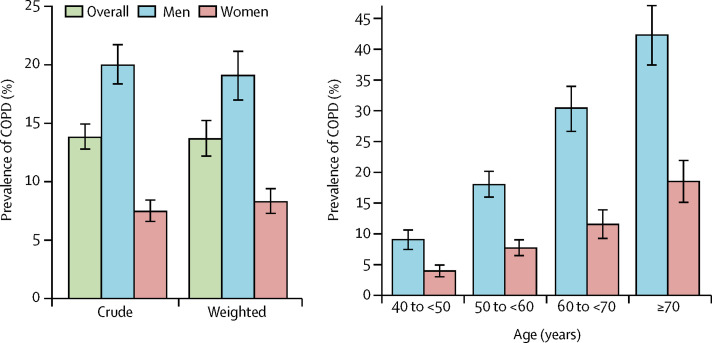
Between Dec 29, 2014, and Dec 31, 2015, 66 752 adults were recruited to the study population. The estimated standardised prevalence of COPD was 13·6% (95% CI 12·0-15·2). The prevalence of COPD differed significantly between men and women (19·0%, 95% CI 16·9-21·2 vs 8·1%, 6·8-9·3; p<0·0001), mainly because of a significant difference in smoking status between men and women (current smokers 58·2% vs 4·0%). The prevalence of COPD differed by geographic region, with the highest prevalence in southwest China (20·2%, 95% CI 14·7-25·8) and the lowest in central China (10·2%, 8·2-12·2). Among adults with COPD, 56·4% (95% CI 53·7-59·2) had mild disease (GOLD stage I), 36·3% (34·3-38·3) had moderate disease (GOLD stage II), 6·5% (5·5-7·4) had severe disease (GOLD stage III), and 0·9% (0·6-1·1) had very severe disease (GOLD stage IV).
In a large, nationally representative sample of adults aged 40 years or older, the estimated overall prevalence of COPD in China in 2014-15 was 13·6%, indicating that this disease has become a major public-health problem. Strategies aimed at prevention and treatment of COPD are needed urgently.
Chinese Central Government, the Ministry of Science and Technology of The People's Republic of China, and the National Natural Science Foundation of China.
由于中国经济发展和生活方式的迅速变化以及人口老龄化,人们越来越担心慢性阻塞性肺疾病(COPD)可能会成为一种流行疾病。因此,需要对中国 COPD 的最新全国流行率进行估计。
我们对来自中国大陆的年龄在 40 岁或以上的具有代表性的人群进行了横断面调查。主要结局是根据 2017 年全球慢性阻塞性肺疾病倡议(GOLD)肺功能标准定义的 COPD。
在 2014 年 12 月 29 日至 2015 年 12 月 31 日期间,研究人群共招募了 66752 名成年人。估计 COPD 的标准化患病率为 13.6%(95%CI,12.0-15.2)。COPD 的患病率在男性和女性之间存在显著差异(19.0%,95%CI,16.9-21.2 与 8.1%,6.8-9.3;p<0.0001),这主要是因为男性和女性的吸烟状况存在显著差异(当前吸烟者为 58.2%,而 4.0%)。COPD 的患病率因地理区域而异,中国西南部的患病率最高(20.2%,95%CI,14.7-25.8),而中国中部的患病率最低(10.2%,8.2-12.2)。在 COPD 患者中,56.4%(95%CI,53.7-59.2)为轻度疾病(GOLD Ⅰ期),36.3%(34.3-38.3)为中度疾病(GOLD Ⅱ期),6.5%(5.5-7.4)为重度疾病(GOLD Ⅲ期),0.9%(0.6-1.1)为非常严重疾病(GOLD Ⅳ期)。
在一项针对年龄在 40 岁或以上的具有代表性的成年人的大型全国性样本中,2014-15 年中国 COPD 的估计总体患病率为 13.6%,表明这种疾病已成为一个主要的公共卫生问题。迫切需要制定预防和治疗 COPD 的策略。
中国中央政府、中华人民共和国科学技术部和国家自然科学基金委员会。