Department of Global Public Health and Primary Care, University of Bergen, Norway
Department of Heart Disease, Haukeland University Hospital, Bergen, Norway.
J Am Heart Assoc. 2018 Apr 12;7(8):e008190. doi: 10.1161/JAHA.117.008190.
Although choline metabolism has been associated with atherosclerotic heart disease, less research attention has been paid to the associations of choline and its oxidative metabolite betaine with cardiac arrhythmias.
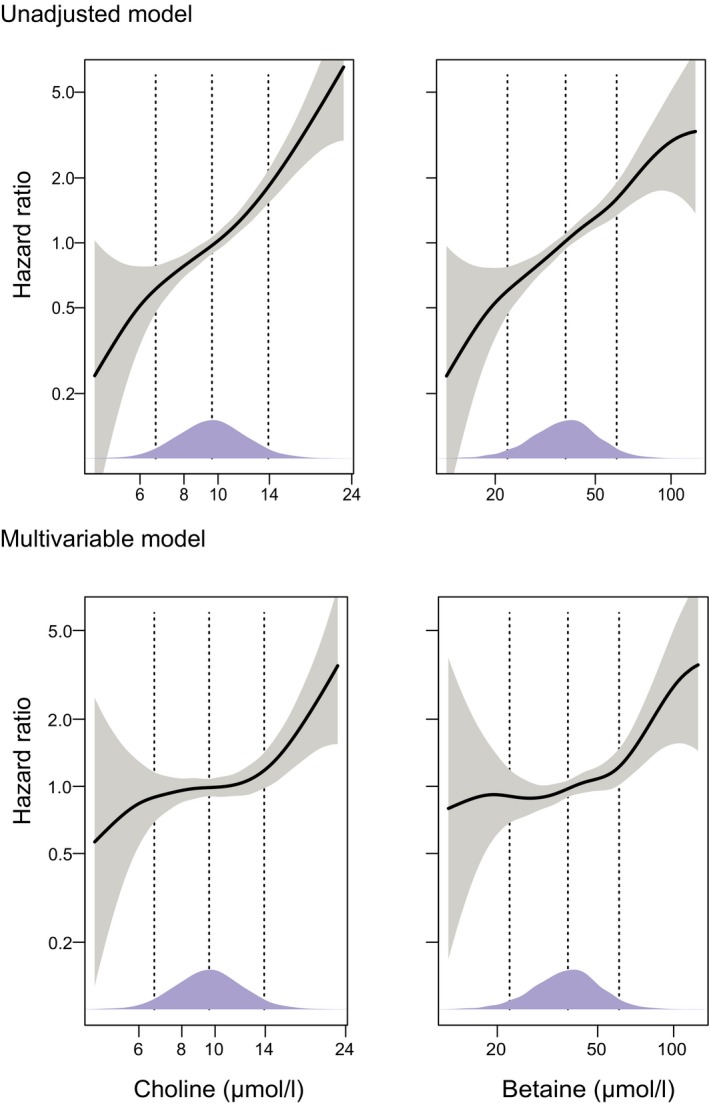
We evaluated associations of plasma concentrations and dietary intakes of choline and betaine with long-term atrial fibrillation (AF) risk in a community-based cohort, HUSK ([the Hordaland Health Study] n=6949), and validated the findings in 2 patient cohorts: the Western Norway Coronary Angiography Cohort (n=4164) and the NORVIT (Norwegian B-Vitamin) Trial (n=3733). Information on AF was obtained from the CVDNOR (Cardiovascular Disease in Norway) project. In HUSK, WECAC (Western Norway Coronary Angiography Cohort), and NORVIT, 552, 411, and 663 AF cases were identified during a median follow-up time of 10.9, 7.3, and, 8.7 years, respectively. Plasma concentrations of choline and betaine were significantly positively associated with later AF risk after multivariable adjustments in HUSK. Such associations were independently replicated in the 2 external prospective patient cohorts. The pooled hazard ratio was 1.13 (95% confidence interval 1.08-1.19, <0.001) and 1.16 (95% confidence interval 1.10-1.22, <0.001) per SD increment for log-transformed choline and betaine, respectively. Moreover, dietary intake of choline was marginally associated with AF risk (pooled hazard ratio 1.29, 95% confidence interval 1.01-1.66, fifth versus first quintile), whereas no significant association was observed between dietary betaine and AF risk.
Our findings indicate that plasma concentrations as well as dietary intake of choline, but not betaine, are associated with subsequent risk of AF, suggesting a potential role of choline metabolism in the pathogenesis of AF.
URL: https://www.clinicaltrials.gov.Unique identifier: NCT00671346.
尽管胆碱代谢与动脉粥样硬化性心脏病有关,但对胆碱及其氧化代谢产物甜菜碱与心律失常之间的关系关注较少。
我们评估了血浆浓度和饮食中胆碱和甜菜碱的摄入量与社区队列 HUSK([Hordaland 健康研究] n=6949)中长期心房颤动(AF)风险的相关性,并在 2 个患者队列中验证了这一发现:西方挪威冠状动脉造影队列(n=4164)和 NORVIT(挪威 B 族维生素)试验(n=3733)。AF 信息来自 CVDNOR(挪威心血管疾病)项目。在 HUSK、WECAC(西方挪威冠状动脉造影队列)和 NORVIT 中,中位随访时间分别为 10.9、7.3 和 8.7 年,分别确定了 552、411 和 663 例 AF 病例。在 HUSK 中,经过多变量调整后,胆碱和甜菜碱的血浆浓度与随后的 AF 风险呈显著正相关。在 2 个外部前瞻性患者队列中,这些关联得到了独立验证。合并风险比为 1.13(95%置信区间 1.08-1.19,<0.001)和 1.16(95%置信区间 1.10-1.22,<0.001),分别为对数转换的胆碱和甜菜碱的每标准差增量。此外,胆碱的饮食摄入量与 AF 风险呈边缘相关(合并风险比 1.29,95%置信区间 1.01-1.66,第 5 五分位与第 1 五分位相比),而饮食甜菜碱与 AF 风险之间无显著关联。
我们的研究结果表明,血浆浓度以及胆碱的饮食摄入量,而不是甜菜碱,与随后的 AF 风险相关,这表明胆碱代谢在 AF 的发病机制中可能起作用。