Department of Nutrition, Harvard T.H. Chan School of Public Health, Boston, MA
Human Nutrition Unit, Faculty of Medicine and Health Sciences, Institut d'Investigació Sanitària Pere Virgili, Rovira i Virgili University, Reus, Spain.
J Am Heart Assoc. 2017 Oct 28;6(11):e006524. doi: 10.1161/JAHA.117.006524.
The relationship between plasma concentrations of betaine and choline metabolism and major cardiovascular disease (CVD) end points remains unclear. We have evaluated the association between metabolites from the choline pathway and risk of incident CVD and the potential modifying effect of Mediterranean diet interventions.
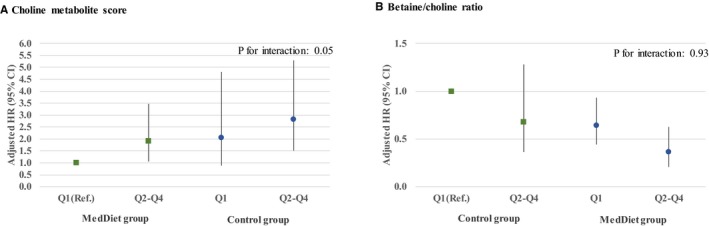
We designed a case-cohort study nested within the PREDIMED (Prevention With Mediterranean Diet) trial, including 229 incident CVD cases and 751 randomly selected participants at baseline, followed up for 4.8 years. We used liquid chromatography-tandem mass spectrometry to measure, at baseline and at 1 year of follow-up, plasma concentrations of 5 metabolites in the choline pathway: trimethylamine N-oxide, betaine, choline, phosphocholine, and α-glycerophosphocholine. We have calculated a choline metabolite score using a weighted sum of these 5 metabolites. We used weighted Cox regression models to estimate CVD risk. The multivariable hazard ratios (95% confidence intervals) per 1-SD increase in choline and α-glycerophosphocholine metabolites were 1.24 (1.05-1.46) and 1.24 (1.03-1.50), respectively. The baseline betaine/choline ratio was inversely associated with CVD. The baseline choline metabolite score was associated with a 2.21-fold higher risk of CVD across extreme quartiles (95% confidence interval, 1.36-3.59; <0.001 for trend) and a 2.27-fold higher risk of stroke (95% confidence interval, 1.24-4.16; <0.001 for trend). Participants in the higher quartiles of the score who were randomly assigned to the control group had a higher risk of CVD compared with participants in the lower quartile and assigned to the Mediterranean diet groups (=0.05 for interaction). No significant associations were observed for 1-year changes in individual plasma metabolites and CVD.
A metabolite score combining plasma metabolites from the choline pathway was associated with an increased risk of CVD in a Mediterranean population at high cardiovascular risk.
URL: http://www.controlled-trials.com. Unique identifier: ISRCTN35739639.
血浆甜菜碱和胆碱代谢物浓度与主要心血管疾病(CVD)终点之间的关系尚不清楚。我们评估了胆碱通路代谢物与新发 CVD 风险之间的关联,以及地中海饮食干预的潜在调节作用。
我们在 PREDIMED(地中海饮食预防)试验中设计了一项病例-队列研究,包括 229 例新发 CVD 病例和基线时随机选择的 751 例参与者,随访 4.8 年。我们使用液相色谱-串联质谱法在基线和随访 1 年时测量了胆碱通路中 5 种代谢物的血浆浓度:三甲胺 N-氧化物、甜菜碱、胆碱、磷酸胆碱和α-甘油磷酸胆碱。我们使用这些 5 种代谢物的加权和计算了胆碱代谢物评分。我们使用加权 Cox 回归模型来估计 CVD 风险。每增加 1-SD 胆碱和α-甘油磷酸胆碱代谢物,CVD 的多变量危险比(95%置信区间)分别为 1.24(1.05-1.46)和 1.24(1.03-1.50)。基线甜菜碱/胆碱比值与 CVD 呈负相关。基线胆碱代谢物评分与 CVD 风险呈 2.21 倍相关性(四分位数范围,1.36-3.59;趋势 P<0.001),与卒中风险呈 2.27 倍相关性(四分位数范围,1.24-4.16;趋势 P<0.001)。评分较高的四分位数组中的参与者被随机分配到对照组时,与评分较低的四分位数组和被分配到地中海饮食组的参与者相比,CVD 风险更高(=0.05 交互作用)。在个体血浆代谢物的 1 年变化与 CVD 之间未观察到显著相关性。
在高心血管风险的地中海人群中,结合胆碱通路血浆代谢物的代谢物评分与 CVD 风险增加相关。