Yoon Eun-Jeong, Kang Da Young, Yang Ji Woo, Kim Dokyun, Lee Hyukmin, Lee Kwang Jun, Jeong Seok Hoon
College of Medicine, Yonsei University, Seoul, South Korea.
College of Health Science, Sangji University, Wonju, South Korea.
Front Microbiol. 2018 Mar 29;9:571. doi: 10.3389/fmicb.2018.00571. eCollection 2018.
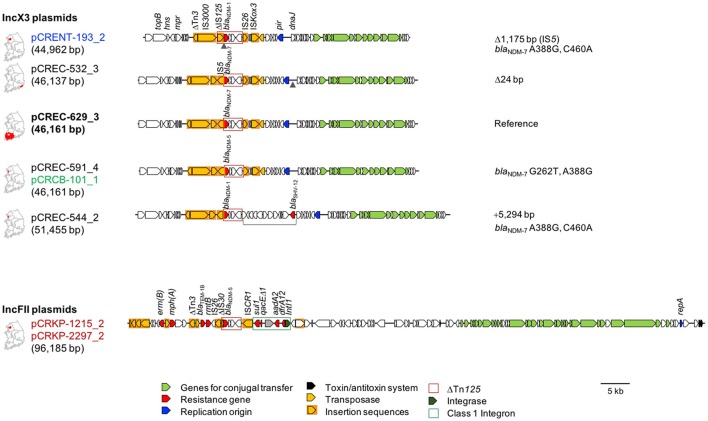
This study was carried out to investigate the epidemiological time-course of New Delhi metallo-beta-lactamase- (NDM-) mediated carbapenem resistance in Enterobacteriaceae in South Korea. A total of 146 non-duplicate NDM-producing Enterobacteriaceae recovered between 2010 and 2015 were voluntarily collected from 33 general hospitals and confirmed by PCR. The species were identified by sequences of the 16S rDNA. Antimicrobial susceptibility was determined either by the disk diffusion method or by broth microdilution, and the carbapenem MICs were determined by agar dilution. Then, multilocus sequence typing and PCR-based replicon typing was carried out. Co-carried genes for drug resistance were identified by PCR and sequencing. The entire genomes of eight random selected NDM producers were sequenced. A total of 69 of 12 sequence types (STs), 34 of 15 STs, 28 spp. (including one ), nine , four spp., and two isolates produced either NDM-1 ( = 126), NDM-5 ( = 18), or NDM-7 ( = 2). The isolates co-produced CTX-M-type ESBL (52.1%), AmpCs (27.4%), additional carbapenemases (7.1%), and/or 16S rRNA methyltransferases (4.8%), resulting in multidrug-resistance (47.9%) or extensively drug-resistance (52.1%). Among plasmids harboring , IncX3 was predominant (77.4%), followed by the IncFII type (5.8%). Genome analysis revealed inter-species and inter-strain horizontal gene transfer of the plasmid. Both clonal dissemination and plasmid transfer contributed to the wide dissemination of NDM producers in South Korea.
本研究旨在调查韩国肠杆菌科细菌中由新德里金属β-内酰胺酶(NDM)介导的碳青霉烯类耐药的流行病学时间进程。2010年至2015年间,从33家综合医院自愿收集了总共146株非重复的产NDM肠杆菌科细菌,并通过PCR进行确认。通过16S rDNA序列鉴定菌种。采用纸片扩散法或肉汤微量稀释法测定抗菌药物敏感性,通过琼脂稀释法测定碳青霉烯类药物的最低抑菌浓度(MIC)。然后,进行多位点序列分型和基于PCR的复制子分型。通过PCR和测序鉴定共携带的耐药基因。对随机选择的8株产NDM细菌的全基因组进行测序。12种序列类型(STs)中的69株、15种STs中的34株、28个种(包括1个种)、9株、4个种和2株分离株产生NDM-1(n = 126)、NDM-5(n = 18)或NDM-7(n = 2)。这些分离株共产生CTX-M型超广谱β-内酰胺酶(ESBL,52.1%)、AmpC酶(27.4%)、其他碳青霉烯酶(7.1%)和/或16S rRNA甲基转移酶(4.8%),导致多重耐药(47.9%)或广泛耐药(52.1%)。在携带NDM的质粒中,IncX3型占主导(77.4%),其次是IncFII型(5.8%)。基因组分析揭示了质粒的种间和菌株间水平基因转移。克隆传播和质粒转移都促成了产NDM细菌在韩国的广泛传播。