Ludwig Boltzmann Institute for Rare and Undiagnosed Diseases, Vienna, Austria.
CeMM Research Center for Molecular Medicine of the Austrian Academy of Sciences, Vienna, Austria.
Front Immunol. 2018 Mar 29;9:588. doi: 10.3389/fimmu.2018.00588. eCollection 2018.
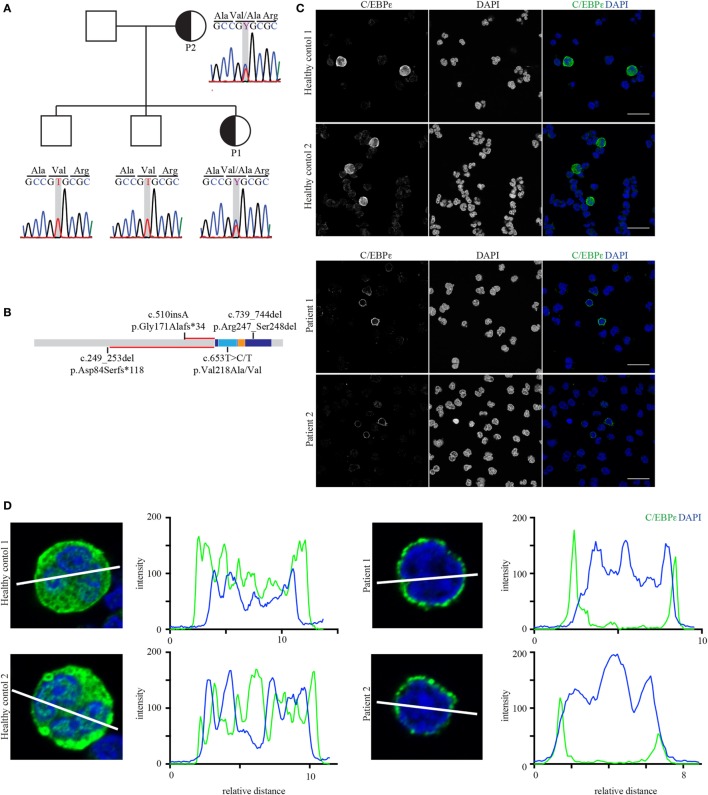
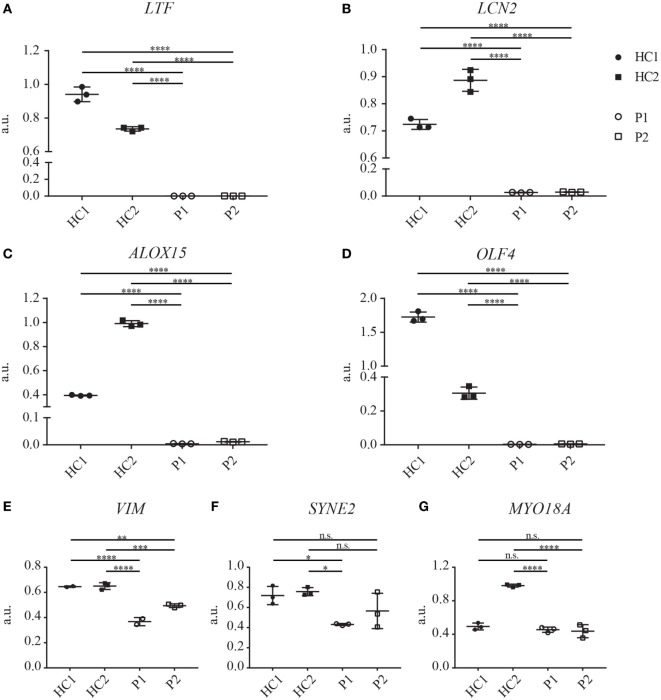
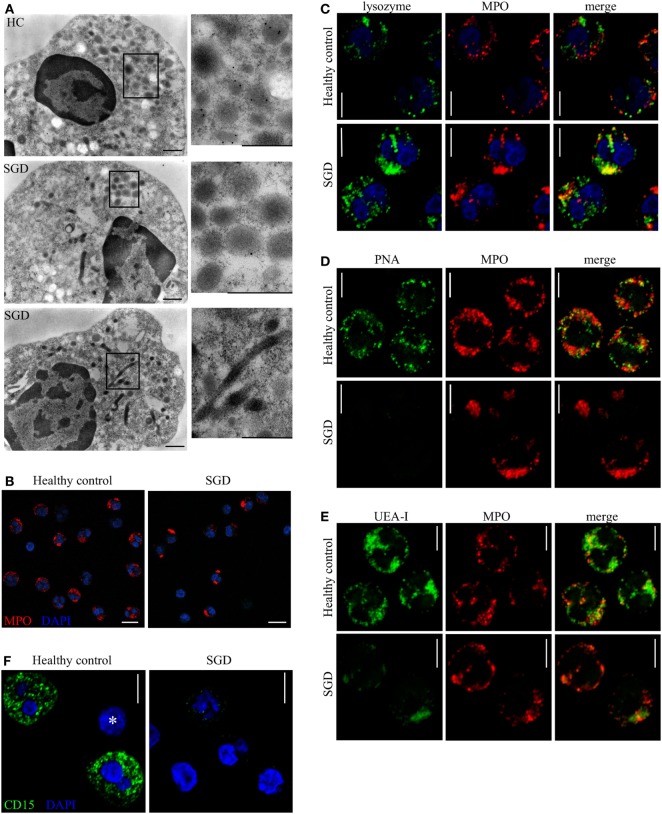
Specific granule deficiency (SGD) is a rare disorder characterized by abnormal neutrophils evidenced by reduced granules, absence of granule proteins, and atypical bilobed nuclei. Mutations in () are one molecular etiology of the disease. Although C/EBPε has been studied extensively, the impact of mutations on neutrophil biology remains elusive. Here, we identified two SGD patients bearing a previously described heterozygous mutation (p.Val218Ala) in . We took this rare opportunity to characterize SGD neutrophils in terms of granule distribution and protein content. Granules of patient neutrophils were clustered and polarized, suggesting that not only absence of specific granules but also defects affecting other granules contribute to the phenotype. Our analysis showed that remaining granules displayed mixed protein content and lacked several glycoepitopes. To further elucidate the impact of mutant , we performed detailed proteomic analysis of SGD neutrophils. Beside an absence of several granule proteins in patient cells, we observed increased expression of members of the linker of nucleoskeleton and cytoskeleton complex (nesprin-2, vimentin, and lamin-B2), which control nuclear shape. This suggests that absence of these proteins in healthy individuals might be responsible for segmented shapes of neutrophilic nuclei. We further show that the heterozygous mutation p.Val218Ala in causes SGD through prevention of nuclear localization of the protein product. In conclusion, we uncover that absence of nuclear C/EBPε impacts on spatiotemporal expression and subsequent distribution of several granule proteins and further on expression of proteins controlling nuclear shape.
特异性颗粒缺乏症(SGD)是一种罕见的疾病,其特征为中性粒细胞异常,表现为颗粒减少、颗粒蛋白缺失和非典型分叶核。()突变是该疾病的一种分子病因。尽管 C/EBPε 已被广泛研究,但突变对中性粒细胞生物学的影响仍不清楚。在这里,我们鉴定了两名 SGD 患者携带先前描述的杂合突变(p.Val218Ala)。我们利用这一罕见的机会,从颗粒分布和蛋白含量两方面对 SGD 中性粒细胞进行了特征描述。患者中性粒细胞的颗粒发生聚集和极化,这表明不仅特定颗粒缺失,而且影响其他颗粒的缺陷也导致了这种表型。我们的分析表明,剩余的颗粒显示出混合的蛋白含量,并且缺乏几个糖基表位。为了进一步阐明突变的影响,我们对 SGD 中性粒细胞进行了详细的蛋白质组学分析。除了患者细胞中几种颗粒蛋白缺失外,我们还观察到核骨架和细胞骨架连接蛋白复合体(nesprin-2、波形蛋白和核纤层蛋白-B2)成员的表达增加,这些蛋白控制着核的形状。这表明在健康个体中这些蛋白的缺失可能是导致中性粒细胞核分叶形状的原因。我们进一步表明,()中的杂合突变 p.Val218Ala 通过阻止蛋白产物的核定位导致 SGD。总之,我们揭示了核 C/EBPε 的缺失会影响几个颗粒蛋白的时空表达和随后的分布,并进一步影响控制核形状的蛋白的表达。