Department of Immunology, Faculty of Medicine, Technion - Israel Institute of Technology, Haifa, Israel.
Front Immunol. 2018 Mar 29;9:623. doi: 10.3389/fimmu.2018.00623. eCollection 2018.
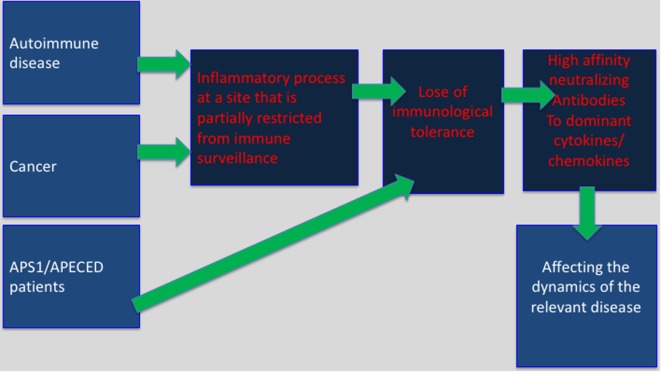
We have previously shown that predominant expression of key inflammatory cytokines and chemokines at autoimmune sites or tumor sites induces loss of B cells tolerance, resulting in autoantibody production against the dominant cytokine/chemokine that is largely expressed at these sites. These autoantibodies are high-affinity neutralizing antibodies. Based on animal models studies, we suggested that they participate in the regulation of cancer and autoimmunity, albeit at the level of their production cannot entirely prevent the development and progression of these diseases. We have, therefore, named this selective breakdown of tolerance as "Beneficial Autoimmunity." Despite its beneficial outcome, this process is likely to be stochastic and not directed by a deterministic mechanism, and is likely to be associated with the dominant expression of these inflammatory mediators at sites that are partially immune privileged. A recent study conducted on autoimmune regulator-deficient patients reported that in human this type of breakdown of B cell tolerance is T cell dependent. This explains, in part, why the response is highly restricted, and includes high-affinity antibodies. The current mini-review explores this subject from different complementary perspectives. It also discusses three optional translational aspects: amplification of autoantibody production as a therapeutic approach, development of autoantibody based diagnostic tools, and the use of B cells from donors that produce these autoantibodies for the development of high-affinity human monoclonal antibodies.
我们之前已经表明,在自身免疫或肿瘤部位主要表达关键的炎症细胞因子和趋化因子会导致 B 细胞耐受丧失,从而产生针对这些部位大量表达的主要细胞因子/趋化因子的自身抗体。这些自身抗体是高亲和力的中和抗体。基于动物模型研究,我们认为它们参与了癌症和自身免疫的调节,尽管在其产生水平上不能完全阻止这些疾病的发展和进展。因此,我们将这种选择性的耐受破坏命名为“有益的自身免疫”。尽管其结果有益,但该过程可能是随机的,而不是由确定性机制驱动的,并且可能与这些炎症介质在部分免疫特权部位的主要表达有关。最近对自身免疫调节因子缺陷患者进行的一项研究表明,在人类中,这种 B 细胞耐受的破坏是 T 细胞依赖性的。这部分解释了为什么反应受到高度限制,并且包括高亲和力的抗体。本期小型综述从不同的互补角度探讨了这一主题。它还讨论了三个可选的转化方面:扩增自身抗体产生作为一种治疗方法,开发基于自身抗体的诊断工具,以及使用产生这些自身抗体的供体 B 细胞来开发高亲和力的人类单克隆抗体。