Sharma Seema, Kumar Sujeet, Tewari Prabhat, Pande Shantanu, Murari Manjula
Department of Pathology, Sanjay Gandhi Post Graduate Institute of Medical Sciences, Lucknow, Uttar Pradesh, India.
Department of Anesthesia, Sanjay Gandhi Post Graduate Institute of Medical Sciences, Lucknow, Uttar Pradesh, India.
Ann Card Anaesth. 2018 Apr-Jun;21(2):151-157. doi: 10.4103/aca.ACA_174_17.
Peri-operative monitoring of coagulation is important to diagnose potential cause of hemorrhage, to manage coagulopathy and guide treatment with blood products in patients undergoing cardiac surgery with cardiopulmonary bypass. This study was done to evaluate usefulness of Thromboelastography (TEG) and routine coagulation tests (RCT) in assessing hemostatic changes and predicting postoperative bleeding in patients undergoing cardiac surgery with cardiopulmonary bypass.
Fifty adult patients undergoing cardiac surgery with cardiopulmonary bypass were enrolled in this prospective study. Preoperative and post-operative samples were collected for routine coagulation tests and TEG. Regression analysis and test of significance using Pearson's correlation coefficient was performed to assess correlation between routine coagulation tests and corresponding TEG parameters .Regression analysis was done to study relation between blood loss at 24 hours and various coagulation parameters.
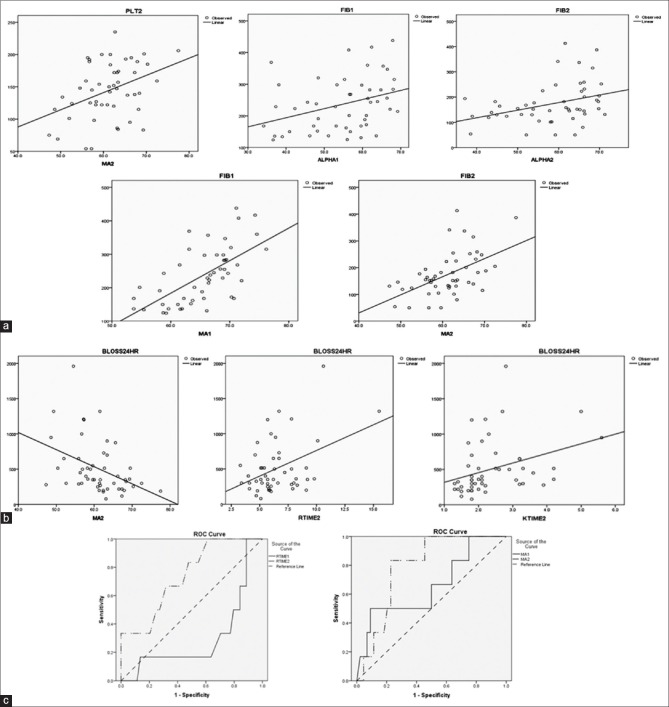
: The Routine coagulation test i.e. PT, INR, APTT showed no significant correlation with corresponding TEG parameters in pre-operative samples. However platelet count significantly correlated (p = 0.004) with MA values in postoperative samples. A significant correlation (p = 0.001) was seen between fibrinogen levels and alpha angles as well as with MA in both baseline preoperative and postoperative samples. TEG parameters R time and MA in postoperative samples were the only parameters that predicted bleeders with fair accuracy.
Though the techniques of RCT and TEG are different, a few RCT e.g. platelet count and fibrinogen correlated with corresponding TEG parameters i.e. MA and Alpha angle. TEG parameters (R time and MA in postoperative samples) were able to predict blood loss better than RCT.
围手术期凝血监测对于诊断出血的潜在原因、处理凝血功能障碍以及指导接受体外循环心脏手术患者的血液制品治疗至关重要。本研究旨在评估血栓弹力图(TEG)和常规凝血试验(RCT)在评估体外循环心脏手术患者止血变化及预测术后出血方面的作用。
五十名接受体外循环心脏手术的成年患者纳入了这项前瞻性研究。采集术前和术后样本进行常规凝血试验和TEG检测。使用Pearson相关系数进行回归分析和显著性检验,以评估常规凝血试验与相应TEG参数之间的相关性。进行回归分析以研究24小时失血量与各种凝血参数之间的关系。
常规凝血试验即PT、INR、APTT在术前样本中与相应的TEG参数无显著相关性。然而,术后样本中血小板计数与MA值显著相关(p = 0.004)。在术前和术后基线样本中,纤维蛋白原水平与α角以及与MA之间均存在显著相关性(p = 0.001)。术后样本中的TEG参数R时间和MA是预测出血者的唯一具有相当准确性的参数。
尽管RCT和TEG技术不同,但一些RCT例如血小板计数和纤维蛋白原与相应的TEG参数即MA和α角相关。TEG参数(术后样本中的R时间和MA)比RCT能更好地预测失血量。