Incyte Corporation, 1801 Augustine Cut-Off, Wilmington, DE, 19803, USA.
UT Health San Antonio Cancer Center, San Antonio, TX, USA.
BMC Cancer. 2018 Apr 13;18(1):420. doi: 10.1186/s12885-018-4322-9.
Patients with the myeloproliferative neoplasms (MPNs) myelofibrosis (MF), polycythemia vera (PV), and essential thrombocythemia (ET) are at increased risk for thrombotic and cardiovascular events and experience a variety of burdensome symptoms. However, there is a paucity of data in the biomedical literature about how MPNs impact productivity in the workplace. This analysis of the Living with MPNs survey was conducted to evaluate the impact of MPNs on employment, career potential, and work productivity.
This cross-sectional online survey included respondents aged 18-70 years living in the United States with a diagnosis of MF, PV, or ET. The survey consisted of ~ 100 questions related to MPN diagnosis, disease-related medical history, MPN-related symptoms and functional status, changes in employment and work productivity, and impact on daily activities since diagnosis. The MPN Symptom Assessment Form Total Symptom Score (MPN-SAF TSS) was used to assess symptom burden. The Work Productivity and Activity Impairment Specific Health Problem questionnaire (WPAI-SHP) was used to assess the effects of MPNs on work productivity and activity (7-day recall) among currently employed respondents. Correlations between MPN-SAF TSS and WPAI-SHP scores were calculated using Spearman's coefficients.
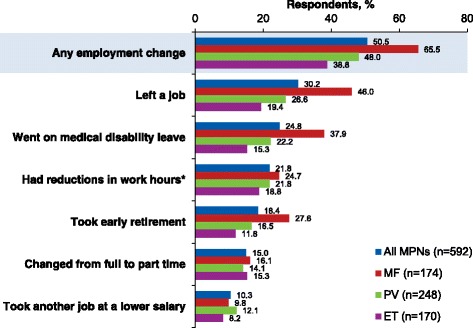
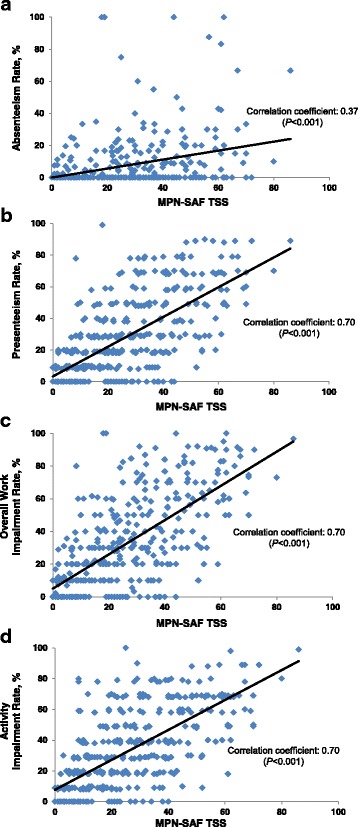
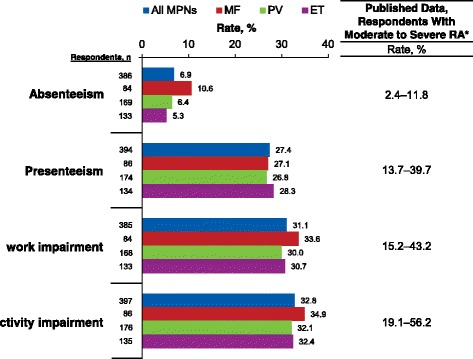
Of 904 respondents, 592 were employed (MF, n = 174; PV, n = 248; ET, n = 170) at the time of their MPN diagnosis. Approximately half (50.5%) of the 592 employed survey respondents reported ≥1 change in employment status because of their diagnosis, most commonly "left a job" (30.2%) "went on medical disability leave" (24.8%), and "had reductions in work hours for at least 3 months" (21.8%). Among respondents who remained employed at the time of survey participation (n = 398), mean WPAI-SHP scores were as follows: absenteeism, 6.9%; presenteeism, 27.4%; overall work impairment, 31.1%; and activity impairment, 32.8%. WPAI-SHP scores positively correlated with MPN-SAF TSS (correlation coefficients, 0.37-0.70; P < 0.001).
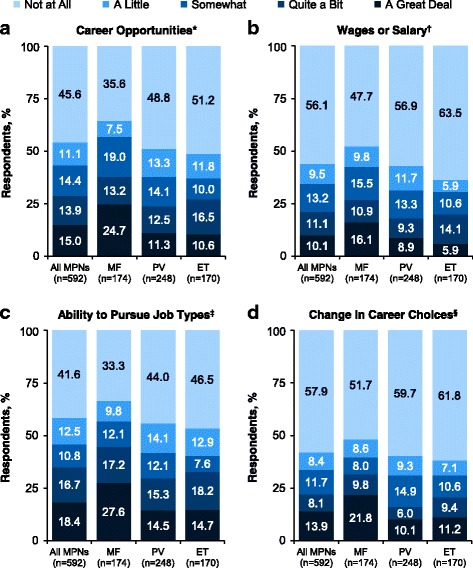
Half of the employed respondents had an employment status change (eg, leaving a job, medical disability leave, early retirement) because of their disease since the diagnosis. Currently employed respondents reported meaningful impairments in work productivity and activities of daily living that were attributable to their MPNs, and the degree of impairments highlighted the severity of symptom burden.
患有骨髓增生性肿瘤(MPN)骨髓纤维化(MF)、真性红细胞增多症(PV)和特发性血小板增多症(ET)的患者发生血栓和心血管事件的风险增加,并经历各种负担沉重的症状。然而,生物医学文献中关于 MPN 如何影响工作场所生产力的数据很少。对生活与 MPN 调查的这项分析是为了评估 MPN 对就业、职业潜力和工作生产力的影响。
这项横断面在线调查包括年龄在 18-70 岁之间的美国 MF、PV 或 ET 诊断患者。该调查包括约 100 个问题,涉及 MPN 诊断、与疾病相关的病史、MPN 相关症状和功能状态、就业和工作生产力变化,以及自诊断以来对日常活动的影响。MPN 症状评估表总症状评分(MPN-SAF TSS)用于评估症状负担。工作生产力和活动障碍特定健康问题问卷(WPAI-SHP)用于评估目前就业的受访者中 MPN 对工作生产力和活动(7 天回顾)的影响。使用 Spearman 系数计算 MPN-SAF TSS 和 WPAI-SHP 评分之间的相关性。
在 904 名受访者中,592 人(MF,n=174;PV,n=248;ET,n=170)在 MPN 诊断时正在工作。大约一半(50.5%)的 592 名在职调查受访者报告说,由于诊断,他们的就业状况发生了至少一次变化,最常见的是“离职”(30.2%)、“请病假”(24.8%)和“工作时间减少至少 3 个月”(21.8%)。在参加调查时仍在职的受访者中(n=398),WPAI-SHP 评分如下:缺勤率为 6.9%;现患率为 27.4%;整体工作障碍率为 31.1%;活动障碍率为 32.8%。WPAI-SHP 评分与 MPN-SAF TSS 呈正相关(相关系数,0.37-0.70;P<0.001)。
自诊断以来,一半的在职受访者因疾病而改变了就业状况(例如,离职、病假、提前退休)。目前在职的受访者报告称,他们的工作生产力和日常生活活动受到了显著的影响,这归因于他们的 MPN,而损害程度突出了症状负担的严重程度。