From the Department of Neuropsychiatric Epidemiology Unit (S.K., J.K., A.Z., M.W., H.W., A.B.-H., I.S.) and Clinical Neurochemistry Laboratory (S.K., H.Z., K.H., U.A., K.B.,), Department of Psychiatry and Neurochemistry, Institute of Neuroscience and Physiology, Sahlgrenska Academy at the University of Gothenburg, Sweden; and UCL Institute of Neurology (H.Z.), Queen Square, London, UK.
Neurology. 2018 May 8;90(19):e1682-e1691. doi: 10.1212/WNL.0000000000005476. Epub 2018 Apr 13.
To determine the prevalence of preclinical Alzheimer disease (AD) according to current classification systems by examining CSF from a representative general population sample of 70-year-olds from Gothenburg, Sweden.
The sample was derived from the population-based H70 Gothenburg Birth Cohort Studies in Gothenburg, Sweden. The participants (n = 322, age 70 years) underwent comprehensive neuropsychiatric, cognitive, and somatic examinations. CSF levels of β-amyloid (Aβ), Aβ, total tau, and phosphorylated tau were measured. Preclinical AD was classified according to criteria of the A/T/N system, Dubois 2016, National Institute on Aging-Alzheimer's Association (NIA-AA) criteria, and International Working Group-2 (IWG-2) criteria. Individuals with Clinical Dementia Rating score >0 were excluded, leaving 259 cognitively unimpaired individuals.
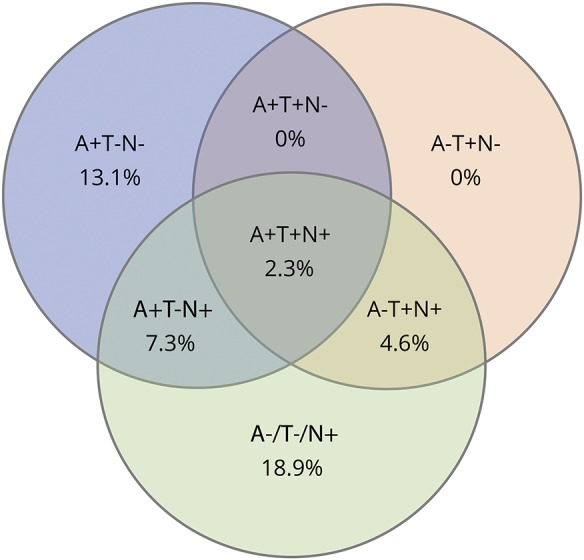
The prevalence of amyloid pathology was 22.8%, of total tau pathology was 33.2%, and of phosphorylated tau pathology was 6.9%. With the A/T/N system, the prevalence of A+/T-/N- was 13.1%, A+/T-/N+ was 7.3%, A+/T+/N+ was 2.3%, A-/T-/N+ was 18.9%, and A-/T+/N+ was 4.6%. When the Dubois criteria were applied, the prevalence of asymptomatic at risk for AD was 36.7% and of preclinical AD was 9.7%. With the NIA-AA criteria, the prevalence of stage 1 was 13.1% and stage 2 was 9.7%. With the IWG-2 criteria, the prevalence of asymptomatic at risk for AD was 9.7%. The ε4 allele was associated with several of the categories. Men more often had total tau pathology, A+/T-/N+, preclinical AD according to Dubois 2016, asymptomatic at risk for AD according to the IWG-2 criteria, and NIA-AA stage 2.
The prevalence of pathologic AD markers was very common (46%) in a representative population sample of 70-year-olds. The clinical implications of these findings need to be scrutinized further in longitudinal studies.
通过检查来自瑞典哥德堡的具有代表性的 70 岁普通人群样本的 CSF,根据当前的分类系统确定临床前阿尔茨海默病(AD)的患病率。
该样本来自瑞典哥德堡的基于人群的 H70 哥德堡出生队列研究。参与者(n=322,年龄 70 岁)接受了全面的神经精神病学、认知和躯体检查。测量 CSF 中β-淀粉样蛋白(Aβ)、Aβ、总 tau 和磷酸化 tau 的水平。根据 A/T/N 系统、杜博伊斯 2016 年、美国国家老龄化研究所-阿尔茨海默病协会(NIA-AA)标准和国际工作组-2(IWG-2)标准对临床前 AD 进行分类。排除临床痴呆评定量表评分>0 的个体,留下 259 名认知正常的个体。
淀粉样蛋白病理的患病率为 22.8%,总 tau 病理的患病率为 33.2%,磷酸化 tau 病理的患病率为 6.9%。根据 A/T/N 系统,A+/T-/N-的患病率为 13.1%,A+/T-/N+为 7.3%,A+/T+/N+为 2.3%,A-/T-/N+为 18.9%,A-/T+/N+为 4.6%。当应用杜博伊斯标准时,无症状 AD 高危人群的患病率为 36.7%,临床前 AD 的患病率为 9.7%。根据 NIA-AA 标准,阶段 1 的患病率为 13.1%,阶段 2 的患病率为 9.7%。根据 IWG-2 标准,无症状 AD 高危人群的患病率为 9.7%。 ε4 等位基因与多个类别相关。男性更常出现总 tau 病理、A+/T-/N+、根据杜博伊斯 2016 年标准的临床前 AD、根据 IWG-2 标准的无症状 AD 高危人群以及 NIA-AA 阶段 2。
在一个具有代表性的 70 岁普通人群样本中,病理性 AD 标志物的患病率非常高(46%)。这些发现的临床意义需要在纵向研究中进一步仔细审查。