Bendels Michael H K, Dietz Michelle Cathrin, Brüggmann Dörthe, Oremek Gerhard Maximilian, Schöffel Norman, Groneberg David A
Division of Computational Medicine, Goethe-Universitat Frankfurt am Main, Institute of Occupational Medicine, Social Medicine and Environmental Medicine, Frankfurt am Main, Germany.
BMJ Open. 2018 Apr 13;8(4):e020089. doi: 10.1136/bmjopen-2017-020089.
The present study aims to elucidate the state of gender equality in high-quality dermatological research by analysing the representation of female authorships from January 2008 to May 2017.
Retrospective, descriptive study.
113 189 male and female authorships from 23 373 research articles published in 23 dermatological Q1 journals were analysed with the aid of the Gendermetrics Platform.
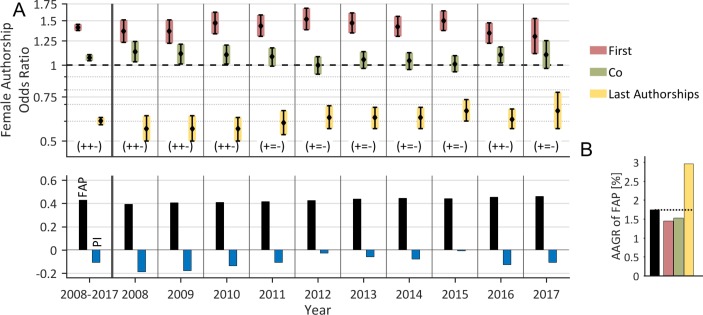
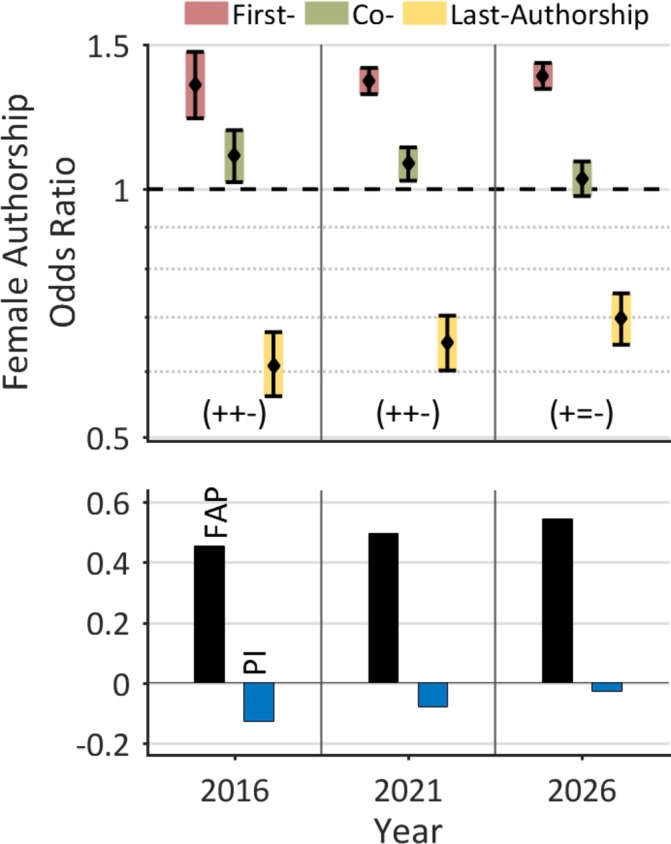
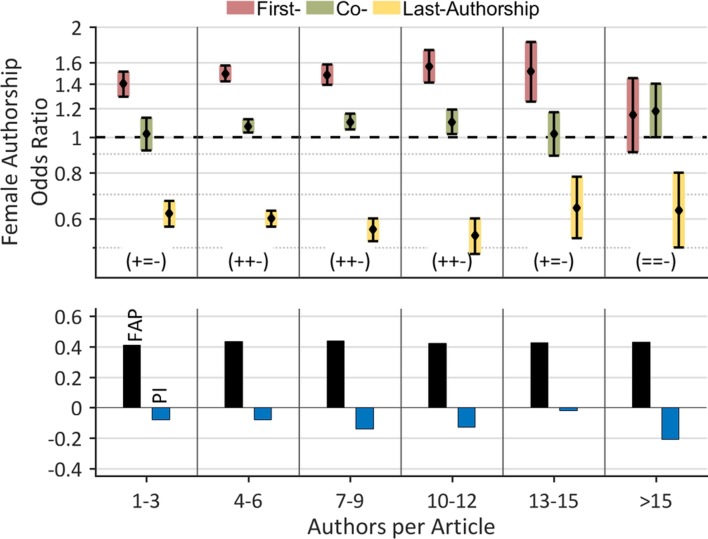
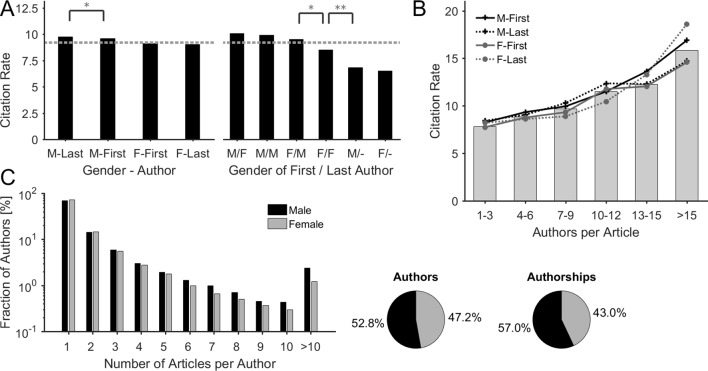
43.0% of all authorships and 50.2% of the firstauthorships, 43.7% of the coauthorships and 33.1% of the last authorships are held by women. The corresponding female-to-male ORs are 1.41 (95% CI 1.37 to 1.45) for first authorships, 1.07 (95% CI 1.04 to 1.10) for coauthorships and 0.60 (95% CI 0.58 to 0.62) for last authorships. The annual growth rates are 1.74% overall and 1.45% for first authorships, 1.53% for coauthorships and 2.97% for last authorships. Women are slightly under-represented at prestigious authorships compared with men (Prestige Index=-0.11). The under-representation remains stable in highly competitive articles attracting the highest citation rates, namely, articles with many authors and articles that were published in highest-impact journals. Multiauthor articles with male key authors are only slightly more frequently cited than those with female key authors. Women publish slightly fewer papers compared with men (47.2% women hold 43.0% of the authorships). At the level of individual journals, there is a high degree of uniformity in gender-specific authorship odds. By contrast, distinct differences at country level were revealed. The prognosis for the next decades forecasts a consecutive harmonisation of authorship odds between the two genders.
In high-quality dermatological research, the integration of female scholars is advanced as compared with other medical disciplines. A gender gap consists mainly in the form of a career dichotomy, with many female early career researchers and few women in academic leadership positions. However, this gender gap has been narrowed in the last decade and will likely be further reduced in the future.
本研究旨在通过分析2008年1月至2017年5月女性作者的代表性,阐明高质量皮肤病学研究中的性别平等状况。
回顾性描述性研究。
借助性别计量平台,对23种皮肤病学Q1期刊发表的23373篇研究论文中的113189名男性和女性作者进行了分析。
所有作者中43.0%为女性,第一作者中50.2%为女性,共同作者中43.7%为女性,最后作者中33.1%为女性。第一作者的女性与男性的相应比值比为1.41(95%可信区间1.37至1.45),共同作者为1.07(95%可信区间1.04至1.10),最后作者为0.60(95%可信区间0.58至0.62)。总体年增长率为1.74%,第一作者为1.45%,共同作者为1.53%,最后作者为2.97%。与男性相比,在享有声望的作者身份中女性的代表性略低(声望指数=-0.11)。在吸引最高引用率的高竞争性文章中,即作者众多的文章和发表在影响最大期刊上的文章中,这种代表性不足的情况保持稳定。男性为主要作者的多作者文章的被引用频率仅略高于女性为主要作者的文章。与男性相比,女性发表的论文略少(47.2%的女性占43.0%的作者身份)。在个别期刊层面,特定性别的作者身份优势存在高度一致性。相比之下,在国家层面发现了明显差异。未来几十年的预测表明,两性之间的作者身份优势将持续趋于一致。
在高质量的皮肤病学研究中,与其他医学学科相比,女性学者的融入程度较高。性别差距主要表现为职业二分法的形式,即许多女性处于早期职业研究阶段,而担任学术领导职位的女性较少。然而,在过去十年中,这种性别差距已经缩小,未来可能会进一步缩小。