Department of Surgery, School of Medicine, The University of North Carolina at Chapel Hill, NC
Cecil G. Sheps Center for Health Services Research, The University of North Carolina at Chapel Hill, NC.
J Am Heart Assoc. 2018 Apr 13;7(8):e007332. doi: 10.1161/JAHA.117.007332.
Available health services data for individuals with peripheral artery disease (PAD) are often from studies of those eligible for or undergoing intervention. Knowledge of the frequency of care and mortality following an initial PAD diagnosis by setting (outpatient versus inpatient) is limited and represents an opportunity to provide new benchmark information.
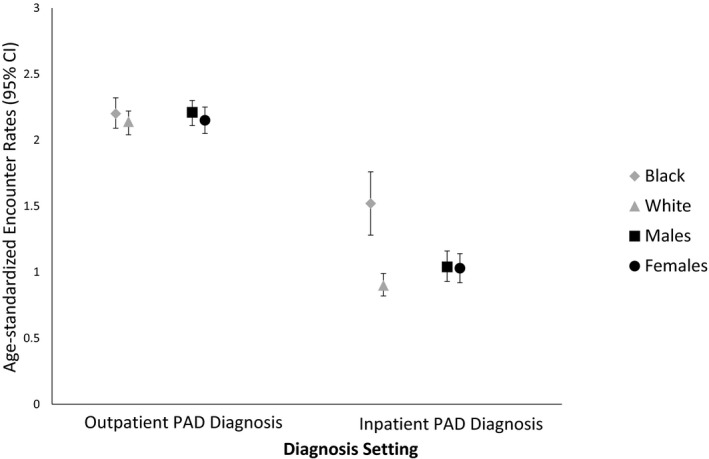
The purpose of this study was to characterize the frequency of care and mortality following an incident PAD diagnosis in the outpatient or inpatient setting using data from the ARIC (Atherosclerosis Risk in Communities) study cohort linked with Centers for Medicare and Medicaid Services fee-for-service claims data (2002-2012). Direct standardization was used to estimate age-standardized rates of encounters and mortality. PAD was defined by billing code in any claim position. We observed 1086 incident PAD cases (873 outpatient, 213 inpatient). At 1 year after diagnosis, participants diagnosed in the outpatient setting had 2.15 (95% confidence interval [CI], 2.10-2.21) PAD-related outpatient encounters per person-year, and 6.4% (95% CI, 4.8-8.1) had a PAD-related hospitalization. Conversely, participants diagnosed in the inpatient setting had 1.02 (95% CI, 0.94-1.10) PAD-related outpatient encounters per person-year, and 14.2% (95% CI, 9.3-18.7) had a PAD-related rehospitalization. One-year mortality was 7.1% (95% CI, 5.4-8.7) and 16.0% (95% CI, 11.0-21.1) among those diagnosed in outpatient and inpatient settings, respectively.
This study provides important data estimating frequency of care and mortality by the setting of initial PAD diagnosis. Individuals with PAD are frequent users of health care, and those diagnosed in the inpatient setting have high rates of rehospitalization and mortality.
外周动脉疾病(PAD)患者的现有卫生服务数据通常来自于符合介入条件或正在接受介入治疗的研究。对于初始 PAD 诊断后门诊与住院患者的护理和死亡率知之甚少,这为提供新的基准信息提供了机会。
本研究旨在利用 ARIC(社区动脉粥样硬化风险)研究队列与医疗保险和医疗补助服务按服务收费数据(2002-2012 年)相关联的数据,描述门诊或住院环境中 PAD 初始诊断后的护理和死亡率的发生频率。直接标准化用于估计按年龄标准化的就诊和死亡率。在任何索赔位置使用计费代码定义 PAD。我们观察到 1086 例 PAD 事件(873 例门诊,213 例住院)。在诊断后 1 年,在门诊环境中诊断出的患者每人每年有 2.15 次(95%置信区间 [CI],2.10-2.21)PAD 相关的门诊就诊,6.4%(95% CI,4.8-8.1)发生 PAD 相关住院。相反,在住院环境中诊断出的患者每人每年有 1.02 次(95% CI,0.94-1.10)PAD 相关的门诊就诊,14.2%(95% CI,9.3-18.7)发生 PAD 相关再住院。门诊和住院诊断患者的 1 年死亡率分别为 7.1%(95% CI,5.4-8.7)和 16.0%(95% CI,11.0-21.1)。
本研究提供了重要数据,估计了初始 PAD 诊断时护理和死亡率的发生频率。PAD 患者是医疗保健的高频使用者,住院诊断患者的再住院率和死亡率较高。