Yokoshiki Hisashi, Shimizu Akihiko, Mitsuhashi Takeshi, Furushima Hiroshi, Sekiguchi Yukio, Manaka Tetsuyuki, Nishii Nobuhiro, Ueyama Takeshi, Morita Norishige, Okamura Hideo, Nitta Takashi, Hirao Kenzo, Okumura Ken
Department of Cardiovascular Medicine Hokkaido University Graduate School of Medicine Sapporo Japan.
Faculty of Health Sciences Yamaguchi Graduate School of Medicine Ube Japan.
J Arrhythm. 2018 Jan 12;34(2):139-147. doi: 10.1002/joa3.12023. eCollection 2018 Apr.
Whether nonsustained ventricular tachycardia (NSVT) is a marker of increased risk of sustained ventricular tachyarrhythmias (VTAs) remains to be established in patients receiving cardiac resynchronization therapy with a defibrillator (CRT-D) for primary prevention.
Among the follow-up data of the Japan cardiac device treatment registry (JCDTR) with an implantation date between January 2011 and August 2015, information regarding a history of NSVT before the CRT-D implantation for primary prevention had been registered in 269 patients. Outcomes were compared between two groups with and without NSVT: NSVT group (n = 179) and No NSVT group (n = 90).
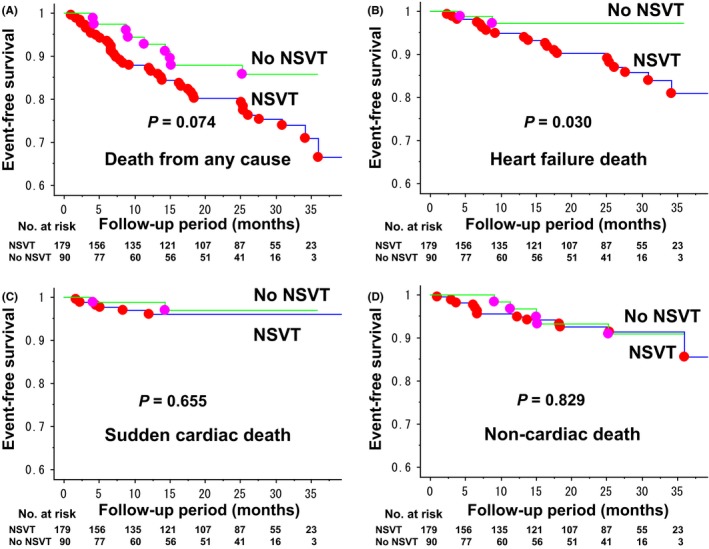
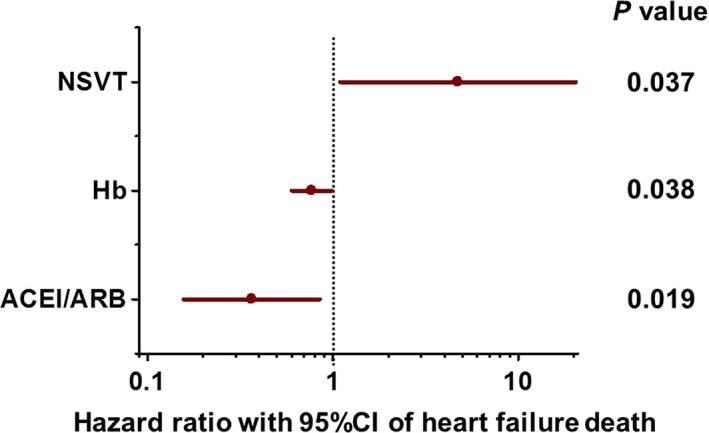
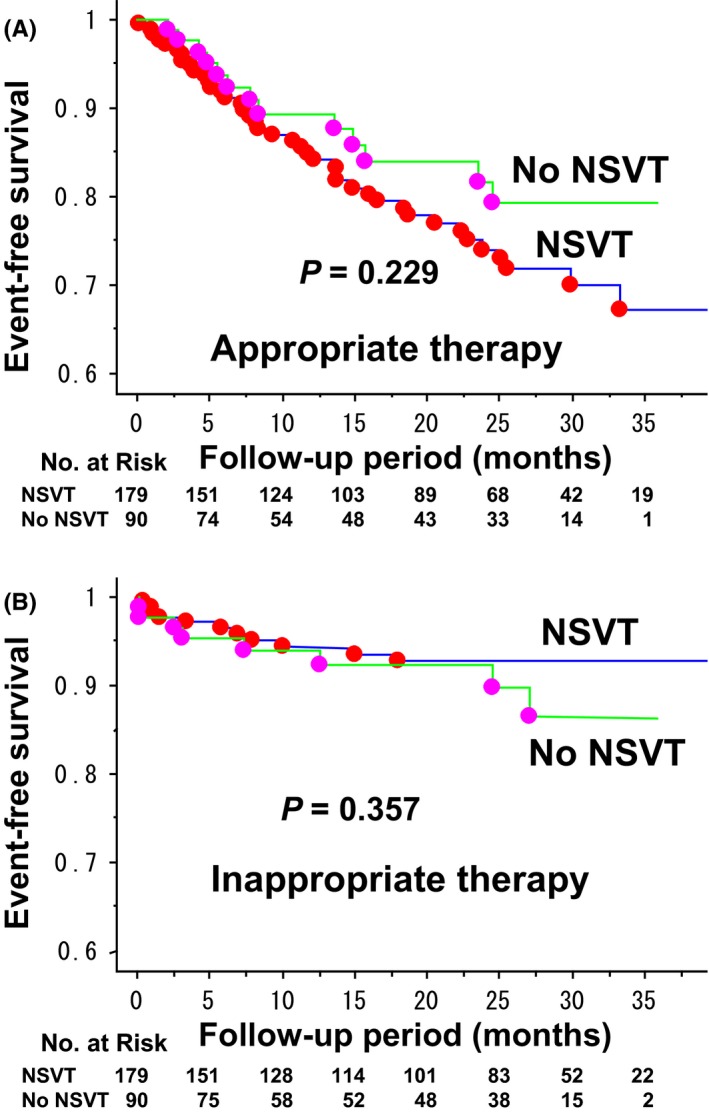
There was no significant difference with regard to age, gender, and NYHA class between the two groups. Left ventricular ejection fraction (LVEF) was 25.6% in the NSVT group and 28.0% in the No NSVT group ( = .046). The rate of appropriate therapy at 24 months was 26.0% and 18.4% in the NSVT and No NSVT groups ( = .22), respectively. Survival free from heart failure death was reduced in the NSVT group, as compared with the No NSVT group, with the rate of 90.2% vs 97.2% at 24 months ( = .030). A multivariate analysis identified a history of NSVT, anemia, and no use of angiotensin-converting enzyme inhibitor (ACEI) or angiotensin-receptor blocker (ARB) as predictors of heart failure death.
NSVT appears to be a surrogate marker of severe heart failure rather than a substrate for subsequent sustained VTAs in patients with CRT-D for primary prevention.
对于接受心脏再同步化治疗除颤器(CRT-D)进行一级预防的患者,非持续性室性心动过速(NSVT)是否是持续性室性心律失常(VTA)风险增加的标志物仍有待确定。
在日本心脏器械治疗注册研究(JCDTR)2011年1月至2015年8月植入器械的随访数据中,有269例患者登记了一级预防CRT-D植入前的NSVT病史。比较有和没有NSVT的两组患者的结局:NSVT组(n = 179)和无NSVT组(n = 90)。
两组在年龄、性别和纽约心脏协会(NYHA)分级方面无显著差异。NSVT组的左心室射血分数(LVEF)为25.6%,无NSVT组为28.0%(P = 0.046)。NSVT组和无NSVT组24个月时的恰当治疗率分别为26.0%和18.4%(P = 0.22)。与无NSVT组相比,NSVT组无心力衰竭死亡的生存率降低,24个月时的生存率分别为90.2%和97.2%(P = 0.030)。多变量分析确定NSVT病史、贫血以及未使用血管紧张素转换酶抑制剂(ACEI)或血管紧张素受体阻滞剂(ARB)是心力衰竭死亡的预测因素。
对于接受CRT-D进行一级预防的患者,NSVT似乎是严重心力衰竭的替代标志物,而非后续持续性VTA的基质。