Sherratt Emma, Rasmussen Arne R, Sanders Kate L
School of Biological Sciences, The University of Adelaide, Adelaide, South Australia 5005, Australia.
The Royal Danish Academy of Fine Arts, Schools of Architecture, Design and Conservation, Copenhagen K, Denmark.
R Soc Open Sci. 2018 Mar 28;5(3):172141. doi: 10.1098/rsos.172141. eCollection 2018 Mar.
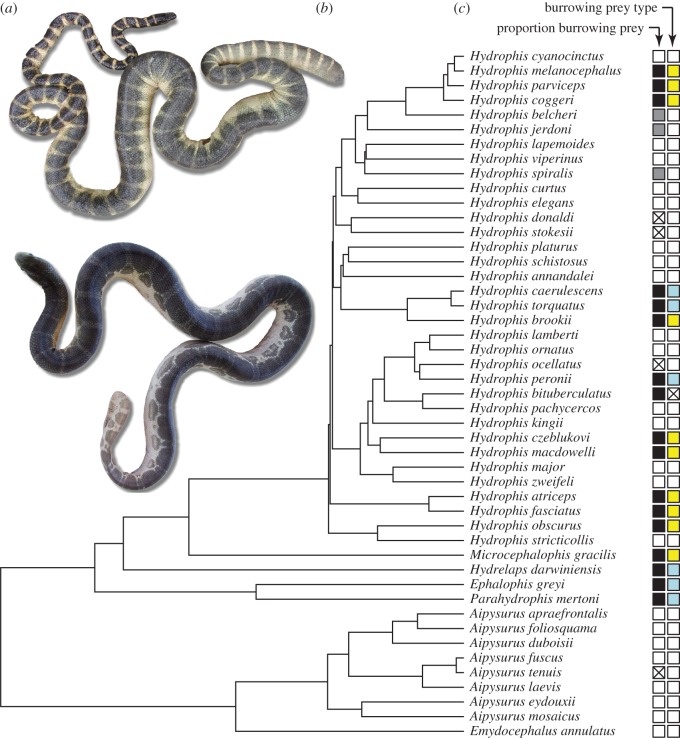
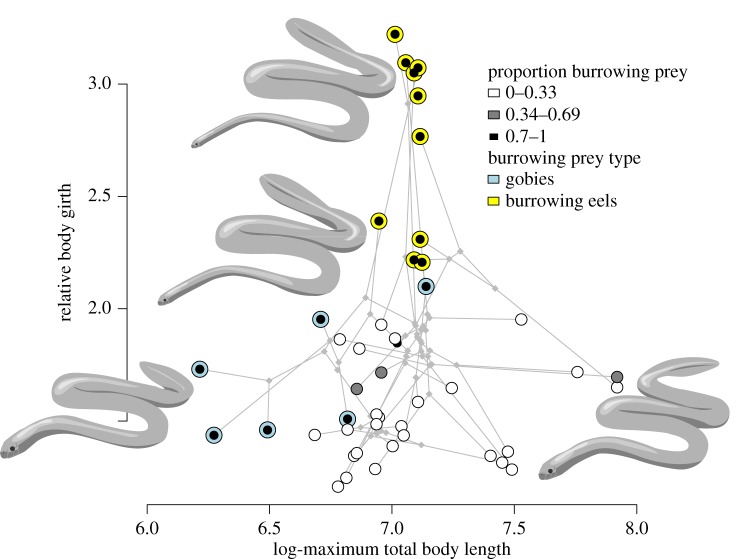
Viviparous sea snakes are the most rapidly speciating reptiles known, yet the ecological factors underlying this radiation are poorly understood. Here, we reconstructed dated trees for 75% of sea snake species and quantified body shape (forebody relative to hindbody girth), maximum body length and trophic diversity to examine how dietary specialization has influenced morphological diversification in this rapid radiation. We show that sea snake body shape and size are strongly correlated with the proportion of burrowing prey in the diet. Specialist predators of burrowing eels have convergently evolved a 'microcephalic' morphotype with dramatically reduced forebody relative to hindbody girth and intermediate body length. By comparison, snakes that predominantly feed on burrowing gobies are generally short-bodied and small-headed, but there is no evidence of convergent evolution. The eel specialists also exhibit faster rates of size and shape evolution compared to all other sea snakes, including those that feed on gobies. Our results suggest that trophic specialization to particular burrowing prey (eels) has invoked strong selective pressures that manifest as predictable and rapid morphological changes. Further studies are needed to examine the genetic and developmental mechanisms underlying these dramatic morphological changes and assess their role in sea snake speciation.
胎生海蛇是已知物种形成速度最快的爬行动物,但这种辐射现象背后的生态因素却鲜为人知。在此,我们为75%的海蛇物种重建了带时间信息的系统发育树,并对体型(前体相对于后体周长)、最大体长和营养多样性进行了量化,以研究食性特化如何在这种快速辐射中影响形态多样化。我们发现,海蛇的体型和大小与饮食中穴居猎物的比例密切相关。以穴居鳗鱼为食的特化捕食者趋同进化出一种“小头”形态类型,其前体相对于后体周长显著减小,体长中等。相比之下,主要以穴居虾虎鱼为食的蛇通常体型短小、头部较小,但没有趋同进化的证据。与所有其他海蛇(包括以虾虎鱼为食的海蛇)相比,以鳗鱼为食的特化者在体型和形状进化上的速度也更快。我们的研究结果表明,对特定穴居猎物(鳗鱼)的食性特化引发了强大的选择压力,表现为可预测的快速形态变化。需要进一步研究来探究这些显著形态变化背后的遗传和发育机制,并评估它们在海蛇物种形成中的作用。