Museum of Zoology and Department of Ecology and Evolutionary Biology, University of Michigan, Ann Arbor, Michigan, United States of America.
PLoS Biol. 2021 Oct 14;19(10):e3001414. doi: 10.1371/journal.pbio.3001414. eCollection 2021 Oct.
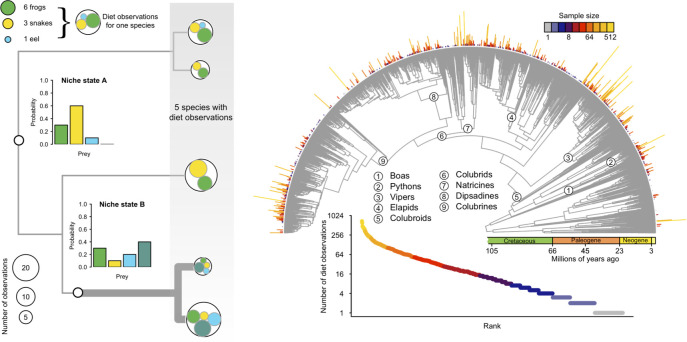
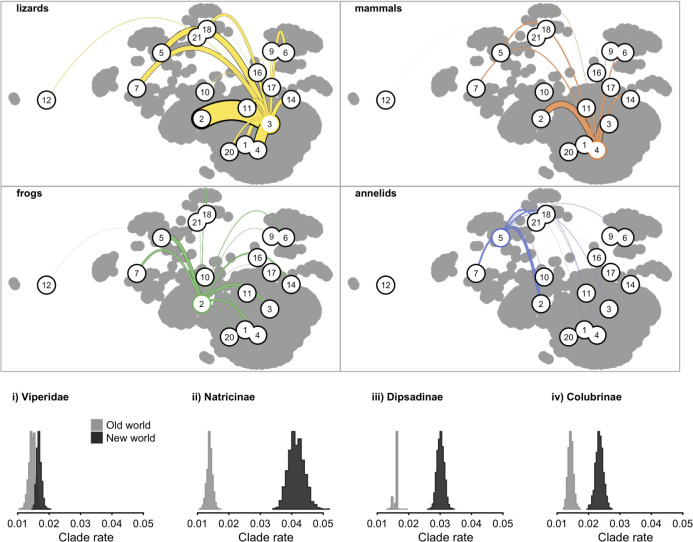
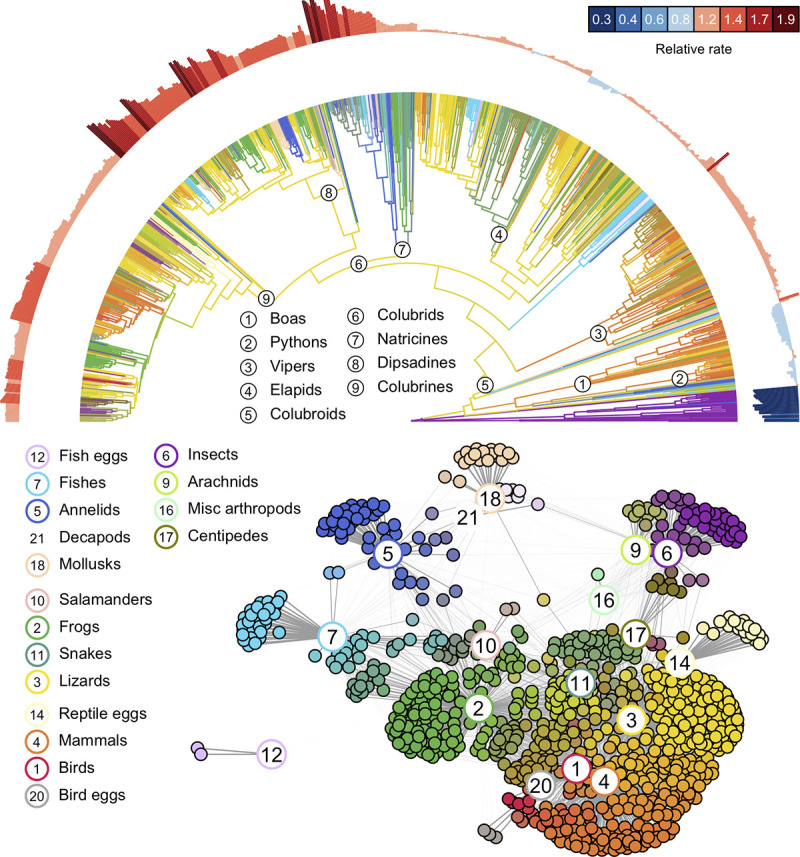
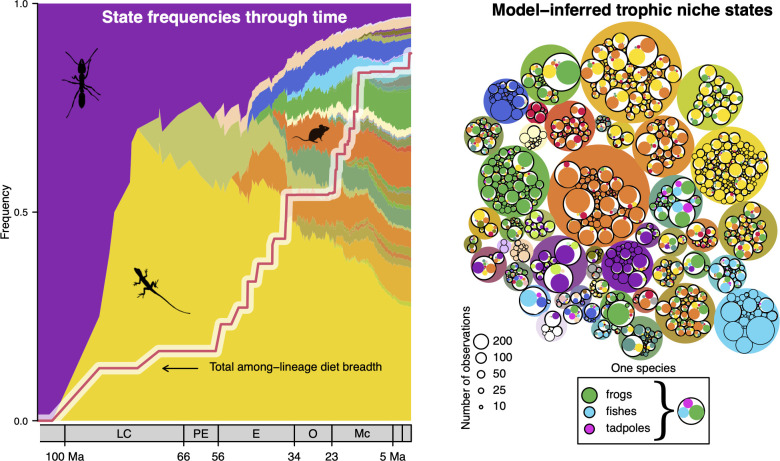
The Cenozoic marked a period of dramatic ecological opportunity in Earth history due to the extinction of non-avian dinosaurs as well as to long-term physiographic changes that created new biogeographic theaters and new habitats. Snakes underwent massive ecological diversification during this period, repeatedly evolving novel dietary adaptations and prey preferences. The evolutionary tempo and mode of these trophic ecological changes remain virtually unknown, especially compared with co-radiating lineages of birds and mammals that are simultaneously predators and prey of snakes. Here, we assemble a dataset on snake diets (34,060 observations on the diets of 882 species) to investigate the history and dynamics of the multidimensional trophic niche during the global radiation of snakes. Our results show that per-lineage dietary niche breadths remained remarkably constant even as snakes diversified to occupy disparate outposts of dietary ecospace. Rapid increases in dietary diversity and complexity occurred in the early Cenozoic, and the overall rate of ecospace expansion has slowed through time, suggesting a potential response to ecological opportunity in the wake of the end-Cretaceous mass extinction. Explosive bursts of trophic innovation followed colonization of the Nearctic and Neotropical realms by a group of snakes that today comprises a majority of living snake diversity. Our results indicate that repeated transformational shifts in dietary ecology are important drivers of adaptive radiation in snakes and provide a framework for analyzing and visualizing the evolution of complex ecological phenotypes on phylogenetic trees.
新生代标志着地球历史上一个生态机会的急剧时期,这是由于非鸟类恐龙的灭绝以及长期的地貌变化,这些变化创造了新的生物地理剧场和新的栖息地。在这段时间里,蛇类经历了大规模的生态多样化,反复进化出新颖的饮食适应和猎物偏好。这些营养生态变化的进化速度和模式实际上是未知的,特别是与同时是蛇类的捕食者和猎物的鸟类和哺乳动物的共同辐射谱系相比。在这里,我们收集了一组关于蛇类饮食的数据(882 种蛇类的 34060 个饮食观察),以研究蛇类全球辐射过程中多维营养生态位的历史和动态。我们的结果表明,即使蛇类多样化以占据不同的饮食生态位,每个谱系的饮食生态位广度仍保持着显著的恒定。在新生代早期,饮食多样性和复杂性迅速增加,生态位扩张的总体速度随着时间的推移而放缓,这表明在白垩纪末期大规模灭绝之后,生态机会可能是一个潜在的反应。在一组蛇类殖民北美和新热带地区之后,出现了大量的营养创新爆发,而今天,这些蛇类构成了大多数现存蛇类的多样性。我们的结果表明,饮食生态学的反复变革性转变是蛇类适应性辐射的重要驱动因素,并为在系统发育树上分析和可视化复杂生态表型的进化提供了一个框架。