Dantas Alisson F, Lopes Renata M, Fascineli Maria L, José Solange C B R, Pádua Juliano G, Gimenes Marcos A, Grisolia Cesar K
Laboratório de Genética Toxicológica, Departamento de Genética e Morfologia, Instituto de Ciências Biológicas, Universidade de Brasília, Brasília, DF, Brazil.
Departmento de Botânica, Instituto de Ciências Biológicas, Universidade de Brasília, Brasília, DF, Brazil.
Genet Mol Biol. 2018 Jan-Mar;41(1):145-153. doi: 10.1590/1678-4685-GMB-2017-0020.
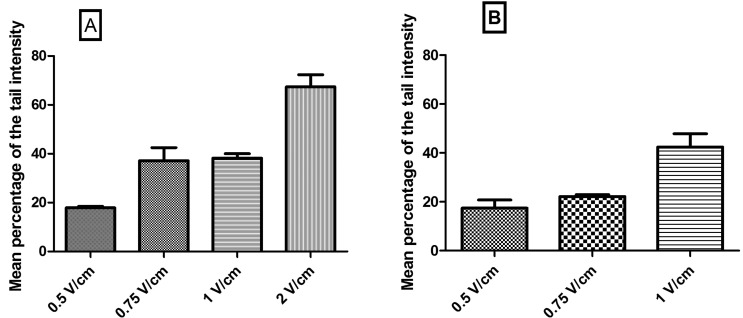
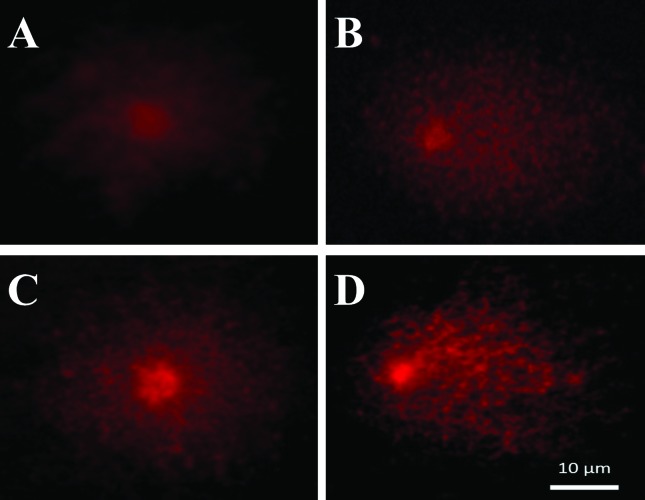
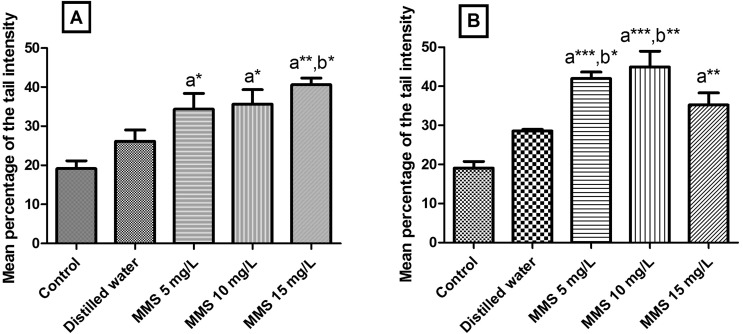
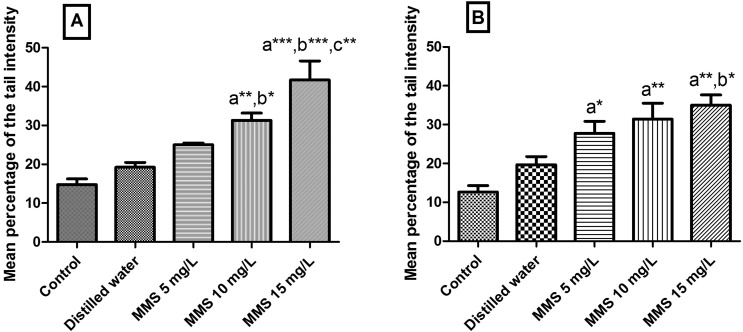
This study aimed to assess the feasibility of comet and cytogenetic tests as tools for evaluating genomic instability in seeds of Oryza sativa L. (rice) and Phaseolus vulgaris (beans) L. from gene banks. Rice and beans were exposed to methyl methanesulfonate (MMS) as a reference DNA damaging agent. Seeds of two accessions of rice and beans were obtained from Embrapa Rice and Beans - Brazil. Seed groups were imbibed in three concentrations of MMS for three periods of time to carry out cytogenetic tests, and for one period for the comet test. At concentrations of 10 and 15 mg/L, MMS induced cytotoxic and/or mutagenic effects in the meristematic cells of roots from all the accessions of both species. In the comet test, MMS induced genotoxic effects at all the concentrations in the evaluated accessions of rice and beans, except in one accession of beans at the lowest concentration (5 mg/L). Both species showed sensitivity to MMS. The comet test can be proposed for the measurement of genomic instability in accessions of rice and beans in gene banks, as being more sensitive than the cytogenetic tests used.
本研究旨在评估彗星试验和细胞遗传学试验作为评估基因库中水稻(Oryza sativa L.)和菜豆(Phaseolus vulgaris L.)种子基因组不稳定性工具的可行性。水稻和菜豆被用作甲基磺酸甲酯(MMS)作为参考DNA损伤剂的实验对象。两种水稻和菜豆品种的种子取自巴西农业研究公司水稻和豆类研究所。种子组在三种浓度的MMS中浸泡三个时间段以进行细胞遗传学试验,并在一个时间段内进行彗星试验。在10和15 mg/L的浓度下,MMS对两种物种所有品种根的分生细胞均诱导了细胞毒性和/或诱变效应。在彗星试验中,除了最低浓度(5 mg/L)的一个菜豆品种外,MMS在评估的水稻和菜豆品种的所有浓度下均诱导了遗传毒性效应。两种物种均对MMS敏感。彗星试验可用于测量基因库中水稻和菜豆品种的基因组不稳定性,因为它比所使用的细胞遗传学试验更敏感。