Department of Basic and Clinical Neurosciences, Institute of Psychiatry, Psychology, and Neuroscience, Academic Neuroscience Centre, King's College London, London, UK.
Department of Biostatistics & Health Informatics, Institute of Psychiatry, Psychology, and Neuroscience, King's College London, London, UK.
Epilepsia. 2018 May;59(5):1048-1061. doi: 10.1111/epi.14073. Epub 2018 Apr 16.
Epilepsy is one of the most common neurological conditions affecting about 1% of adults. Up to 40% of people with epilepsy (PWE) report recurring seizures while on medication. And optimal functioning requires good self-management. Our objective was to evaluate a group self-management education courses for people with epilepsy and drug-resistant seizures by means of a multicenter, pragmatic, parallel group, randomized controlled trial.
We recruited adults with epilepsy, having ≥2 seizures in the prior 12 months, from specialist clinics. Consenting participants were randomized 1:1 to a group course or treatment as usual. The primary outcome measure was quality of life 12 months after randomization using Quality of Life 31-P (QOLIE-31-P). Secondary outcome measures were seizure frequency and recency, psychological distress, impact and stigma of epilepsy, self-mastery, medication adherence, and adverse effects. Analysis of outcomes followed the intention-to-treat principle using mixed-effects regression models.
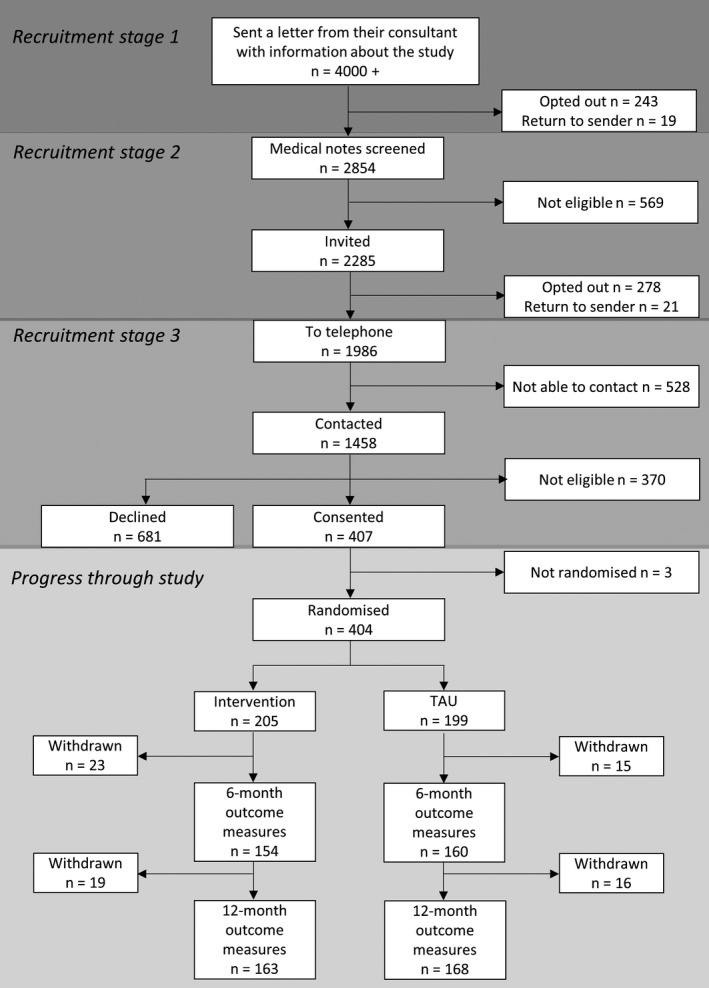
We enrolled 404 participants (intervention: n = 205, control: n = 199) with 331 (82%) completing 12-month follow-up (intervention: n = 163, control: n = 168). Mean age was 41.7 years, ranging from 16 to 85, 54% were female and 75% were white. From the intervention arm, 73.7% attended all or some of the course. At 12-month follow-up, there were no statistically significant differences between trial arms in QOLIE-31-P (intervention mean: 67.4, standard deviation [SD]: 13.5; control mean: 69.5, SD 14.8) or in secondary outcome measures.
This is the first pragmatic trial of group education for people with poorly controlled epilepsy. Recruitment, course attendance, and follow-up rates were higher than expected. The results show that the primary outcome and quality of life did not differ between the trial arms after 12 months. We found a high prevalence of felt-stigma and psychological distress in this group of people with drug-resistant seizures. To address this, social and psychological interventions require evaluation, and may be necessary before or alongside self-management-education courses.
癫痫是最常见的神经系统疾病之一,影响约 1%的成年人。多达 40%的癫痫患者(PWE)在服药时报告反复发作。而最佳功能需要良好的自我管理。我们的目标是通过多中心、实用、平行组、随机对照试验,评估一组针对癫痫和耐药性发作患者的团体自我管理教育课程。
我们从专家诊所招募了患有癫痫、在过去 12 个月内有≥2 次发作的成年人。同意参与的患者按照 1:1 的比例随机分为团体课程组或常规治疗组。主要结局测量指标是随机分组后 12 个月的生活质量,使用生活质量 31 项问卷(QOLIE-31-P)。次要结局测量指标是发作频率和最近发作、心理困扰、癫痫的影响和耻辱感、自我掌控、药物依从性和不良反应。分析结果遵循意向治疗原则,使用混合效应回归模型。
我们共招募了 404 名参与者(干预组:n = 205,对照组:n = 199),其中 331 名(82%)完成了 12 个月的随访(干预组:n = 163,对照组:n = 168)。平均年龄为 41.7 岁,年龄范围为 16 至 85 岁,54%为女性,75%为白人。从干预组来看,73.7%的人参加了全部或部分课程。在 12 个月的随访中,试验组之间在 QOLIE-31-P(干预组平均:67.4,标准差 [SD]:13.5;对照组平均:69.5,SD 14.8)或次要结局测量指标上均无统计学差异。
这是第一项针对控制不佳的癫痫患者进行团体教育的实用试验。招募、课程出勤率和随访率均高于预期。结果表明,12 个月后,试验组之间的主要结局和生活质量没有差异。我们发现,这群耐药性发作的患者中存在较高的感觉耻辱感和心理困扰。为了解决这个问题,需要评估社会和心理干预措施,这些措施可能需要在自我管理教育课程之前或同时进行。