QPS Bio-Kinetic, Springfield, MO, USA.
Central Michigan University, Substantiation Sciences, Mt. Pleasant, MI, USA.
Clin Pharmacol Drug Dev. 2018 Nov;7(8):871-879. doi: 10.1002/cpdd.451. Epub 2018 Apr 16.
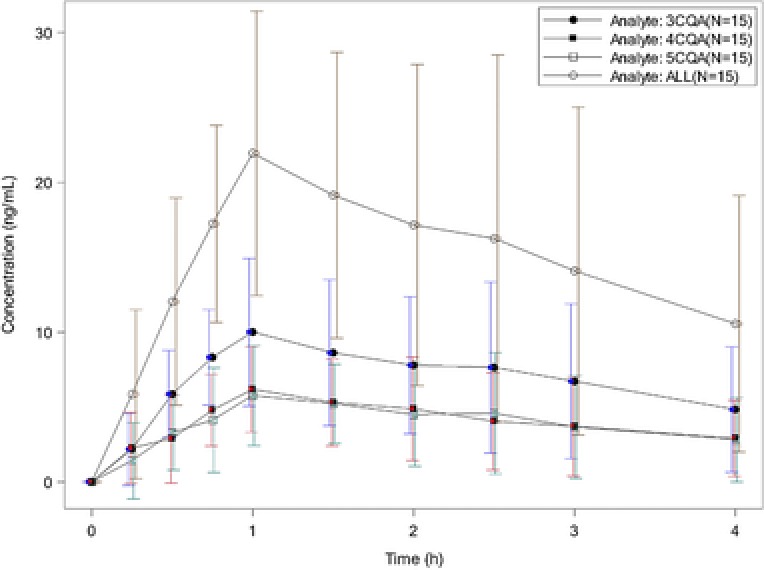
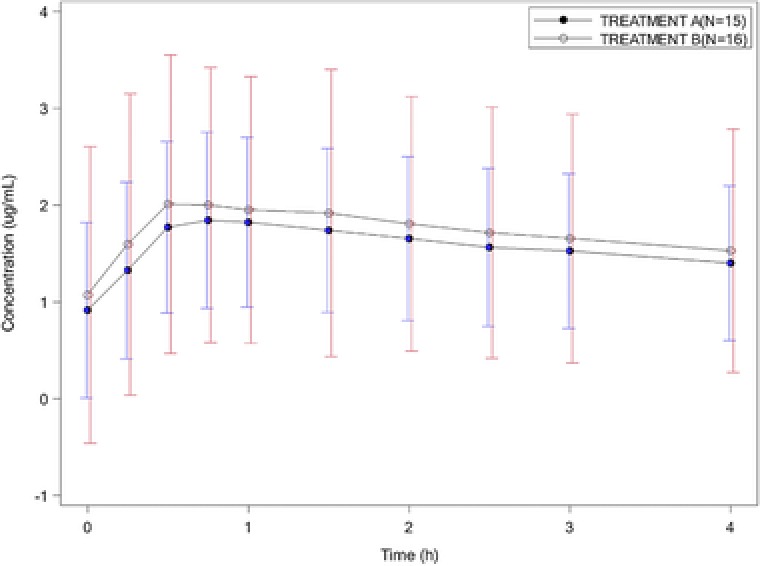
Coffee is a primary dietary source of the chlorogenic acids (CGAs) of phenolic compounds. Coffee contains caffeine and other phytonutrients, including CGAs. Caffeine on its own has been well characterized and descried pharmacokinetically in the literature, less so for CGAs. The purpose of this double-blind crossover study was to determine the comparative pharmacokinetics of CGAs with caffeine (natural extract) with synthetic caffeine (US Pharmacopeia [USP] standard). Sixteen healthy male subjects were randomly assigned to take 1 dose of product 1, 60 mg of botanically sourced caffeine from 480 mg of green coffee bean extract, or product 2, 60 mg of synthetic USP caffeine, with 5 days between. Blood analysis was done to determine the levels of CGA compounds, more specifically 3-, 4-, and 5-caffeoylquinic acid (CQA), and serum caffeine. The natural caffeine extract exhibited mean peak concentrations (C ) of 3-CQA (11.4 ng/mL), 4-CQA (6.84 ng/mL), and 5-CQA (7.20 ng/mL). The mean systemic 4-hour exposure (AUC ) was 3-CQA (27.3 ng·h/mL), 4-CQA (16.1 ng·h/mL), and 5-CQA (15.7 ng·h/mL). The median t was 3-CQA (1.00 hour), 4-CQA (1.00 hour), and 5-CQA (1.50 hours). The t of caffeine was 0.75 hours (natural extract) and 0.63 hours (synthetic caffeine). C and AUC of serum caffeine were statistically equivalent between products. The geometric least-squares mean ratios (GMRs) of C and AUC of caffeine were 97.77% (natural extract) and 98.33% (synthetic caffeine). It would appear that CGA compounds from the natural caffeine extract are bioavailable, and 3-CGA may be the compound most absorbed. In addition, caffeine sourced from natural extract versus synthetic were statistically similar for pharmacokinetic parameters. There were no adverse events or safety concerns.
咖啡是酚类化合物中的绿原酸(CGAs)的主要膳食来源。咖啡含有咖啡因和其他植物营养素,包括 CGAs。咖啡因本身的药代动力学特征在文献中已有很好的描述,而 CGAs 的描述则较少。本双盲交叉研究的目的是确定天然来源的咖啡因与 CGAs(来自 480mg 绿咖啡豆提取物的 60mg 咖啡因)与合成咖啡因(美国药典[USP]标准)的比较药代动力学。16 名健康男性受试者随机分为两组,分别服用 1 剂产品 1,即 480mg 绿咖啡豆提取物中的 60mg 植物源咖啡因,或产品 2,即 60mg 合成 USP 咖啡因,两组之间间隔 5 天。进行血液分析以确定 CGAs 化合物的水平,更具体地说是 3-、4-和 5-咖啡酰奎宁酸(CQA)和血清咖啡因。天然咖啡因提取物的平均峰值浓度(C )为 3-CQA(11.4ng/mL)、4-CQA(6.84ng/mL)和 5-CQA(7.20ng/mL)。4 小时的平均系统暴露量(AUC )为 3-CQA(27.3ng·h/mL)、4-CQA(16.1ng·h/mL)和 5-CQA(15.7ng·h/mL)。中位数 t 为 3-CQA(1.00 小时)、4-CQA(1.00 小时)和 5-CQA(1.50 小时)。咖啡因的 t 为 0.75 小时(天然提取物)和 0.63 小时(合成咖啡因)。产品之间血清咖啡因的 C 和 AUC 无统计学差异。咖啡因的几何最小二乘均值比(GMR)为 C 97.77%(天然提取物)和 AUC 98.33%(合成咖啡因)。似乎天然咖啡因提取物中的 CGAs 化合物是可吸收的,3-CGA 可能是吸收最多的化合物。此外,天然提取物来源的咖啡因与合成咖啡因在药代动力学参数方面无统计学差异。没有不良反应或安全问题。